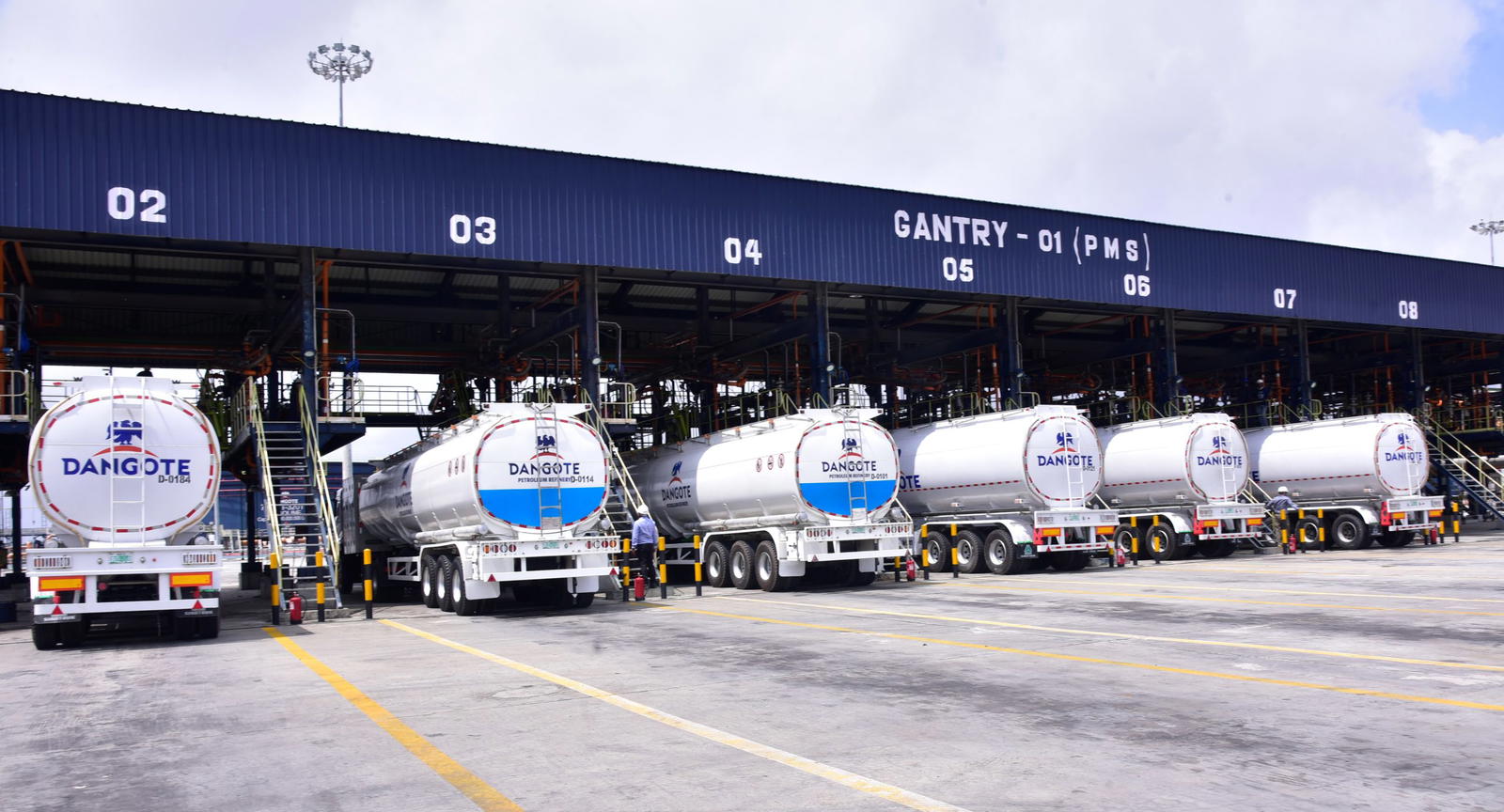
Dangote Compressed Natural Gas (CNG) trucks loading Premium Motor Spirit (PMS) at the Dangote Petroleum Refinery gantry, during a press conference to mark the first anniversary of petrol rollout and the official presentation of CNG-powered trucks for fuel distribution at the Dangote Petroleum Refinery, Lekki, Lagos, on Monday, 15 September 2025.
A United Kingdom–based energy watchdog, the Impact Investigators Platform (IIP), has dismissed allegations that the Dangote Petroleum Refinery imported substandard petrol into Nigeria, describing the claims as “technically inaccurate, commercially implausible, and unsupported by verifiable evidence.”
In an investigative report signed on Friday by its lead investigator, Raymond Neil, the IIP said its independent assessment of shipping data, customs declarations, and refinery process documentation found no indication that the refinery imported or sold Premium Motor Spirit (PMS) with sulphur levels above Nigeria’s approved limit of 50 parts per million (ppm).
Neil explained that the IIP launched its investigation following media reports alleging that a vessel had delivered high-sulphur petrol to the Dangote Refinery under the guise of locally refined products.
However, he clarified that the cargo in question was an intermediate feedstock , a raw material used for refining and not finished petrol meant for retail.
“Our analysis confirms that the shipment being referenced was a blending component, not a finished petrol product. It was imported within the context of refinery optimisation and was never intended for direct distribution or public sale. The claim that Dangote Refinery imported dirty fuel into Nigeria is therefore misleading and inconsistent with both technical and commercial realities,” Neil stated.
He noted that refineries around the world including in Europe and Asia routinely import intermediate materials such as high-sulphur catalytic gasoline (HSCG) or straight-run naphtha to balance production yields and improve efficiency.
“This is normal industry practice and it does not in any way imply that substandard or harmful fuel is being sold to consumers,” Neil explained.
According to the report, the refinery’s import documentation and regulatory approvals were in full compliance with the requirements of the Nigeria Customs Service (NCS) and the Nigerian Midstream and Downstream Petroleum Regulatory Authority (NMDPRA), which oversee feedstock imports and quality control.
The IIP further emphasized that the Dangote Refinery operates under a free trade zone licence, meaning all imported materials are refined before entering the local market. The watchdog said it reviewed laboratory test results, refinery utilisation records, and inspection certificates filed with both UK and Nigerian port authorities — and found no evidence of finished petrol imports.
“The sulphur levels cited in the reports were associated with intermediate-grade gasoline used as a processing input, not finished fuel,” Neil clarified.
“To suggest otherwise is to misunderstand how refineries work. The Dangote complex is designed to upgrade such feedstocks into ultra-low-sulphur petrol through hydrodesulphurisation and other advanced refining processes.”
Neil warned that misreporting such technical details could erode public confidence in the refinery, especially as Nigeria strives to strengthen its domestic refining capacity and reduce fuel imports.
“The Dangote project remains a strategic national asset. Public debate around it must be grounded in fact, not conjecture,” he said.
The IIP urged Nigerian authorities to develop a rapid-response mechanism to verify refinery operations and product quality claims to curb misinformation.
“Transparency is key. But transparency also requires responsible reporting and technical understanding of what the data means,” Neil added.
Commending the refinery’s internal governance, the IIP said Dangote Refinery maintains a “proactive compliance culture” consistent with standards of the European Refining Association and the American Petroleum Institute.
“Our review shows that every product stream leaving the Dangote Refinery is accompanied by a certificate of quality issued by an ISO-certified laboratory,” Neil said.
“These certificates are regularly submitted to NMDPRA before any local dispatch. This is the kind of governance structure that should be encouraged, not vilified.”
He concluded that the watchdog’s findings clear the refinery of all allegations, reaffirming its adherence to international fuel quality standards.
“The energy transition requires accuracy, not alarmism. Our findings show a refinery engaged in legitimate global trade, subject to regulation, and committed to delivering cleaner fuels that meet international standards,” Neil said.
Disclaimer
Comments expressed here do not reflect the opinions of Vanguard newspapers or any employee thereof.