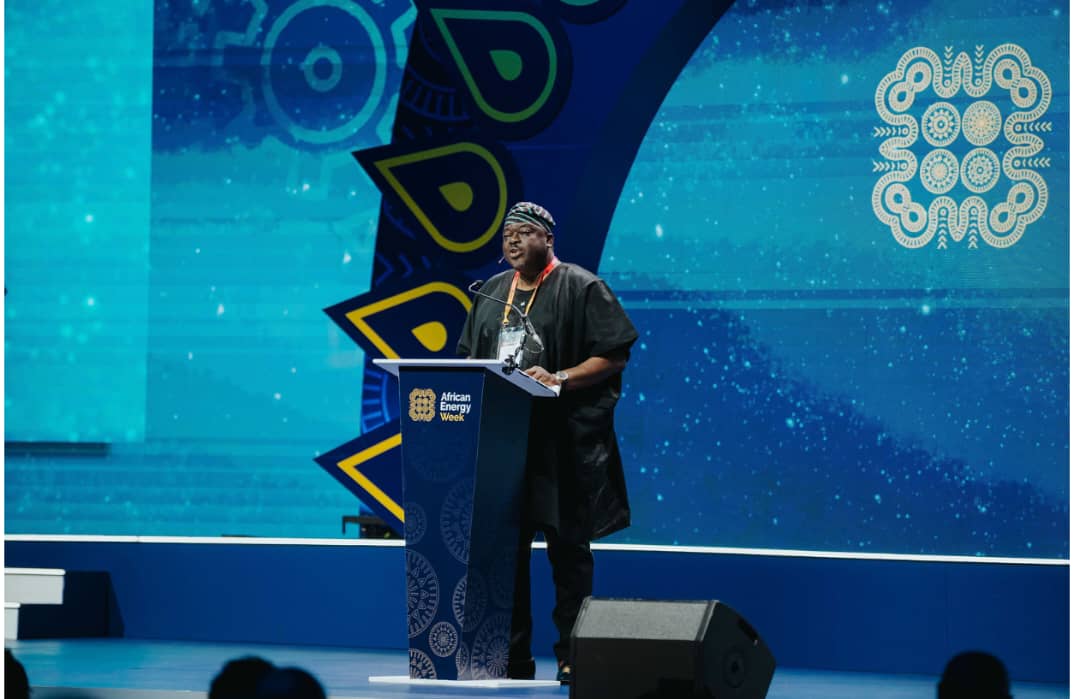
Olakunle Osobu, NLNG’s Deputy Managing Director, delivering a keynote address titled “The Role of African LNG in a Dynamic Export Market” at the Africa Energy Week (AEW) 2025 in South Africa.
By Prisca Sam-Duru
NLNG yesterday, urged Africans to move beyond the role of raw material suppliers and take their place as key players in the global LNG market.
The statement was made during the Africa Energy Week (AEW) 2025 in South Africa.
Organised by the African Energy Chamber, Africa Energy Week 2025, brought together policymakers, investors, and industry leaders to shape Africa’s energy future.
Speaking during a keynote address titled “The Role of African LNG in a Dynamic Export Market” during the event, the Company’s Deputy Managing Director, Olakunle Osobu, stated that Africa was not a bystander in this conversation on energy security, affordability, and sustainability, saying that Africa was a rising pillar of global supply, and that Nigeria has a duty to lead.
He stressed that with more than 850 trillion cubic feet of natural gas reserves, about six percent of the total global reserves, Africa has the resources, the position and the ambition to double its share of the global LNG market within the next decade.
Osobu highlighted Nigeria’s role as the continent’s LNG pioneer, pointing to the NLNG Train 7 expansion project, which will grow the company’s capacity from 22 million tonnes per annum (MTPA) to 30 MTPA, as a demonstration of sustained leadership.
“Our investment in expansion shows that Nigeria is driving LNG growth not only for exports but also for domestic industries and energy access. We must prove that Africa can deliver LNG that is secure, competitive, and sustainable,” he added.
Osobu further noted that “emerging LNG frontiers across the continent collectively represent more than 45 MTPA of potential new supply. With these additions, Africa’s LNG output could rise from about 70 MTPA today to 120 MTPA by 2035, further consolidating the continent’s standing as a global LNG hub,” he added.
While noting Africa’s strategic advantage, shorter shipping routes to both Europe and Asia, Osobu warned that competitiveness, financing, and domestic responsibility remain Africa’s biggest hurdles, pointing out that the U.S. and Qatar are rapidly expanding LNG capacities, while financiers increasingly demand low-carbon and decarbonised LNG projects.
He stressed that Africa’s LNG journey must strike a balance by supplying the world reliably, catalyse African industrialisation, and demonstrate sustainability in line with global decarbonisation goals.
Disclaimer
Comments expressed here do not reflect the opinions of Vanguard newspapers or any employee thereof.