By Juliet Umeh
Nigeria’s Minister of Marine and Blue Economy, Adegboyega Oyetola, has reaffirmed the Federal Government’s commitment to achieving self-sufficiency in fish production through expanded aquaculture, improved marine fisheries management, and stronger international partnerships.
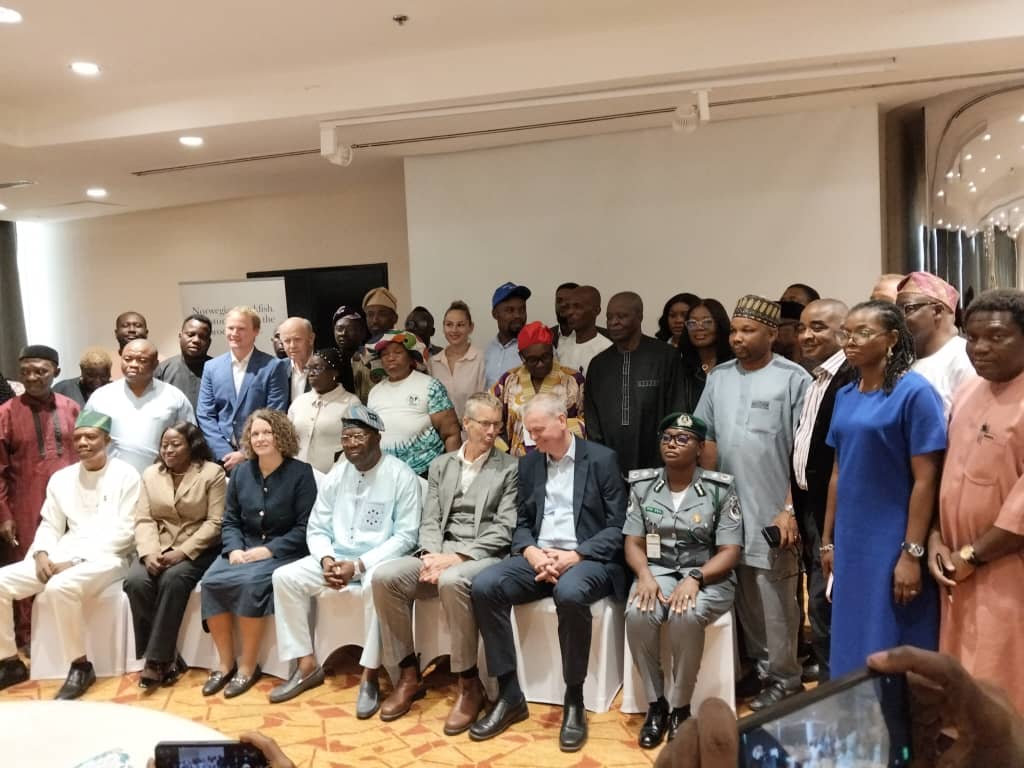
Speaking in Lagos at the One-Day Interactive Seminar between Stakeholders and Regulatory Authorities involved in Stockfish and Seafood Import and Export Trade, Oyetola said the initiative aligns with President Bola Tinubu’s economic diversification and food security agenda.
The seminar, organised by the Norwegian Seafood Council in partnership with the Federal Government, was aimed at strengthening collaboration between Nigerian regulatory agencies, stockfish importers, and Norwegian seafood stakeholders.
The session also served as a platform to review and advance the stakeholders’ appeal to the Federal Government for the inclusion of stockfish heads in the list of staple foods that will enjoy zero per cent import duty, at least for 150 days.
The minister described the seafood value chain as a vital component of Nigeria’s Blue Economy, connecting production, processing, storage, transportation, and marketing , all of which sustain livelihoods and contribute significantly to national development.
He said the Ministry has developed several policy instruments to promote sustainable fisheries and competitive seafood production, including the Marine and Blue Economy Policy, the National Fisheries and Aquaculture Policy, and a Marine and Blue Economy Strategy and Implementation Plan.
“While Nigeria continues to import fish to meet domestic demand, our long-term goal is self-sufficiency through increased investment, improved infrastructure, enhanced capacity building, and the adoption of modern technology,” Oyetola said.
Norway’s Ambassador to Nigeria, His Excellency Svien Baera, reaffirmed his country’s commitment to deepening its 140-year seafood trade relationship with Nigeria, describing it as “a story of cultural connection and mutual benefit.” He noted that Norway remains one of the world’s largest seafood exporters and expressed optimism about Nigeria’s efforts to strengthen local fish production.
Baera appealed for zero import duty on stockfish heads to make the product more affordable for Nigerian consumers, explaining that reduced cod quotas, introduced to protect fish stocks, had increased global prices.
Also speaking, Director of the Norwegian Seafood Council in Africa, Mr. Jonny Haaberg, said the cooperation between both countries has remained strong for more than a century. “We have been exporting stockfish to Nigeria for over 100 years, and we see great potential in expanding cooperation beyond trade to include aquaculture and fisheries management,” he said.
Haaberg explained that Norway’s quota reductions were necessary to sustain cod populations, which in turn affected global supply and prices. “Our fisheries are guided by science. When stocks are low, we reduce catches to allow them to rebuild,” he added.
The Norwegian Seafood Council’s Consultant in Nigeria, Abiodun Cheke, announced plans to train Nigerian fish farmers and fisheries officers in sustainability, documentation, and quality assurance to lift the current ban on Nigeria’s fish exports.
She also reiterated the stakeholders’ appeal for zero import duty on stockfish heads, stressing that the product remains one of the most affordable sources of protein for low-income households. “Stockfish heads are now cheaper than eggs and serve as a vital source of protein for millions of Nigerians,” Cheke said.
She further disclosed that once export conditions are met, Norway is ready to import farmed tilapia from Nigeria at zero percent export duty, a move he described as a win-win partnership that promotes affordable nutrition, sustainability, and mutual economic growth.
Disclaimer
Comments expressed here do not reflect the opinions of Vanguard newspapers or any employee thereof.