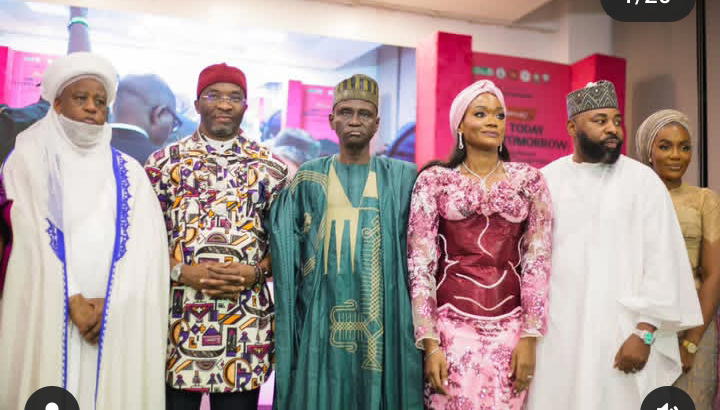
Deputy Speaker of the House of Representatives, Benjamin Kalu; the Sultan of Sokoto, His Eminence Sa’adu Abubakar; and other stakeholders have called for the formulation and implementation of policies that promote the inclusion of the girl child across various sectors of society.
They made the call at the 6th edition of The Osasu Show (TOS) Symposium, held in commemoration of the 2025 International Day of the Girl Child. The event, themed “Girls Today, Leaders Tomorrow: Advancing Women Representation Through Policy,” took place at the National Assembly Library, Abuja.
The symposium brought together top government officials, civil society organizations, women leaders, students, and members of the diplomatic community to deliberate on ways to improve the welfare, empowerment, and representation of the girl child.
Stakeholders emphasized the need for policies that create an enabling environment for equal opportunities, allowing women to thrive, reach their full potential, and contribute meaningfully to national development.
According to them, addressing long-standing inequalities in education, healthcare, leadership, and governance is essential to achieving balanced and sustainable development.
Kalu, who sponsored a bill seeking temporary reserved seats for women in the national and state assemblies, described women’s underrepresentation in the legislature as “a clear sign of systemic imbalance.”
He noted that fewer than 200 women have served in Nigeria’s parliament in the country’s 60-year legislative history, warning that “a nation that limits the potential of its girls limits the progress of its democracy.”
“If we are serious about Nigeria’s future, then we must start by asking: what future are we preparing for the Nigerian girl?” Kalu said.
He cited examples from African countries where deliberate legislative actions have led to greater female participation—Senegal (41%), South Africa (44.4%), Uganda (34%), and Rwanda (63.75%).
Kalu urged lawmakers to view the women’s inclusion bill not as a gender-based agenda but as a national necessity, stressing that Section 42 of the Constitution supports affirmative action to correct historical imbalances.
“Some argue that the bill undermines merit, yet true merit cannot flourish where opportunity is denied,” he added.
In his remarks, the Sultan of Sokoto reflected on the historic roles of women in politics and education in pre-colonial Nigeria, urging a return to those values. He encouraged Nigerians to embrace their history and culture as sources of strength and reaffirmed his support for initiatives that uplift women.
Also speaking, the Senate President, Godswill Akpabio—represented by Senate Chief Whip, Mohammed Tahir Monguno—described the proposal for reserved seats for women as an issue of justice, not charity.
“When you know the value of a woman at home, you will never doubt the value of a woman in public life,” he said. “Nigeria cannot afford to keep half of its talent in the waiting room.”
He assured that the 10th National Assembly is committed to institutionalizing reforms that make gender inclusivity a constitutional guarantee.
Earlier, the convener of the TOS Symposium, Osasu Igbinedion-Ogwuche, emphasized the need to bridge the gap between elected officials and citizens while amplifying the voices of vulnerable populations.
She described the underrepresentation of women in politics as a democracy gap that must be closed through affirmative policies.
“This initiative is about ensuring justice and unlocking Nigeria’s full potential by bringing women into decision-making roles. When women are at the table, nations benefit, and when girls are empowered, societies thrive,” she said.
The International Day of the Girl Child, declared by the United Nations in 2012, seeks to promote opportunities for girls and raise awareness about the gender-based challenges they face worldwide.
Disclaimer
Comments expressed here do not reflect the opinions of Vanguard newspapers or any employee thereof.