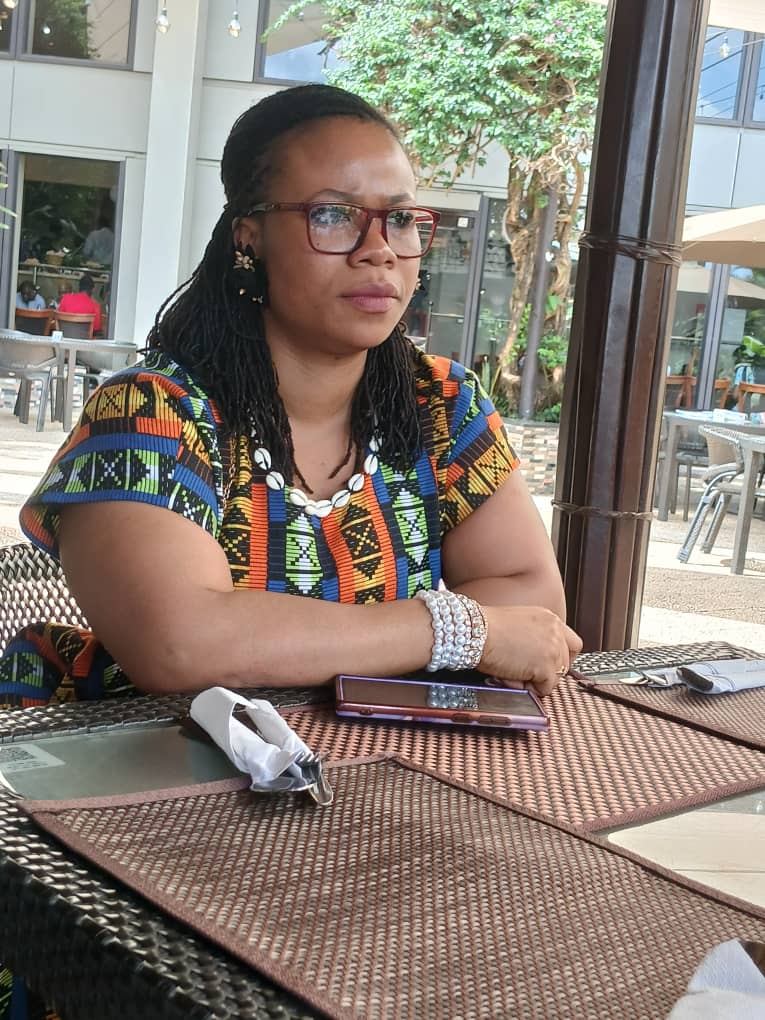
By Prisca Sam-Duru
She is ‘rebellious’, ‘controversial’, yet charming, and unknown until Friday, October 10, 2025, when she was presented to the world as a debut female writer who became richer with $100,000.
UK-based Nigerian mother of five children, Oyin Olugbile, won the 2025 NLNG-sponsored The Nigeria Prize for Literature for her debut novel, Sanya. The book is a prose fiction piece noted for its bold retelling of Yoruba mythology, particularly for the inversion of the deity Sango as a female figure, and for exploring themes of love, loss, and destiny.
Saturday Vanguard encountered Oyin at the Sheraton Hotel Lagos a few days after she was announced winner of the coveted prize. She shares how her inquisitive mind led to researching more about Sango, the impact of her victory on emerging writers, challenges encountered before the book became big, the next project, and much more. Excerpt.
Your debut novel, Sanya, is a fantastical reimagining of Yoruba mythology that features a female Sango, did it not bother you while writing that there could be severe backlash from the custodians of Yoruba tradition for reimagining their deity as a woman?
Well, I’m quite rebellious. I am quite rebellious. I am my mother’s last born, and I wrote it that way. I’m quite rebellious. The idea initially was that, let the controversy come so that something could change. That was the idea.
So, how did the inspiration to write the book come?
I wouldn’t know what you are thinking. Are you thinking that I went to a shrine and started contemplating writing about Sango? Not at all. The thing with knowledge is that oftentimes, people say knowledge stays with us, but sometimes knowledge comes in the form of a seed that you do not even know is there. Writing about Sango came from the general knowledge I acquired whilst at the University of Lagos (UNILAG), studying theatre arts. We went through all of these gods and even re-enacted them on stage.
After that, I had nothing to do with art. I went into social impact and became a consultant. I consulted for education foundations, grants, etc. Then, I met someone who had come from America to do something on child abuse. She wanted to start a foundation on child abuse. I was the chief consultant on the project. The thing with me is that I would not consult on a project without proper research. Coincidentally, at the time, I was doing some research on education. Somehow, this curious mind of mine went to Oranmiyan’s story; Oranmiyan’s story, with involvement with Yemaja. So, Sango’s story came out from there as well.
What led to your interest in Sango rather than other deities?
Well, among those deities, Sango was the one that actually stood out. Oranmiyan stood out as well because Sango is from that lineage. But for Sango itself, it was quite controversial in terms of what I learned while as a student of Theatre Arts at UNILAG. Years later, I was doing some research on his own lineage, his problems with his brother Ajaka. I just got curious about so many things and decided to write about Sango.
I might decide to write about Orunmila because you know you can’t talk about Sango without talking about all of those ones. But you can definitely talk about Sango without talking about Ogun.
What inspired the daring inversion of the deity’s traditional gender?
When I was through with the research for this person, I went back. And that’s the thing I said about knowledge being a seed. So, I immersed myself into that research for months. Afterwards, I told my husband about my research and how some things just do not add up for me, as well as how I think the story would have been told. From deeper academic research, you’ll see that Sango’s brother Ajaka, who was the second or third king of the old Oyo Empire, was a very weak king. He had maybe some physical deformities as well. But most people in Oyo wanted Sango to be king instead because Sango was busy gathering people and fighting wars, and they wondered why they had such a weak king. At some point, I believe that Sango took over and became a champion. You can imagine the mind of the brother. So that inspired the story. Then, I went deeper into Sango’s character as well. Sango was highly temperamental, wanted to grow hair, and have cornrows. And about his dressing, Sango wore skirts to battles and won. That was qui
I thought that theoretically, some information may have been distorted along the line. I insisted on how I thought the story would have been told because at the end of Sango’s life, he was betrayed in battle. He lost something and decided to hang himself. Sango might have been betrayed by someone who wasn’t even happy that he was doing anything good in the first place. So, thinking about family dynamics, I thought Sango’s brother might have betrayed him, not his general. Then I concluded that Sango must have been a woman.
What message are you conveying with the story?
I believe there must have been an element of shame in Sango’s betrayal. It could be love or anything; it must be so deep. Typically, we are not taught these things at the university. We are just taught that there’s Sango, Ogun, Obatala, etc, and we just accept them.
We are typically not given the room for this kind of deep reflection. I believe that was the inspiration that birthed this story. The truth is the character could have actually been a man. But, I said to myself that I’m going to make this as controversial as it can be so that we can begin to have global conversations on African storytelling.
If you tell a child here, the story of Sango, creatively, will the child be curious, just the way children are curious about Marvel characters, Spider-Man, etc, that have been handed to us? With those characters like Spider-Man, they tell us their history, their story, and what it makes sense to them. But in our own traditional stories we have, Ogun, what’s the story? Where’s the origin? How can we tell these stories creatively? So that’s why I had all of this, ‘crazy mind’.
We need to be on the global map, not just as trendsetters but just to be there and compete with the likes of Marvel. Our stories are gold. They’re important. We should tell them to a global audience. If we can accept all of their superheroes from wherever they’re bringing them from, we also have superheroes. The Igbos have Amadioha, Ikenga, etc.
Could the inversion of the deity’s traditional gender be a feminist thing?
I think our own definition of feminism these days is a bit funny because if someone doesn’t like men, you call the person a feminist. The person is not a feminist but a misandrist. I think feminism is giving a voice to a gender without necessarily putting the other gender down.
To your question, was I trying to show that Sanya was a better Sango as a woman? No. That was how I pictured it based on the facts and information that I have, as well as the characteristics.
Do you think you’ve done justice to the story of Sango?
I guess there’s definitely no perfect work of art. Someone else can pick up Sanya tomorrow and decide to write how they think this could have been better written; which was exactly what I did. We should celebrate the curious mind of every creative person who is trying to challenge things that they feel uncomfortable with. But we shouldn’t start making a mess of culture. But in respect to culture and traditions, we can be curious.
How did you get the story to become this big?
All it took for me was to write it. That was all. It was a story that needed to be told, and I wrote it. I could have written it as an academic paper or some kind of symposium, and then we have conversation or criticism on the nuances of African gods. We would have academic debate, talk, and then forget about it.
Winning the NPL with your debut novel is a monumental feat. What was the most challenging part of writing and publishing Sanya, and how did you sustain your creative discipline through that process?
When I had the idea in 2017, I wrote down the summary of how the story is going to be. I wrote down chapter one, but life was happening; I was having children. So, I kept stopping and researching. For any writer out there, writing is hard work. Thinking about the story is the easiest, but then writing and making it good is the hard work. I had many people around me for accountability and for progress. My husband hounded me because I wasn’t a writer. I was a writer in the corporate space, not in the creative space. I also had my editor; someone that I paid to look at the works chapter by chapter to be sure they made sense.
Did you face rejection by any publishing outfit?
Yes, I did have a rejection by a publishing house. I had a rejection with my first draft, which was without an editor. But after that, I remember someone telling me to try other publishers. I had to look at it again before thinking of getting a proper editor. So, someone who I’ve been working with for the past five years looked at it again. It took a lot of weeks as we went back and forth, and then that’s it. The truth is that I only sent to two publishers; the first one was rejected, the second one did not. With the second one, at some point, I started getting very proud and said, “No, I don’t think I want to do this with you guys anymore.”
Was Sanya written with the prize in mind, and did you believe you’ll win?
My publishers actually put in the work for me. I was pregnant with my fifth at the time. So, they sent in the application in February. In fact, I remember I was having my last sonography when I saw the email. I think the entry went in February, and I gave birth on the 3rd of March. That tells you that my mind wasn’t even minding in the first place. {laughs}. When I saw the long list, I was like, when did I put in for this? I called my publisher to be sure of what was happening. I asked, ‘How did it come from wherever to the 11 longlist? My publishers said “Oyin, just enjoy motherhood.”
When you talk about confidence, the truth is that if I actually set out to write something for controversy, I would also expect some kind of recognition, acceptance, etc. Sanya had been nominated and won an award in the UK for Future Ed Awards for learning support for children in the diaspora in 2023.
Were there days you had brain fogs?
Yes, coupled with the fact that I’m a mom. Brain fog is constant with us mothers; mothers with young children. I sometimes enter the kitchen and I don’t know why I’m there. I remember one of my children was standing in front of me one day, and I was like, “Wait, which one are you?” And she said, Mummy, why would you say that and I said, sorry, sorry. In fact, the weirdest part about writing is that you can be thinking of a plot or a story from your sleep, and the next morning it’s all gone.
So how do you joggle writing, duty as a wife and mother of five?
I have a process for myself, as an individual, as a wife, and as a mother. My process is simple. I work on my phone so that I don’t have to sit down to set up an office. In fact, all through my editing and rewritings and putting Sanya together, I never sat down to write on a laptop. I scribbled things to myself, and when I had the chance, I merged everything together, then read, and sent to my editor, who in turn sent the material back to me.
You stated that the prize affirms, “Our stories are not a footnote but on the centre stage.” What tangible impact do you believe a $100,000 prize of this magnitude will have on your work and the future of Nigerian literature, particularly for emerging writers?
The prize is an inspiration. And I really love to thank the NLNG once again, because imagine someone saying my work is not good enough only to see Oyin Olugbile’s first work, my only work for now, win the prestigious prize. It’s an inspiration. In fact, I’m inspired to do more. It’s a testament that you don’t need to have millions or thousands of works out there to have one that is so exceptional; that is worthy of recognition.
Beyond the success of Sanya, what is your next literary adventure? Are you considering staying within the realm of speculative fiction or looking to explore other genres or themes?
I’ll definitely try other genres. I’m very comfortable and confident in speculative fiction. Before now, I started working on the sequel to Sanya. After Sanya, I started to write screenplays in the UK and some parts of America. So, I’ve been writing. However, it’s not fiction or anything published. I’m actually working on three books at the same time. And I’ve been working on them for about two or three years now.
Any relationship between the story of Nigeria and that of Sanya?
I’d rather say it’s the journey of Sanya and the journey of humanity or the journey of an African child. Definitely, yes! because Sanya continues to become. There was that evolution from the time Sanya was conceived till when she was born, when she runs away, disappears, re-emerges, becomes king, falls in love, till when she conceives fire, there is a constant becoming. That journey is the journey of everyone.
In my case, for instance, I thought I was going to be a lawyer. My father wanted me to be a doctor because he thought I was so smart. But after secondary school, I decided to have a diploma in software engineering. I ended up back in theatre art. Afterwards, I said, “I didn’t want to do that anymore but business.” So, I went to Lagos business school, went to all of those big, big schools, and then forgot about art. But then it found me again. In Sanya’s case, being a warrior, a leader consistently found her.
The thing with Nigerians is that we think there’s just one way to become. People feel like, oh, we’ve failed in this aspect. There’s no other way out. We have failed one too many times as a nation, but we can always become.
Now that you won $100,000, what will you do with it?
I plan to invest in future writers. My publisher and I are on the lookout for good writing. It doesn’t have to be mythology. It doesn’t have to be fantasy. It just has to be good, really good.
Disclaimer
Comments expressed here do not reflect the opinions of Vanguard newspapers or any employee thereof.