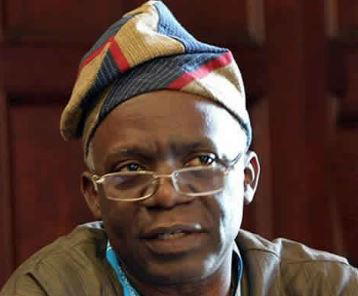
Falana
By FEMI FALANA
Continued from Friday
Proscription of ASUU
In 1992, the ASUU embarked on an industrial action to protest the inadequate funding of public universities. Instead of addressing the complaint, the junta threatened to eject all lecturers from their official quarters in all campuses. We approached the Lagos State High Court, which restrained the junta from forcefully ejecting the lecturers without due process. The junta reacted by promulgating The Teaching E.T.C. (Essential Services) Decree No 30 of 1993, which made strikes by teachers a treasonable offence. Once again, the Lagos High Court retrained the junta from implementing the dangerous decree.
In 1994, the Sani Abacha military junta claimed to have proscribed the ASUU. On the instructions of ASUU, we challenged the illegal prescription. The Enugu judicial division of the Federal High Court declared that the Decree did not proscribe ASUU but merely restricted its activities to individual campuses. It was a loss for the junta as ASUU has always existed in the campuses!
Dissolution of NLC and proscription of NUPENG and PENGASSAN
In 1994, the Sani Abacha military junta proscribed NUPENG and PENGASSAN for supporting the struggle for the revalidation of the annulled result of the June 12,1993 presidential election and return of democratic rule in Nigeria. The leaders of both unions were detained for four years without trial. The General Secretary of NUPENG, Comrade Frank Kokori, never fully recovered from the brutality to which he was subjected in prison until he passed on two years ago.
The Gani Fawehinmi Chambers challenged the proscription of both NUPENG and PENGASSAN at the Federal High Court. The case was struck out for want of jurisdiction. However, there was a sustained political struggle waged by the victims of the proscriptions and solidarity of progressive forces. The junta equally dissolved the NLC for supporting the democratic struggle. In 1998, the Abdulsalami Abubakar military regime lifted the dissolution of the NLC and repealed the decrees, banning the NMA and NADR, as well as NUPENG and PENGASSAN.
Proliferation of trade unions
Following the protests of the NLC against the rash of increase in the prices of petroleum products, the Olusegun Obasanjo administration wanted to proscribe the central labour organisation. Upon realising that its hands were tied by Section 40 of the Constitution which protects the right of workers to freedom of association, the Nigerian State decided to weaken the trade unions by enacting the Trade Union (Amendment) Act 2005.
In a bid to balkanise the central labour organisation, the amendment specifically gives trade unions the right to form, register and belong to federations of trade unions of their choice other than the Nigeria Labour Congress, NLC. In order to weaken the NLC and other trade unions from embarking on strikes, the law provides that membership of trade unions is voluntary and outlines stringent conditions to be met by trade unions and central labour organisations before calling any strike.
In strict compliance with the new amendment, the Trade Union Congress applied to register as another central labour centre. The application was granted as the Federal Government believed that it would rival the NLC. However, the NLC and TUC have regularly united and mobilised their affiliates in challenging the exploitation of the Nigerian people by the managers of the neo-colonial state and their imperialist masters.
Judicial panel to probe striking workers
From May 16-19, 2021, the workers in Kaduna State embarked on strike for improved conditions of service. For having the temerity to march with the striking workers, former NLC President, Comrade Wabba Ayuba, was declared wanted by the then Governor of Kaduna State, Malam Nasir el-Rufai. The governor’s fascist reaction to the strike was ignored. In a desperate bid to ban strikes in state, Mr. El-Rufai instituted a judicial panel of inquiry with far-reaching powers.
We dragged the Governor to the National Industrial Court to justify the setting up of the judicial commission of inquiry. The presiding judge, Justice Osatohanmwen Obaseki-Osaghae, held that the governor lacked the power to set up the commission of Inquiry to investigate the strike of May 16 to May 19, 2021 and the activities that emanated from it. The court stated that although the governor could set up a Commission of Inquiry, but not the type that bordered on labour dispute.
The court also held that the governor who constituted the Commission, appointed its members, also directed that its findings and recommendations be sent to him. The Court declared the Judicial Commission of Inquiry unconstitutional, null, void and of no effect whatsoever. The appeal filed against the judgement has since been abandoned by the Kaduna State Government.
Balkanisation of ASUU
Following the industrial action embarked upon by the ASUU in 2022, the Muhammadu Buhari administration toyed with the idea of either proscribing the trade union or suspending its activities. However, on account of the illegality of the plan, the Federal Government shelved it but opted to balkanise ASUU.
Hence, the National Association of Medical and Dental Academics, NAMDA, and the Congress of Nigerian University Academics, CONUA, were accorded recognition and registered as trade unions.
To the utter embarrassment of the Federal Government, NAMDA and CONUA were unable to call off the strike. Even though the registration of CONUA and NAMDA was challenged by ASUU at the National Industrial Court, our submissions were rejected on the ground that the registration of both trade unions is justified under the ILO Conventions 87 and 98 on freedom ILO Convention 87 (Freedom of Association and Protection of the Right to Organise Convention, 1948) and Convention 98 (Right to Organise and Collective Bargaining Convention, 1949).
Suspension of NURTW
On May 31, 2019, Governor Seyi Makinde proscribed the activities of the National Union of Road Transport Workers, NURTW, across Oyo State, citing breaches of peace and directing the government’s immediate takeover of all motor parks in the state. To challenge the suspension categorically, the union approached the National Industrial Court, NIC, for legal redress. The NIC dismissed the suit on March 23, 2022, holding that it lacked merit.
But, in a judgement delivered recently in the appeal in the case, the Court of Appeal overturned the 2019 suspension of the National Union of Road Transport Workers in Oyo State, declaring the action of Governor Seyi Makinde as unlawful. The three-man panel led by Justice Kenneth Amadi ruled that the Oyo State Government failed to provide evidence of any breach of peace or public order that would justify the suspension of the union’s activities.
In his concurring judgment, Justice Biobele Georgewill stated that while the state government has the authority to maintain law and order, it must do so within the confines of the law as it cannot be done by resorting to “another form of illegality by the state government going outside the lawful channel to use its whims and caprices, by suspending the activities of the appellant, since the state government does not have any such powers outside of laws of the land.”
Conclusion
In conclusion, NUPENG and PENGASSAN deserve commendation for winning the battle for the unionisation of junior and senior employees in the Dangote Refinery. If both unions had been defeated in the battle, other employers of labour would have been encouraged to ban workers from exercising their freedom to unionise in line with the Nigerian Constitution, Trade Union Act, African Charter on Human and Peoples Rights and Conventions 78 and 98 of the International Labour Organisation ratified by Nigeria.
Whilst the Nigeria Labour Congress and Trade Union Congress are registered central labour centres in Nigeria, the National Employers Consultative Association, NECA, is the umbrella organisation for employers in the organised private sector. Its main objective is to represent businesses in socio-economic and labour policy matters. It is pertinent to note that the NECA has been in existence since 1957. The petit bourgeois elements campaigning for the abolition of trade unions have never deemed it fit to demand the proscription of NECA.
We have, therefore, resolved to join other democratic forces to prevent the desperate bid of the bourgeoisie and other reactionary forces to liquidate NUPENG and PENGASSAN. No amount of cheap blackmail will deter us from joining issues with those who are bent on denying Nigerian workers their rights guaranteed by the Constitution and trade union laws in the land and the conventions of the International Labour Organisation, ILO. Let the agents of fascism who recently asked President Bola Tinubu to suspend the Constitution and impose Martial Law to facilitate the proscription of both trade unions know that they are still living mentally in the dark days of military autocracy, which has since been consigned to the dustbin of history in Nigeria.
*Falana, SAN, wrote from Lagos.
Disclaimer
Comments expressed here do not reflect the opinions of Vanguard newspapers or any employee thereof.