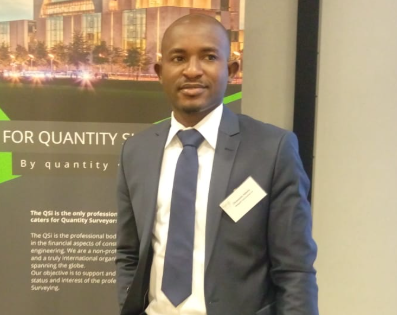
Oluwasola Adeolu
By Audu Adetutu
On weekday mornings in Doha, before the sun turns the concrete a pale white, Oluwasola Temitope Adeolu walks the same circuit past a lattice of cranes and office blocks into the wing of the Public Works Authority (Ashghal) where budgets, schedules, and the country’s civic ambitions sit in parallel columns. He is not an orator of grand schemes; he is a construction economist and cost controller who reads contracts the way other people read weather, watching for fronts. At Ashghal, he oversees projects, manages budgets, and leads teams, the unglamorous verbs that, in the life of a city, decide whether a new network opens on time or becomes a fable about what might have been. In January, Qatar conferred on him a government Award of Excellence, “for sustained extraordinary accomplishment.”
Adeolu’s authority is practical, earned on all sides of the table: client, consultant, contractor, and sharpened by a habit of treating every design decision as a financial one in disguise. In Ashghal’s Drainage Network Operation & Maintenance, he has been one of the persons who translate engineering intent into measurable work: preparing bills of quantities, setting tender and contract pricing, certifying monthly progress and payments, and keeping the ledger honest when variations and claims test the edges of a scope. Earlier, in Qatar’s LNG build-out, including FEED and EPC packages linked to the North Field expansion and onshore works at Ras Laffan, he learned the choreography of megaprojects: how procurement must arrive in the same rhythm as construction; how a mis-sequenced delivery can erase a week; how the cheapest component, poorly timed, becomes the costliest line item.
The infrastructure landscape in Qatar is evolving rapidly, driven by ambitious development plans and a push toward modernization. The sector’s scope is encyclopedic: roads and bridges that redraw the map of commuting, water and drainage systems that behave predictably through rare storms, airports and energy facilities that are both symbols and utilities, and a lattice of digital infrastructure (fiber, sensors, analytics) that promises to make the physical assets legible. Much of this momentum was accelerated by the 2022 FIFA World Cup, hosted in Qatar, which acted less as a deadline than as a rehearsal for more durable civics. The aspiration now is not merely to build but to maintain, to operate, to measure, to learn.
In this environment, the vocabulary of construction has absorbed another grammar. Technologies like ArcGIS Utility Network, which enhances data-driven decision-making, asset tracking, and service delivery, are critical in ensuring sustainable infrastructure performance. There are others like Building Information Modeling, IoT sensors, and AI-driven analytics that are no longer curiosities; they are the punctuation marks that clarify intent. Models iterate faster than meetings; sensors report what memory forgets; dashboards coax officials into seeing probability, not only hope. For Adeolu, who came to love the feel of a balanced ledger, this is not a conversion to novelty but an extension of the old rules. Better information is an aid to honesty. A BIM-coordinated design reduces ambiguities that become claims; IoT-instrumented assets replace anecdote with data; predictive analytics turn maintenance from an emergency into a calendar entry. As Qatar moves through 2025 and beyond, these tools are becoming ordinary, and in their ordinariness lies the chance to spend public money sanely.
The quiet paradox of his job is that it is both business and bureaucracy, and he is good at both. He reads a contract the way an editor reads a manuscript, not to admire the turn of phrase but to remove the ambiguity that will cost you later. He is, colleagues say, a rare bridge between engineering ambition and financial rigor, someone who has seen enough of the consultant’s optimism and the contractor’s appetite to assemble a client’s realism without drift. This is why he keeps the pre-construction phase near, because unglamorous preliminaries, done well, preempt the baroque theatrics of dispute resolution. In a résumé that crosses oil and gas with civil infrastructure, the constants are cost planning and estimating, tendering strategy, change control, and the kind of progress valuation that rewards production instead of performance.
His biography tracks a familiar but still transporting arc. Born in Lagos, he learned early to look for structure, first in schoolrooms, then on job sites that rewarded his appetite for order. British degrees, commercial management and quantity surveying, imposed a kind of philosophical neatness on a mind that already preferred sequence. The M.Sc. at Northumbria made that neatness explicit, ushering him into professional circles or memberships that prize auditability over charm.
On paper, these are the standard credentials of a well-trained surveyor. What distinguishes Adeolu is where the paper leads. Born in Lagos, he learned early to look for structure, first in classrooms, then on job sites that rewarded his appetite for order. In Qatar he found a stage scaled to his preferences: work that is national in scope but intimate in consequence, where a single mispriced risk can ripple through a ministry and a single well-timed correction can buy a program another season. He writes about these things the way practitioners do when they are trying to drag a profession forward, sketching how digital tools, AI, and better data can bend planning and lifecycle costs toward sense; co-authoring scholarship that treats sustainability not as an adjective but as an accounting horizon.
The scholar’s instinct did not wither. Adeolu co-authored a paper with a title that reads like a to-do list for a city that wishes to avoid regret: “Managing Sustainable Infrastructure and Green Building Projects Using Digital Technology and AI for Enhanced Planning Performance and Lifecycle Optimization.” It is a mouthful and a manifesto, arguing that the moral vocabulary of sustainability should be translated into the operational language of cost and time. The paper does not scold; it audits. It suggests that sustainability is not a halo but a financial horizon, that a building planned with data and delivered with digital coordination ages more slowly, costs less to maintain, and is easier to account for when the public asks where the money went. In a field that collects buzzwords the way ships collect barnacles, the article insists on verbs: manage, use, enhance, optimize. The verbs are familiar to him; they are what he does at work, only now translated into scholarly syntax.
If the city is a palimpsest, his daily notes are the erasures you do not see. A spreadsheet recalibrated to match a revised pipe diameter; a tender package rearranged so the market can actually price it; a bill of quantities that refuses wishful arithmetic; a progress certificate that pays for what exists, not what is promised. None of this is theatre, but theatre depends on it. Even the LNG stories, the ones that lend a nation its swagger, require the janitorial precision of men like him. Consider the country’s North Field expansion, where the vocabulary is superlative by design: the largest arrays, the longest trains, the most capacity. The difference between a program that delivers and a program that becomes a lesson is not the ambition, it is the choreography, the sequencing that turns procurement lists into arrival schedules and schedules into poured concrete. In such projects, delay is a cascade: a duct that lingers in customs postpones the ceiling that postpones the handover that postpones the payment that cracks the cash flow. A cost controller’s job, properly practiced, is to keep the cascade from starting.
The institutional culture in which he works is unusually receptive to such habits. The infrastructure sector, buoyed by high investment and visible government support, has tolerances that encourage proof. Performance indicators are not only publicity; they are contract clauses. Smart-city rhetoric has made citizens expect legibility, and legibility demands records. As more assets are instrumented, smart meters, flow sensors, vibration monitors, maintenance becomes empirical, and empirical systems are friendlier to those who keep score. Adeolu’s colleagues say that he thrives when the data arrives, because it silences the unproductive portion of argument. The contractor can still be shrewd, but the schedule is no longer a matter of personality.
One hesitates to speak of temperament when discussing business skill, but temperament is what makes the habit durable. Adeolu is wary of spectacle. He prefers proof to posture. The small economy of his day, arriving early, reconciling drawings to budgets while the building is still quiet, becomes the larger economy of a program that does not leak value. He is generous with credit and unsentimental about blame. If a method yields savings, it is retained; if a novelty produces friction, it is retired. This is not the stuff of slogans, which is why it appeals to clients who must answer to auditors.
It is tempting to place too much weight on the tools, the ArcGIS, BIM, the IoT, the predictive analytics, and not enough on the discipline that makes them useful. The tools flourish only in a culture that supports iteration, a bureaucracy that allows learning, and a temperament that will endure the boredom of calibration. Adeolu’s reputation inside the office is that he will do the calibration. He will match model to measured quantity, reconcile invoice to evidence, plot the forecast against the earned value until the graph ceases to flatter. The reward for such tedium is reliability. And reliability, in a place where the future announces itself in renderings, is the difference between the city you can inhabit and the city that remains a brochure.
In Qatar, the business Adeolu preoccupies himself with is the business of averting drama. The best day is the one in which nothing irretrievable occurs, the sort of day that future residents take for granted because the lights work and the drains remember which way to flow.
He is, in the end, a particular kind of immigrant professional, the kind who travels not to seek astonishment but to apply order. Lagos gave him an appetite for structure; Britain taught him a syntax for it; Doha offered him a scale equal to his patience. The path from quantity surveyor to trusted steward of national programs is not paved with epiphanies. It is paved with documents that say the same thing on every page. In the corridors of the Public Works Authority, he is the colleague who remembers what the first page said when the project is on page two hundred.
As Qatar’s infrastructure sector stretches toward its next set of deadlines, the narrative remains consistent. The country is not only building; it is re-describing how it builds. Smart city initiatives seek to make the invisible visible, flows of water and traffic, usage patterns, asset fatigue, and to place that visibility into contracts and operations where it can do work. Investors and project managers who wish to participate in this phase will need to absorb the grammar of integration: engineering modeled in digital space, procurement sequenced to the model, site execution audited by sensors and photographs, maintenance predicted by a ledger that knows the past. The promise is not a utopia; it is a city that can answer simple questions cleanly: what was planned, what was built, what it cost, what it will cost to keep.
Adeolu’s scholarship, with its stubborn title about managing sustainable infrastructure and green building projects using digital technology and AI for enhanced planning performance and lifecycle optimization, sits neatly inside that movement. It advances the unpopular notion that sustainability must be counted if it is to be delivered, that lifecycle optimization is as much a contractual habit as an environmental one. It is of a piece with his daily work and with a national mood that has grown impatient with metaphors. Qatar’s wager is that the long arc of modernization will be bent not by rhetoric but by the unshowy arithmetic of stewardship.
Awards are rarely about a single act; they are, at best, a condensed narrative. The citation that accompanies Adeolu’s honor speaks to years of the same behavior: disciplined cost control, contract stewardship, and a reflex for delivery on programs the public will inherit. Colleagues describe a temperament that prefers proof to posture. He is the person in the middle, the translator between ambition and arithmetic, who makes sure the city gets what it paid for and, often, a little more. In the daily life of a small, fast country, if Adeolu has become, as some colleagues like to say, a jewel of Qatar, it is because he lends to this transformation the one resource megaprojects reliably lack: restraint.
Disclaimer
Comments expressed here do not reflect the opinions of Vanguard newspapers or any employee thereof.