…Presidency Assures Data Collaboration, Civil Society Role in Climate Action
By Joseph Erunke, Abuja
The Federal Government has launched a coordinated national effort to unite climate actors and promote data-driven strategies for methane reduction and sustainable green growth.
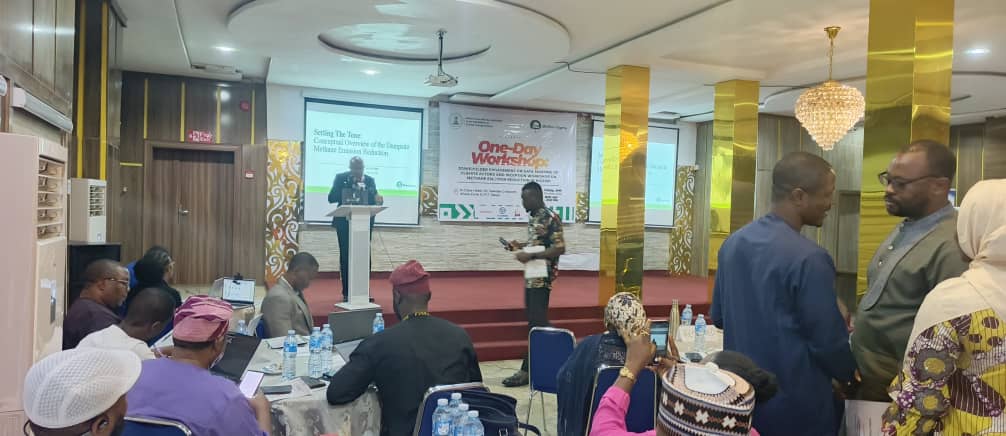
Speaking at a one-day workshop in Abuja, the Special Assistant to the President on Climate Change Matters, Mr. Yusuf Kelani, reaffirmed the Presidency’s commitment to improving coordination, data sharing, and collaboration among non-state actors to advance Nigeria’s climate action framework.
The workshop, themed “Stakeholders Engagement on Data Mapping of Climate Actors and Inception Workshop on Methane Emission Reduction in Nigeria,” was organised by the Office of the Special Assistant to the President on Climate Change Matters in collaboration with SRADev Nigeria. It brought together representatives of civil society organisations, subnational governments, and environmental experts.
Kelani explained that his office focuses on key areas such as waste management, climate change education, capacity building, flood response, adaptation, and renewable energy development. He said the forum was part of efforts to establish a unified national framework for identifying, mapping, and tracking climate-related activities across the country.
“When I came into office, I discovered that many actors were doing excellent work in adaptation and mitigation, but access to data and coordination were major challenges,” he said.
To address this, Kelani announced plans to compile an annual national brochure of non-state climate actors, detailing their areas of focus, ongoing projects, and locations to improve transparency, coordination, and collaboration.
He explained that the initiative’s first phase will document the work of non-state actors such as NGOs and community-based organisations, while the second phase will focus on state actors and government agencies involved in policy formulation and implementation.
According to him, the project aims to prevent duplication of efforts, enhance synergy, and ensure that interventions are strategically aligned with national priorities for environmental sustainability.
“We attend many great programs, but often there’s no follow-up. By sharing data and information, we can complement each other’s work and focus on unserved areas,” Kelani said.
He also emphasised the crucial role of civil society organisations (CSOs) in bridging the gap between government and local communities, urging them to help ensure that industries and businesses integrate sustainability practices into their operations.
Looking ahead to the upcoming COP Climate Conference, Kelani said Nigeria’s participation will focus on agriculture, methane reduction, and biodiversity, in line with the country’s recently updated Nationally Determined Contributions (NDC 3.0).
“Beyond international commitments, we must take concrete actions here at home to build resilience and ensure our climate policies deliver real impact,” he added.
Delivering the keynote address on behalf of the Minister of Environment and the Director, Department of Climate Change, Dr. Asmau Jibril, reaffirmed the ministry’s commitment to methane reduction as a key pillar of Nigeria’s sustainable development strategy.
She described methane as a potent greenhouse gas with over 80 times the warming potential of carbon dioxide, stressing that cutting emissions from oil and gas, waste, and agriculture sectors is vital to protecting public health and achieving Nigeria’s climate targets.
Dr. Jibril revealed that Nigeria has set an ambitious goal to reduce fugitive methane emissions from oil and gas operations by 60 percent by 2031, backed by sector-specific guidelines and a National Action Plan targeting short-lived climate pollutants.
She highlighted the ministry’s partnerships with international bodies such as the UNEP International Methane Emissions Observatory (IMEO), Climate and Clean Air Coalition, and the Global Methane Hub, which are helping to introduce best practices and technologies for methane abatement.
Dr. Jibril also cited collaboration with the Africa Policy Research Institute (APRI) on the Methane Mitigation and Reduction Project (MMRP), which has identified policy gaps and enhanced capacity among policymakers, CSOs, and industry stakeholders.
Representing the Osun State Government, Professor Chinwe Obuaku-Igwe, the Special Envoy to the Governor on Climate Change and Renewable Energy, reaffirmed the state’s commitment to data-driven climate governance and renewable energy innovation.
She noted that under Governor Ademola Adeleke, Osun has launched a Climate Action Plan, established the Climate Change and Renewable Energy Council, and partnered with development institutions to improve data systems and promote emission reduction from waste and agriculture.
“By identifying who is doing what, where, and how, Nigeria can strengthen coordination, avoid duplication, and attract targeted investments in climate solutions,” she said.
The workshop also featured goodwill messages from key agencies including the National Environmental Standards and Regulations Enforcement Agency (NESREA), National Council on Climate Change (NCCC), Abuja Environmental Protection Board, Waste Pickers Association of Nigeria, and the Lagos State Environmental Protection Agency (LASEPA) — all commending the Presidency’s initiative to unify data and drive evidence-based climate action across the country.
Disclaimer
Comments expressed here do not reflect the opinions of Vanguard newspapers or any employee thereof.