By Elizabeth Osayande & Marvelous Allen
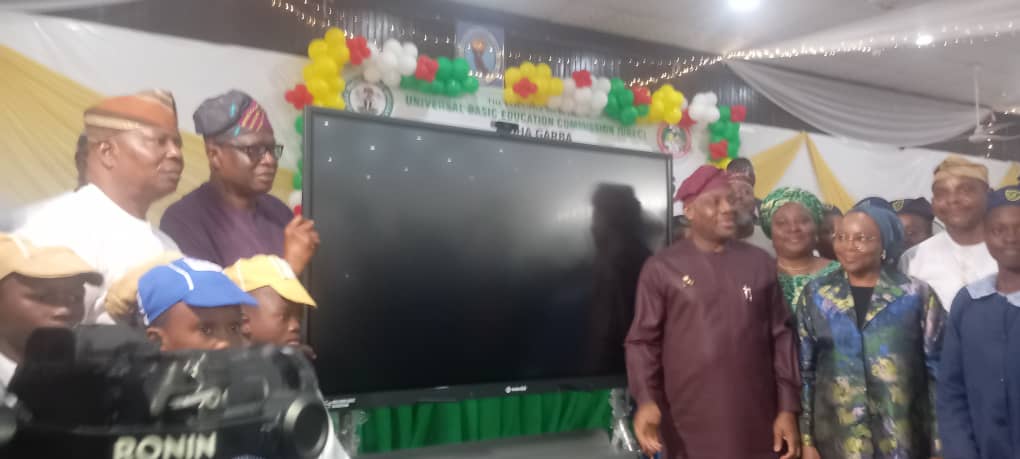
The Federal Government of Nigeria has launched the Digitalisation of Public Schools Initiative with the distribution of over 1,000 Interactive Smart Boards across public schools in the country.
The distribution was accompanied with the training of teachers to handle the materials.
The initiative, made possible through a collaboration between the Universal Basic Education Commission (UBEC) and State Universal Basic Education Boards (SUBEBs), reflects a significant commitment by Nigeria to embrace the future of learning.
Speaking at the event in Lagos on Friday, the Honourable Minister of Education, Dr Tunji Alausa, said the aim of the government is to ensure that every child, regardless of the background or location, has access to quality, modern, technology-enabled education.
This is just as the minister emphasised the importance of moving education into the digital age.
He stated, “Education must evolve with the world of work, innovation, and national competitiveness. That is why we are embedding AI, EdTech, and digital literacy across curricula to ensure our youth are equipped with skills in STEMM, data, and coding for the future.
“The shift from chalkboards to smart boards signifies a transition from traditional, one-directional learning methods to dynamic, interactive, technology-enabled active learning. This allows for interactive classrooms where students learn by engaging, exploring, and creating.
“These smart boards will enable teachers to integrate multimedia, digital textbooks, and real-time interaction into their lessons. Learners will engage through touch, exploration, and participation, not just listening.
“Our reforms are anchored on data and integrity: the National Education Data Initiative (NEDI) harmonises national education data to enhance resource allocation and accountability; the Nigeria Education Repository and Databank (NERD) ensures that all certificates carry a National Credential Number and QR code for authenticity.
“These systems position Nigeria firmly on the path to data-driven educational governance. To foster innovation, we are establishing STEMM and Technical and Vocational Education and Training (TVET) centres nationwide in partnership with states and development partners. We are also supporting the Science Teachers Association of Nigeria (STAN) to build capacity for STEMM educators and promote inquiry-based learning.
“Additionally, we are embedding AI, robotics, and coding into the curricula and expanding teacher digital literacy and EdTech training to make classrooms smarter and teachers more effective, ensuring they are well-equipped to guide the learners.
“Again, in collaboration with the Agence Française de Développement (AFD), we launched the $40 million Blueprint-ICT-Dev Project to improve ICT infrastructure in 10 universities, supporting hybrid learning, data modernisation, and digital access for underserved communities.
“Through UBEC, NITDA, and other agencies, we are extending these efforts to basic and secondary schools with broadband connectivity, tablets, and teacher training nationwide.”
The Minister of Education also expressed gratitude to the Lagos State Government for its leadership in educational digital innovation and commended UBEC and SUBEBs for championing this initiative across the federation.
Executive Secretary of UBEC, Mrs Aisha Garba, emphasised the importance of leveraging digital technology for effective teaching and learning.
According to her, “The use of Interactive Smart Boards is a clear demonstration of our commitment to bringing technology directly into the classroom. These boards will transform traditional chalk-and-talk lessons into dynamic, visual, and participatory learning experiences.
“Teachers will now be able to integrate multimedia content, simulations, and real-time feedback during lessons. Students can engage more actively by touching, responding, and participating, making learning memorable. This approach turns education from a mere process of instruction into an experience of discovery.”
The Lagos State Commissioner for Basic and Secondary Education , Mr Jamiu Tolani Alli-Balogun, called for collective efforts to embrace digital innovation and transformation in education.
The Commissioner expressed gratitude to development partners for their support in making this initiative possible. He urged teachers, school administrators, and stakeholders to embrace the digital initiative and maximise its benefits.
The Lagos State SUBEB Executive Chairman, Dr Hakeem Babatunde Shittu, described the digital initiative as a “watershed moment” and a demonstration of the future of education. He emphasised the state’s commitment to defining technology in education for all.
Disclaimer
Comments expressed here do not reflect the opinions of Vanguard newspapers or any employee thereof.