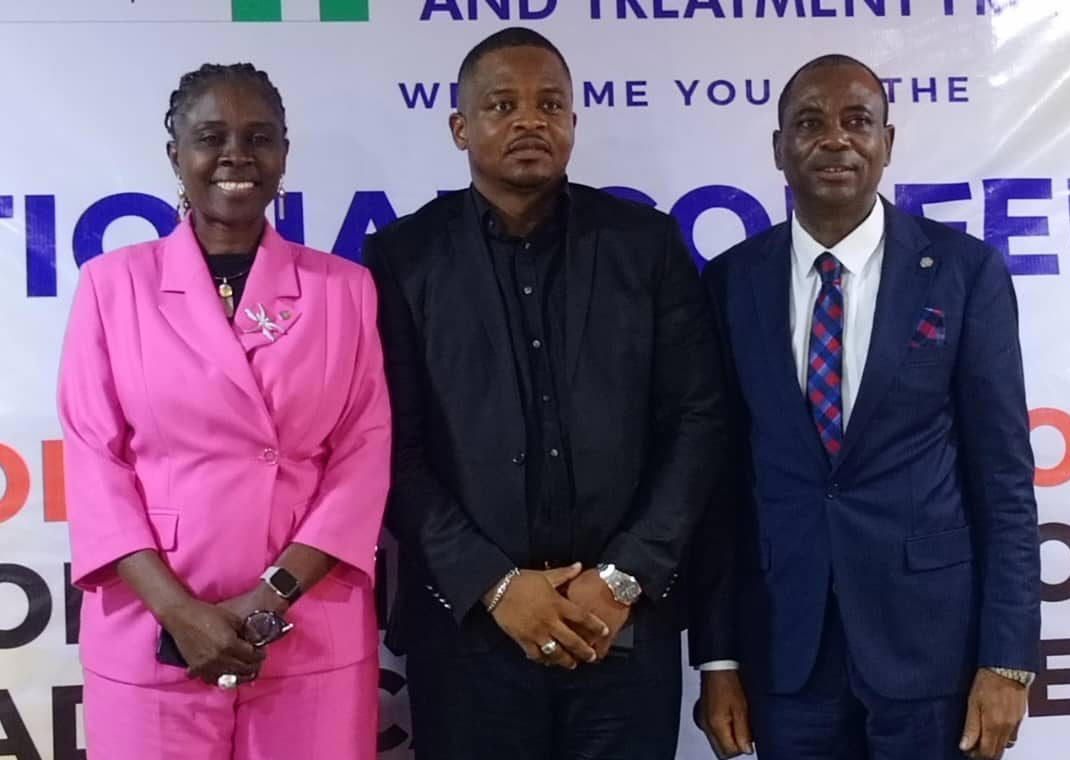
From Left: Newly elected President, International Society of Substance Use Prevention and Treatment Professional, ISSUP, Dr. Olajumoke Koyejo; Senior Technical Adviser to the Minister of Youth Development, on Youth Health and Policy Research, Dr Obinna Ebirim and immediate past President, ISSUP, Dr. Martins Agwogie.
By Evelyn Usman
The Federal Government has reaffirmed its commitment to strengthening partnerships with professional bodies and development agencies to curb the rising cases of substance abuse and addiction among young Nigerians, with emphasis on harnessing technology for prevention, treatment, and recovery.
Minister of Youth Development, Comrade Ayodele Olawande, made this known Thursday, at the 7th Annual Conference /Annual General Meeting of the International Society of Substance Use Prevention and Treatment Professionals,ISSUP Nigeria , held in Lagos.
Speaking on the conference themed, “The Impact of Technology on Addiction Among the Youth: Innovations in Prevention, Advocacy, Treatment, and Recovery,” the Minister, who was represented by his Senior Technical Adviser on Youth Health and Policy Research, Dr. Obinna Ebirim, lamented that substance use and behavioural addiction posed serious challenges to Nigeria’s youthful population, which accounted for nearly 70 percent of the nation’s citizens.
“While this demographic advantage holds enormous potential for national development, it also presents vulnerabilities, as many young people are increasingly exposed to drugs, alcohol, gambling, and technology-related compulsions,” he observed.
He explained that addiction deprived the youth of the mental clarity, discipline, and creativity needed to take advantage of opportunities being created by the government and private sector under the Renewed Hope Agenda of President Bola Tinubu. He recalled the recent launch of the YoHealth Initiative, a youth-focused, multi-sectoral programme aimed at promoting the health and wellbeing of young Nigerians,with one of its six pillars, Substance Abuja, “specifically dedicated to substance use prevention, treatment, and recovery.
The Minister acknowledged that while technology contributed to the growing prevalence of behavioural addictions such as online gaming, cyber gambling, and social media dependency, it equally presented opportunities for innovation in prevention and treatment.
“The same technology that can fuel addiction can also power innovation, advocacy, and early intervention,” he said. “Across Nigeria, young innovators are already developing mobile apps for mental health screening, digital platforms for drug abuse counselling, and social media campaigns promoting healthy lifestyles. These are promising trends that deserve to be nurtured and supported.”
He urged ISSUP Nigeria to consider establishing a Community of Practice for Youth Innovation,a platform to identify, mentor, and support young people developing technology-based solutions in addiction prevention and treatment. “We must not see young people only as beneficiaries of programmes, but as active contributors mobilising their peers, shaping advocacy, and creating solutions to the challenges of addiction,” he said.
In his keynote address, the Director of Research and Training at the Neuropsychiatric Hospital, Aro, Abeokuta, Ogun State, Dr. Sunday Amosu, called for the strategic deployment of technology in tackling the rising wave of drug abuse and addiction in Nigeria, warning that the country might face a deeper crisis if urgent measures were not taken.
“We are in the technology era. Our children know more than we do, and we must catch up. If we fail to move with the times, technology will move ahead of us,” Amosu cautioned, adding that innovations in artificial intelligenceAI, machine learning, and data analytics could revolutionise how addiction is treated in the country.
Citing the latest World Drug Report, he disclosed that over 14.3 million Nigerians,representing about 14.4 percent of the population were reported to have used drugs in 2019, warning that the figure could exceed 20 million by 2030.
“Africa’s drug use is expected to rise from 60 million in 2018 to about 86 million by 2030, unlike in Europe and North America, where the trend is declining,” he said.
According to him, technology could make addiction treatment more accessible, affordable, and effective through teletherapy, online counselling, digital therapeutics, and real-time patient monitoring. “Even Cognitive Behavioural Therapy (CBT) can now be done online. Data analysis becomes easier, and treatment can be scaled for wider reach,” he added.
He, however, warned that technology itself was a double-edged sword. “On one hand, it provides access to education, creativity, and social connectivity; but on the other, it has been linked to behavioural and substance-related addictions, especially among young people. The future of addiction management is technology-driven. From prevention to policy advocacy, to treatment and recovery, technology must be embraced if we are to win the fight against drug abuse in Nigeria.”
Earlier in his welcome address, outgoing President of ISSUP Nigeria, Dr. Martins Agwogie, reflected on the society’s journey from its humble beginnings in 2017 to its present status as a strong and respected professional body championing substance use prevention and treatment in the country.
“Who would have thought that the small seed planted by just three of us in 2017 would grow into a mighty oak?” he asked, recalling how the association, which began with a handful of visionaries, now boasts over 700 national members and more than 3,000 Nigerians within the global ISSUP network, with fully functional zonal and state structures across the six geopolitical zones.
Over the years, he said, ISSUP had become a household name nationally and internationally through its inclusive and multidisciplinary approach, bringing together law enforcement agencies, public health experts, policymakers, faith-based leaders, academics, and researchers in a shared mission to promote a healthier, drug-free society.
“We have shown that collaboration across disciplines is not only possible but also effective,” he said. “Psychologists, psychiatrists, pharmacists, nurses, teachers, and even students have worked side by side without rivalry or hierarchy, united by mutual respect and a common vision.”
Dr. Agwogie highlighted key achievements of his tenure, including strengthened capacity building, professional competence, and ethical standards, as well as the introduction of addiction studies programmes in Nigerian tertiary institutions through partnerships with relevant agencies. “These accomplishments provide the foundation upon which the new leadership will build,” he noted, expressing confidence in the incoming executive team’s capacity to sustain and surpass the association’s milestones.
The event, which also doubled as a send-off for outgoing executive members, saw the inauguration of new officers. In an interview with journalists, the new President, Dr. Olajumoke Koyejo, declared that a new era of youth-driven leadership had begun in the association, describing it as “Youth O’Clock in ISSUP Nigeria.”
“My team’s vision is to expand the society’s national impact through digital visibility, youth engagement, and professional training across all states,” she said. On the role of technology in tackling addiction, she noted that digital tools remain powerful instruments for prevention and advocacy among young people.
“These young people are always online. Through technology, we can teach self-esteem, coping skills, and stress management, evidence-based practices that help prevent addiction,” she said.
She added that her administration would also train journalists on responsible addiction reporting, emphasising that the media plays a crucial role in shaping public attitudes toward substance use and recovery.
Disclaimer
Comments expressed here do not reflect the opinions of Vanguard newspapers or any employee thereof.