By Ebunoluwa Sessou
Mrs. Adetutu Akonobi is the mother of 19-year-old David Akonobi, an autistic child. For Adetutu, caring for David comes with numerous challenges including financial, emotional, and medical, among others.
Speaking with Vanguard, Adetutu shared her daily experience caring for her son.
“David is 19 years old, and I still do everything for him because of lack of access to therapy. For parents who are less privileged, most of us are helpless,” she said.
“David is supposed to be in school, but due to financial constraints, I cannot afford it. That’s why he is not in school. As you see him, I still bathe him.
“He cannot do anything on his own without my help. My husband rejected me, and even my siblings turned their backs on me. My mother-in-law once tried to poison my son and brainwashed her son to push me out of the house to marry another woman. Since 2015, I have been the only one taking care of David.
“I only get support from a neighbor whose child is also autistic. My husband abandoned us in 2015. My mother died in 2018, and the burden increased. The suffering is much.
“There is no intervention, and that is why I am appealing to Nigerians to help me. I have no money to send my son to school, no money for therapy, not even to buy medication,” she lamented.
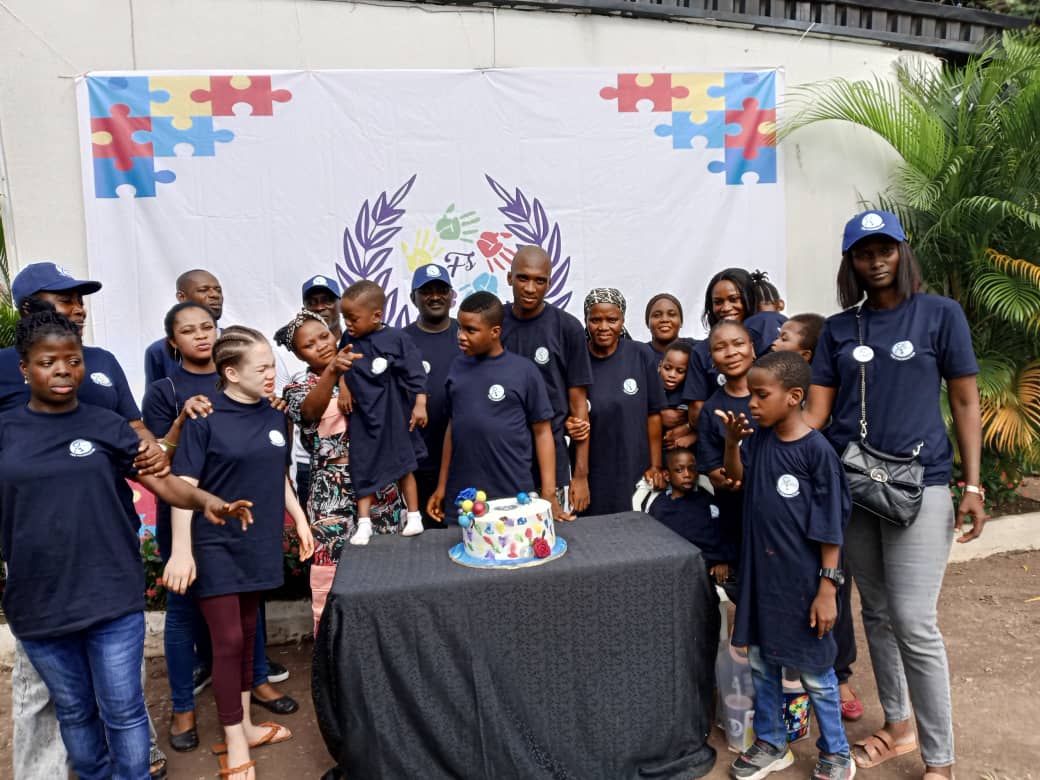
The need to empower autistic children was the highlight of the just-concluded Fun Day of Art and Giving organized by the FSS Foundation for Autistic Children.
The event, which featured activities including artwork, beading, painting, sensory toys, and a bouncing castle, was designed to celebrate autistic children and their caregivers.
Speaking at the event, Ms. Brook Eduok, Founder of the FSS Foundation, noted that although April is globally recognized as Autism Awareness Month alongside celebrations for Down Syndrome and Cerebral Palsy, the foundation remains committed to supporting autistic children and their caregivers throughout the year.
Eduok explained that the foundation focuses primarily on autism, noting that about 85 percent of children with cerebral palsy are also on the autism spectrum.
“Children living with disabilities in this country face a lot of stigmatization, isolation, and discrimination,” she said.
“They do not get invited to parties or special outings.
“A child on the autism spectrum is often sensitive to light, touch, or noise. The goal of our foundation is to ensure these children live inclusively and feel they are not alone. That is why we created this Fun Day.”
Eduok described David’s condition as one of many heartbreaking cases.
“One of the children, David, a 19-year-old, has the mind of a two-year-old. He does not know what to do without his mother’s help. His mother, who is in her fifties, is helpless and the government has refused to intervene,” she said.
“Autistic children need vocational centers where they can learn, especially as some of them are already adults. As a foundation, we are underfunded, and that’s why we are calling on government and other organizations to support these children. They also have a future that can be nurtured.
“Our biggest challenge is lack of financial support. To get sensory toys and other materials for their needs is not a walk in the park.
“In advanced countries like the U.S., U.K., and Canada, there are systems that cater to children with autism from sensory toys to speech and physical therapy.
“In Nigeria, a single speech therapy session can cost up to ₦200,000 a month. How can a parent who struggles to afford two square meals pay such an amount?
“Parents of special-needs children in those countries even receive special allowances. Many don’t work because caring for such a child is a full-time job.
“If an autistic child falls ill, you can’t just give paracetamol some react to certain medications. Imagine a mother who can hardly feed; how is she supposed to buy sensory toys or a trampoline for her child? How can she afford a suction machine for children with cerebral palsy?
“We keep going step by step, believing that one day God will send us sponsors. Sadly, Nigerians don’t care about people with disabilities. Many feel, ‘It’s not my story, so it’s not my business.’”
She lamented that people often see children with disabilities as undeserving of love or care.
“People treat them like second-class citizens. But I am fulfilled knowing that the parents and caregivers I work with now realize they are not alone.
“Many of them are rejected and isolated. They believe the world is not listening. With foundations like FSS, they feel loved and supported.”
“Disability is expensive,” she added. “My call to government is simple these children and parents need help. Nigerians and organizations must do more and stop investing in trivialities. These children deserve the best.
“With the right opportunities and therapies, even non-verbal children can talk. Look at Elon Musk, he is autistic. If his parents had rejected him, he wouldn’t have had the structure to become who he is today.
“If the government can commit even one percent to helping these children, they will thrive beyond imagination,” she concluded.
Also speaking, Barr. Chika Ugokukwu, Founder of Flora’s Trust Centre, emphasized the need for increased funding.
“One of our biggest challenges is funding. These children have complex needs and require therapies behavioral, occupational, and modern interventions which are very expensive.
“These therapies go a long way in helping them reach their full potential. Unfortunately, the high cost makes it almost impossible.
“We need to invest in resources that will help these children actualize their potential for their benefit and for the good of society at large,” she said.
Disclaimer
Comments expressed here do not reflect the opinions of Vanguard newspapers or any employee thereof.