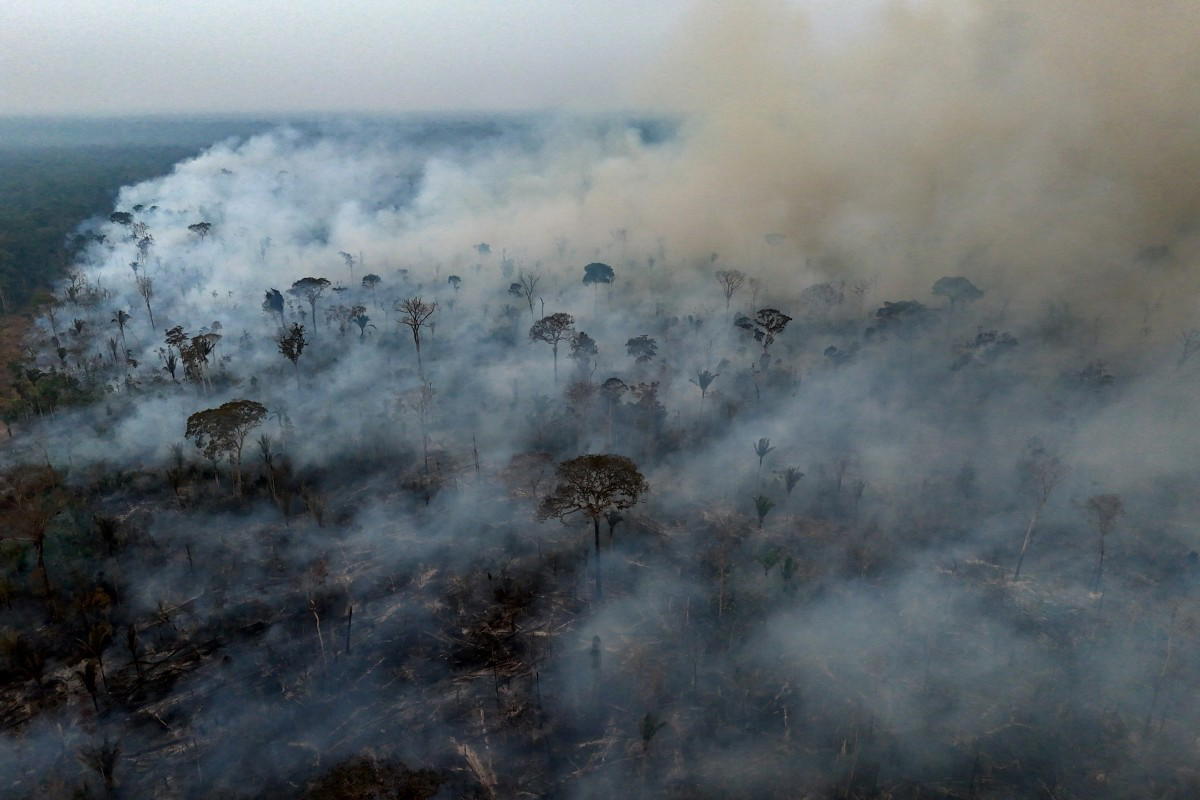
(FILES)Aerial view of an illegal fire in the Amazon rainforest on the banks of the BR-230 (Transamazon Highway), near the city of Labrea, Amazonas state, northern Brazil, taken on September 4, 2024. Temperatures passed 50 degrees Celsius (122 Fahrenheit) in northern India as an unrelenting heatwave triggered warnings of water shortages and heatstroke. 2024 is confirmed by the Copernicus Climate Change Service (C3S) to be the warmest year on record globally, and the first calendar year that the average global temperature exceeded 1.5°C above its pre-industrial level. C3S is implemented on behalf of the European Commission by the European Centre for Medium-Range Weather Forecasts (ECMWF), whose scientists have been monitoring key climate indicators, and documenting unprecedented daily, monthly, and annual temperature records over 2024. (Photo by MICHAEL DANTAS / AFP)
By Emmanuel Elebeke
Organisers of the upcoming African Energy and Climate Change Conference (AFRECCC) 2025 have described the event as a pivotal platform to transform Africa’s climate response through innovation, data integrity, and coherent policy action.
Speaking at a pre-conference media briefing in Abuja, Engr. Michael Mozie, Secretary of AFRECCC 2025, said the event goes beyond being a routine stakeholder gathering, noting that it aims to serve as a catalyst for structural transformation across the continent through evidence-based decision-making and sustainable development.
“For too long, climate discourse in Africa has been fragmented between environment, energy, and economic policy,” Mozie stated. “AFRECCC seeks to bridge that divide by connecting science to governance and governance to action. We are building a continental framework that positions climate action as the foundation for industrial competitiveness, food security, and human development.”
He emphasised that data infrastructure and integrity will be central to discussions, warning that without accurate and verifiable data, African countries risk formulating policies and investments disconnected from reality.
Mozie also underscored that climate change should not be viewed solely as an environmental concern but as a moral and economic imperative, citing soil degradation as a growing threat to livelihoods across the continent.
“At the heart of this conference lies data integrity — the ability to measure, monitor, and manage our transition using verifiable evidence,” he added.
To sustain the momentum beyond the conference, organisers unveiled plans to establish the African Sustainability and Innovation Centre, which will drive research, policy, and industrial applications of climate and energy solutions.
Dr. Peter Oji, AFRECCC’s Lead for Awards and Fundraising, disclosed that the secretariat aims to raise between $50 million and $100 million to fund the centre and other climate-related projects.
“We call on stakeholders across industries to harness the momentum of this conference to achieve our collective sustainability goals,” Oji said.
The President of the African University of Science and Technology (AUST), Professor Peter Onwualu, described the conference as timely, noting that it aligns closely with Nigeria’s preparation for COP 30.
“This conference brings together scientists, practitioners, consultants, and policymakers to discuss how Nigeria can be a major player in the climate change ecosystem,” he said. “Whether we like it or not, climate change will continue; it is all about mitigation and adaptation.”
Onwualu added that AUST has established a Centre of Excellence on Climate Change, Adaptation, and Mitigation, which will engage the private sector, government agencies, and development partners in designing actionable, research-based solutions.
A key focus of AFRECCC 2025 will be the energy transition, viewed as a strategic driver of sustainable economic growth across Africa.
Onwualu stressed that progress in this sector will directly impact economic development through the adoption of clean and sustainable energy alternatives.
“If we get it right in terms of energy development, our economy will be better for it, especially through sustainable energy that does not degrade the environment,” he said.
Scheduled ahead of the United Nations Climate Change Conference (COP 30), AFRECCC 2025 aims to serve as a continental springboard for aligning Africa’s climate priorities with global sustainability goals.
The event will convene key stakeholders from government, academia, civil society, and the private sector, offering a platform to strengthen collaboration and accelerate climate action.
Organisers said the conference represents Africa’s opportunity to assert leadership, shape global narratives, and build a future rooted in resilience, equity, and innovation.
Disclaimer
Comments expressed here do not reflect the opinions of Vanguard newspapers or any employee thereof.