By Ayo Oke
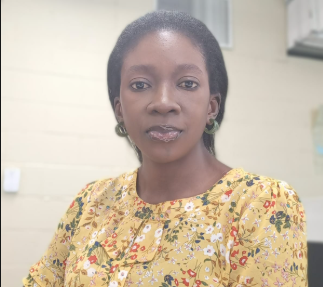
Cynthia Osuala, a Nigerian physicist and research scientist based in the United States, is leading pioneering work in graphene-based quantum technologies with potential applications in national security, advanced communications, and next-generation computing.
Osuala, a physicist and research scientist, is investigating how the unique quantum properties of graphene—a one-atom-thick material celebrated as the “wonder material” of the 21st century—can be harnessed to build quantum sensors and computing components with unprecedented precision and efficiency.
Her work revolves around solving one of the most pressing challenges in modern physics and engineering: how to model devices capable of detecting extremely weak signals and processing massive amounts of data at speeds far beyond the limits of traditional electronics.
In one of her notable projects, Osuala developed advanced models to simulate quantum transport in graphene devices, revealing how electron pathways can be tuned to minimise noise and improve sensitivity. This modelling work provides a blueprint for constructing highly quantum sensors capable of detecting even the faintest changes in magnetic or electric fields—an ability critical for applications in defence, environmental monitoring, and secure communication systems.
“Graphene’s extraordinary mobility and low resistivity make it ideal for pushing the boundaries of sensing and computing technologies,” Osuala explained. “By leveraging these properties, we can design devices that are smaller, faster, and more sensitive than anything currently available.”
Her research builds on a series of significant milestones, including the first demonstration of the Aharonov-Bohm effect in chemical vapour deposition (CVD)-grown graphene rings at cryogenic temperatures. This breakthrough revealed how quantum interference effects in graphene can be harnessed for real-world applications, laying the foundation for highly sensitive quantum technologies. The work earned her the Best Paper Award at the IEEE Conference on Nanoelectronics and Nanotechnology. She has also been featured in a Stevens Institute of Technology Research & Innovation article titled “Travelling Light”, where she discussed the broader implications of her research in making quantum technologies more practical and scalable.
Beyond the lab, Osuala is a strong advocate for STEM education and diversity in science. She has served as a mentor and judge in science competitions, inspiring young scientists and helping address the under-representation of women and minorities in physics.
“This research is more than an academic pursuit,” Osuala emphasised. “It’s about building the technologies that will define the future – technologies that ensure resilience, security, and innovation.”
Her contributions exemplify international leadership that advances materials science and quantum technology while strengthening U.S. innovation in emerging quantum systems.
Disclaimer
Comments expressed here do not reflect the opinions of Vanguard newspapers or any employee thereof.