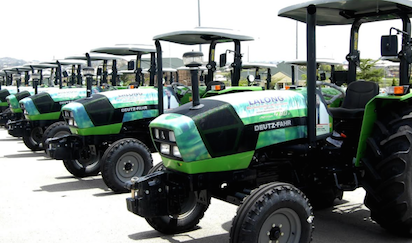
…distributes 160 three-wheeler tractors to 160 coops
…as NCAM decries 6 tractors per 10,000 hectares
By Gabriel Ewepu
ABUJA – AS the quest for food production remains in the front burner, an agribusiness mechanisation firm, TracTrac Mechanization Services Limited, has called on the government to make agricultural mechanization attractive to investors as the sector lacks clear data and other basic things that would transform food production and create jobs.
Speaking on the sidelines of ‘The State of Agricultural Mechanization Ecosystem in Nigeria’ organized by TracTrac Mechanization Services Limited, the Chief Executive Officer, CEO, TracTrac Mechanization Services Limited, Godson
Ohuruogu, while speaking on deepening the penetration of mechanization in the agricultural sector and the essence of the conference at this time.
According to Ohuruogu, investors do not have enough information to make that investment decision in the nation’s mechanization drive.
The forum had attendance from both the public and private sectors including the media to chat a new course to make mechanization a priority and easy for sector players including investors, service providers and farmers to galvanize food production in the country.
TracTrac had distributed 160 Tryctors (three-wheeler tractors) to 160 cooperatives across Nasarawa and Kaduna States this September, marking a significant milestone in expanding access to affordable mechanisation for Nigerian smallholder farmers.
The first distribution was done on September 11th in Nasarawa and on September 22nd in Kaduna respectively, which a total of 113 cooperatives in Nasarawa and 47 cooperatives in Kaduna will each receive a Tryctor, enabling them to deliver cost-effective mechanisation services directly to their members and surrounding farming communities.
Over 79,000 farmers benefited from cooperative structures, with thousands more indirectly reaching through community-level service access.
He said: “People have information around things that are easier to invest in, but over the years, mechanization seems to be some sort of difficult space, so a lot of would-be investors are not going into this space because they do not have enough information to make that judgment.
“And one of the things we want to do in Trac Trac Mechanization Services Limited is to make that information available to everybody out there, so that they can make an investment decision.
“From the perspective of the government; the government should enable, should make it easy for people to invest and make the business easy.”
He further stated that, “From the point of the farmers, they should understand that they need these tractors and they should patronize the different vendors providing tractor services, so that there can be continued interest in that space.
Meanwhile the Trac Trac boss disclosed that, “We have a long-term strategic plan, which is to raise interest about investments in the mechanization space, and to also continue the conversation on mechanization policy that is already at the table of the Federal Ministry of Agriculture.
He also made his company’s expectation known in the next five years as far as agric mechanization is concerned.
“So what we want to see in the next five years is, number one, a reasonable investment in the mechanization space, whether by the government or private sectors, or by NGOs, or by whoever, to the tune of about 250,000 tractors, and also train about 500,000 mechanization service providers into the ecosystem.
“And these mechanization service providers cover drivers, sorry, operators, booking and hiring agents, mechanics, and a whole lot of others. Number three, we can also start supporting local assembly plants, and a whole lot of others.
“The mission of Trac Trac is to make investments easy, investment into mechanization easy, is to make sure that the various mechanization service providers, or young people, are equipped with the necessary skillset to become mechanization service providers, and then to continue to work with every interested stakeholder to move in the mechanization, improving the mechanization situation currently in Nigeria, to something way, way better in the next five years”, he said.
Meanwhile, in a keynote address, the Executive Director and Chief Executive Officer, CEO, National Centre for Agricultural Mechanization, NCAM, Engr Kamal Rasheed described agricultural mechanization as “the backbone of any nation’s drive towards food security, employment generation, and sustainable rural development.”
According to Rasheed, in Nigeria, the mechanization ecosystem has grown steadily, but “significant gaps still exist in terms of access, affordability, local fabrication, maintenance services, and operator training.”
He also acknowledged that agricultural mechanization in Nigeria “remains at a relatively low level, characterized by a heavy reliance on manual labour and simple tools.”
He expressed worry that “the tractor density in Nigeria is still reported as approximately 0.027 horsepower per hectare (equivalent to about 6 tractors per 10,000 hectares).
“This is significantly below the Food and Agriculture Organization (FAO) recommendation of 1.5 horsepower per hectare. (about 200 tractors per 10,000 hectares).”
He said: “Agricultural mechanization, measured by indicators like the Mechanization Level (hp/hectare) and the Tractorisation Index (tractors/1000 hectares), is a cornerstone of modern agricultural productivity.
“To really guide national policy and Investment and to accurately Assess the food security equation there is the critical Need for Updated Data with reliable statistic.
Barriers and Opportunities
Several barriers persist within the mechanisation ecosystem.
“These include limited access to modern equipment, inadequate infrastructure, and insufficient technical expertise among stakeholders.
“Despite these obstacles, there are considerable opportunities for improvement. Increasing investment in research and development, expanding training programmes, and enhancing accessibility to machinery can foster growth and innovation within the sector.”
However, the NCAM boss disclosed what his organization is doing, which it has “developed and promoted over series of locally-fabricated agricultural machines tailored to smallholder farmers.
“Strengthened partnerships with private sector operators for the deployment of mechanization services in rural communities; Expanded training programmes for machine operators and artisans to ensure sustainability of mechanization investments; Facilitated research–industry linkages to stimulate innovation and job creation in the mechanization value chain.
“We believe that sustainability in agricultural mechanization in Nigeria can be best achieved through local manufacturing of mechanization technologies.
“Our New Vision is to encourage home grown agricultural mechanisation technologies while reducing or eliminating importation of agricultural machines and equipment.”
Disclaimer
Comments expressed here do not reflect the opinions of Vanguard newspapers or any employee thereof.