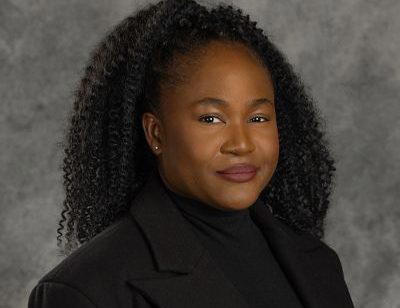
Anigala
first black African woman to earn a CS Ph.D. at South Dakota State University, speaks
By Prisca Sam-Duru
Raised in Nigeria in a family that prized education, US-based Omeshamisu Anigala is one of the many Nigerian students in the diaspora excelling in their diverse fields. Anigala’s early spark for computer science came from the promise of building tools that many people could use to make life better. Watching her mother pursue a university degree while raising seven children set a durable example of grit and ambition that continues to guide her. It was nothing short of an inspiration.
In this virtual interview, Ms. Anigala shares reasons for her choice ofuniversity, challenges of being a diaspora Ph.D student, cultural surprises in the US, her plans to mentor women and international students in AI, and so much more. Excerpts.
Why did you choose South Dakota State University (SDSU) for your Ph.D.?
I chose South Dakota State University first, because it’s a state with a very low crime rate. Having some sense of security was something I considered important, andit made my decision even solidified to find out about their state-of-the-artresearch facilities, and most importantly, a faculty member whose research expertise aligned with my research interests.
You’ll be the first Black African woman to earn a CS Ph.D. at SDSU—how does that feel?
It feels surreal, but I am super grateful to God for the achievement. I do this not just for myself but for young girls and women in Nigeria, showing them what is possible if they put their mind to it.
Can you describe the focus of your dissertation research and what makes it novel?
My dissertation is centeredon safe and transparent AI models. My first paper PEARL is titled Perceptual and Analytical Representation (Object tracking information) Learning for video anomaly detection uses multimodal learning to enhance video anomaly detection. Second paper is on Explainable Video Anomaly Detection System. The third focuses on unsafe behaviour detection using multimodal learning in the production industry, and finally a paper on evaluating multimodal datasets and how their quality/alignment affect downstream performance.
Which accomplishment (paper accepted, award, leadership role) are you most proud of?
So far, I have one publication which I am proud of, but I will say my research is very important. So, that is what I am most proud of.
What major obstacles have you faced as an international student and how did you overcome them?
The major obstacle is not related to being an international student but more of straying from a business background to a science one. My bachelors was in accounting. So, science was not as easy to grasp at first, but with tedious research and learning foundation concepts I caught on.
In navigating the shift from business background to science, did you encounter moments of self-doubt, and what got you through?
Absolutely, indubitably, like I said I came from a business background, so I didn’t have a strong science foundation, so I was lost when I first started my research, butThank God, I have learned a lot because of my research experience, course work and a phenomenal advisor.
In the future, what do you see as the biggest opportunity or challenge in video anomaly detection / explainable AI?
The big challenge is open-world reality. You’ll never have a dataset that contains every possible anomaly. That’s why my work leans on unsupervised and weakly supervised learning that can generalize beyond seen events. The opportunity ispairing that with XAI—so models don’t just flag “weird unrelated events” theyshow “why” in human terms. That combo is what makes these systems trustworthy for real deployments.
Where do you hope your research will take you after graduation?
I want to lead the development of deployable, human-centered safety systems—starting with construction and public-space monitoring—by fusing multimodal signals and concept-driven explanations. Practically, that means continuing in a researchlab or faculty role, releasing open tools/datasets, collaborating with industryand agencies, and mentoring the next generation—especially women and international students in AI.
What practical tips would you give to young Nigerians (or women) looking to pursue STEM abroad?
Having God and just putting in the work. Hard work always pays off in the end.
How do you stay motivated during long stretches of research work?
I don’t rely on motivation; I rely on systems. I break work into weekly micro-milestones, keep a visible “why” (safer worksites, fairer AI) on my wall, and make progress measurable—plots, ablations, or a bug closed. I rotate tasks when I’m stuck: ifexperiments stall, I switch to data cleaning, writing, or code tests somomentum never dies. I also keep accountability—weekly updates to myadvisor/collabs—and protect energy with short deep-work blocks, walks, and hardstop times. Small wins compound; that’s what carries me through the longstretches.
How doyou balance research, teaching, and personal life?
I used to be a Graduate Administrative Assistant, so my hours flexed around classes. Now that coursework is done, I’m a full-time Software Engineer in SDSU’s OIT programming office while finishing my dissertation. I keep core OIT hours for teamwork, and reserve early mornings/evenings for research sprints. I plan weekly micro-milestones, rotate tasks when experiments stall, and protect recovery—at least 1–2 full days off each month, and I take advantage of public holidays if no deadline is near, so I don’t teach.
Are you involved in mentoring, student organizations- National Society of BlackEngineers (NSBE) or community outreach?
Yes. I’m leading the launch of the NSBE chapter at SDSU—co-writing the constitution/recognition docs and recruiting founders. I mentor undergrads informally (resume reviews, research on campus), and I support outreach. At the Girl Scouts “Believe in Girls” STEM event in Sioux Falls, our team demoed an interactive computer-vision system to 500 plus scouts and families.
What cultural surprises have you encountered in the U.S.?
Food! Portion sizes are huge. The default spice level is mild, and there’s so much sugar. The flip side is amazing access to global cuisines. You can eat the world in one town. I’ve learned to ask for “extra spice” and to pace portions.
And the Systematic life, almost everything runs by appointment, email, andpolicy—forms, schedules, calendars, receipts. It’s efficient but unforgiving if you miss steps. I adapted by planning, living by my calendar, and keeping good documentation. The predictability helps my research.
In what ways do you stay connected to Nigeria, personally and professionally?
Personally, I keep a weekly call with my family, and I mostly cook Nigerian food at home. I hardly eat out, so my kitchen keeps me grounded.
Professionally, I actively collaborate with Nigerian researchers on AI projects—regular check-ins, shared code/data, and co-writing. So, my work stays relevant tochallenges back home.
Disclaimer
Comments expressed here do not reflect the opinions of Vanguard newspapers or any employee thereof.