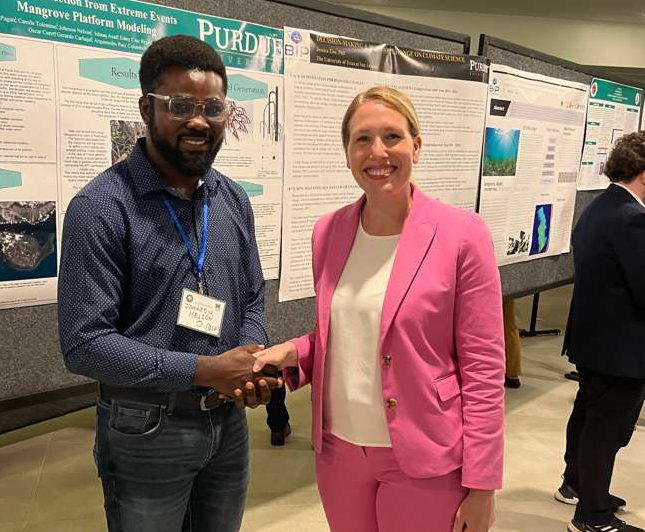
By Teslim Abdul
Amid persistent threats from climate change, coastal erosion and energy insecurity, a climate-resilient engineering expert, Johnson Oluwatuyi Nelson, has unveiled a research-driven vision aimed at protecting vulnerable communities while advancing sustainable energy systems.
Nelson, a mechanical engineer and Trailblazers in Engineering Fellow at Purdue University, is among a select group of early-career researchers being trained to lead transformative engineering solutions to some of the world’s most pressing environmental challenges.
Hosted by Purdue University’s College of Engineering, the Trailblazers in Engineering Fellowship is one of the most competitive academic development programmes in the United States, admitting fewer than 10 per cent of applicants annually. The initiative prepares future engineering faculty through intensive mentorship, research leadership training and direct engagement with deans, policymakers and federal funding agencies.
Speaking on his selection, Nelson described the fellowship as both an affirmation of his work and a call to greater responsibility.
“The Trailblazers programme recognises not just academic output, but the ability to shape the future of engineering through inclusive research, teaching and mentorship,” he said.
Nelson’s academic journey began in Nigeria, where he earned a bachelor’s degree in mechanical engineering from Obafemi Awolowo University in 2018. He later obtained a master’s degree from Purdue University in 2023 and is currently completing his PhD, with a projected graduation date of August 2026.
“Mechanical engineering gave me a solid foundation in fluid mechanics and materials,” Nelson said. “However, I became increasingly drawn to coastal protection and renewable energy because I wanted my work to directly improve lives, especially in climate-vulnerable regions.”
His research spans renewable energy systems, coastal protection, artificial intelligence and extreme climate events, with a focus on integrating sustainable infrastructure and environmental resilience for coastal communities exposed to flooding, storm surges and unreliable power supply.
One of his notable studies centres on mangrove-inspired coastal defence structures. Using advanced computational fluid dynamics simulations, Nelson examined how engineered root-like arrays can slow water flow, dissipate wave energy and stabilise shorelines more effectively than traditional rigid barriers.
“Our findings show that moderately porous, nature-inspired structures perform better than overly dense or sparse designs,” he said. “They create elongated vortices that reduce wave energy while remaining environmentally friendly. This opens the door to sustainable alternatives to concrete seawalls.”
Beyond coastal protection, Nelson is exploring the application of artificial intelligence in strengthening renewable-energy systems. He noted that AI has the potential to transform material design, energy forecasting and infrastructure performance under extreme conditions.
“By combining solid mechanics with machine learning, we can design adaptive materials that respond dynamically to stress,” he explained. “Imagine infrastructure that stiffens during earthquakes or extreme storms and relaxes afterwards—AI makes that possible.”
Nelson stressed that addressing climate and energy challenges requires interdisciplinary collaboration.
“Climate change, erosion and energy insecurity are interconnected problems,” he said. “Engineering solutions must integrate ecological understanding, energy systems and policy frameworks to be truly effective.”
He added that his long-term vision links nature-based coastal defences with resilient energy systems.
“Protecting coastlines while powering communities through solar-wind hybrid systems and smart grids creates a systems-level approach to climate resilience,” Nelson said.
His work also extends to energy governance, particularly in Nigeria, where he has examined policy barriers limiting renewable-energy adoption. He identified weak regulatory frameworks, poor grid integration and inconsistent policy implementation as major obstacles.
“Nigeria has immense renewable potential, but energy security is as much a governance challenge as it is a technical one,” he said. “Without stable policies, modern training and long-term planning, even the best technologies will fail.”
Advising young researchers, Nelson urged them to think beyond disciplinary boundaries.
“Learn broadly, collaborate globally and ground your work in real problems faced by vulnerable communities,” he said. “The future of climate resilience depends on collective expertise and sustained commitment.”
Disclaimer
Comments expressed here do not reflect the opinions of Vanguard newspapers or any employee thereof.