By Kehinde Adepegba
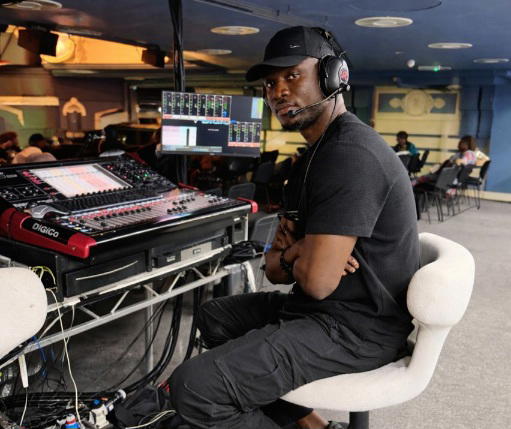
In contemporary live performance, the boundary between stagecraft and visual art has become increasingly porous. Light, projection, framing, and spatial composition now operate as expressive media in their own right, shaping how performance is perceived rather than simply supporting it. Within this evolving terrain, some practitioners approach live visuals not as technical output but as a form of responsive image-making. One such practitioner is Adetunle Sunday Micheal, known professionally as Micheal Able, whose recent work across cultural event, live production reflects a developing practice situated between live visual direction and digital art.
What first becomes apparent in his work is an attention to timing. During the Bella Shmurda UK tour in early 2024, a multi-city concert production defined by high-energy performance dynamics, visual transitions did not always coincide precisely with musical cues. Instead, shifts in light or framing often arrived just after a change in rhythm or vocal phrasing. The delay was slight, yet perceptible. It produced the impression that the visual field was listening before responding, allowing sound to initiate movement rather than the reverse. This subtle inversion altered the relationship between audience, performer, and space, encouraging perception rather than instruction.
A similar sensibility could be observed during the Diamond Platnumz performance at London’s Royal Albert Hall in June 2025, a venue whose architectural scale frequently invites continuous visual intensity. Large environments often encourage visual excess as production teams attempt to occupy spatial magnitude with uninterrupted activity. Here, however, several passages relied on reduced illumination and controlled visual pacing. Moments of stillness allowed gesture, silhouette, and stage geometry to carry visual emphasis. Such decisions suggested an understanding of light not as decoration, but as compositional material, handled with noticeable restraint within a large-scale concert setting.
His involvement in Nigeria Week London, held at the Hippodrome Theatre in July 2025, a programme combining live performance and real-time broadcast elements, extended this visual language into hybrid environments. In these contexts, image becomes simultaneously physical and digital, experienced by audiences both inside and outside the venue. Coordinating that dual perception requires sensitivity to how timing, framing, and motion translate across platforms. The overall coherence of the programme indicated a practice attentive to these differences, adjusting visual rhythm to maintain continuity between stage presence and screen image.
Across these projects, Micheal Able’s work suggests a consistent methodology grounded in responsiveness rather than spectacle. Visual elements are treated as temporal and spatial media, shaped in relation to sound, movement, and audience attention. This approach places his practice within a growing field of practitioners who regard live visual direction as a form of real-time composition, and digital imagery as a material through which performance space can be interpreted.
As live performance continues to evolve within globally connected and technologically mediated environments, distinctions between technical execution and artistic interpretation remain increasingly relevant. Micheal Able’s recent work indicates a developing practice attentive to this intersection, one in which visual direction functions not as an accessory to performance but as an integrated mode of artistic expression.
Kehinde Adepegba PhD, is an art critic and art historian
Disclaimer
Comments expressed here do not reflect the opinions of Vanguard newspapers or any employee thereof.