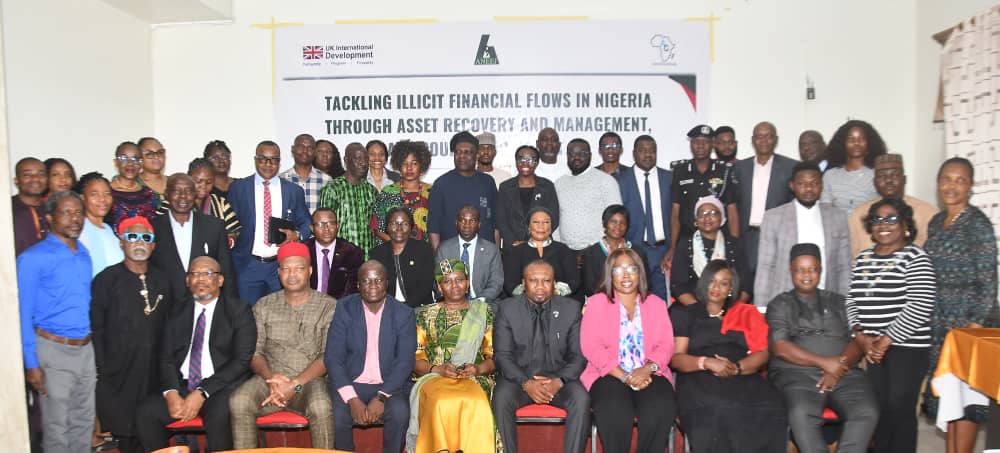
…as government institutions pledge strong enforcement
By Gabriel Ewepu
ABUJA – The African Network for Environmental and Economic Justice (ANEEJ) and the African Centre have jointly launched the Illicit Finance Resilience Project, aimed at strengthening Nigeria’s fight against illicit financial flows (IFFs) through asset recovery, management, and stronger enforcement.
The project, a nine-month initiative funded by the UK Foreign, Commonwealth & Development Office (FCDO), will support the implementation of the Proceeds of Crime (Recovery and Management) Act (2022), advance transparency, and address vulnerabilities in Nigeria’s extractive industries.
At the inception meeting in Abuja, more than 60 representatives from key government institutions, law enforcement, civil society, and international partners pledged support. Participants included officials from the Ministry of Justice, ICPC, NAPTIP, NEITI, FIRS, NFIU, Nigerian Police, UNODC, and other agencies.
Minister of Justice and Attorney-General of the Federation, Prince Lateef Fagbemi SAN, represented by Ali Bozi, assured government backing.
“Illicit financial flows remain one of the most significant threats to sustainable development, governance, and national security. Together, we can ensure that recovered resources are not only returned but are invested in critical sectors that directly benefit the Nigerian people. I pledge my continued support to cooperate, coordinate, and back this project to achieve its purpose.”
Speaking on behalf of the UK Government, Anicetus Atakpu, representing FCDO’s Illicit Finance Advisor, reaffirmed international partnership.
“Asset recovery is a central pillar in these efforts. Confiscating and recovering the proceeds of crime are essential to leveraging sanctions against offenders and securing justice for victims. Evidence has shown that putting stolen assets towards public goods and services is the best way of ensuring anti-corruption efforts deliver for ordinary citizens.”
Executive Director of ANEEJ, Rev. David Ugolor, stressed the scale of the challenge.
“Illicit financial flows continue to drain Nigeria of much-needed resources for development. The African Union estimates that the continent loses about $150 billion annually, with Nigeria accounting for nearly 20 percent of that loss. Our project seeks to build partnerships across government and civil society to ensure that recovered assets are transparently managed and reinvested for the benefit of Nigerians.”
Co-implementer, Juliet Ibekaku-Nwagu, Executive Director of the African Centre for Governance, Asset Recovery and Sustainable Development, highlighted the technical role.
“Through this project, we will provide technical support and follow up with training of investigators and prosecutors so they become better aligned with the Proceeds of Crime (Recovery and Management) Act. This will help ensure asset recovery processes are more effective and accountable.”
From the extractive sector, Dr Orji Ogbonnaya Orji, Executive Secretary of NEITI, underscored the urgency of closing systemic loopholes.
“Illicit financial flows are not abstract statistics. They represent stolen opportunities—lost revenues that could have built schools, hospitals, roads, and jobs. If we do not close the loopholes in oil, gas, and mining governance, asset recovery will remain a revolving door—recovering what is stolen today, only to lose more tomorrow.”
He pledged NEITI’s full cooperation, adding:
“We will bring fully to the table our ability and capability to provide the data needed. NEITI stands ready to extend this partnership to other stakeholders.”
The United Nations Office on Drugs and Crime (UNODC), through its StAR (Stolen Asset Recovery) Initiative, also assured support.
“The StAR Initiative will continue to support this progress,” said Princess Aruoriwoh-Esmer Chifiero, UNODC Nigeria’s Anti-Corruption Coordinator.
Other agencies, including NFIU, NDLEA, NAPTIP, FIRS, and SCUML, pledged collaboration, reinforcing a strong consensus that illicit finance is a serious national threat and that the project provides a critical platform for joint action.
Disclaimer
Comments expressed here do not reflect the opinions of Vanguard newspapers or any employee thereof.