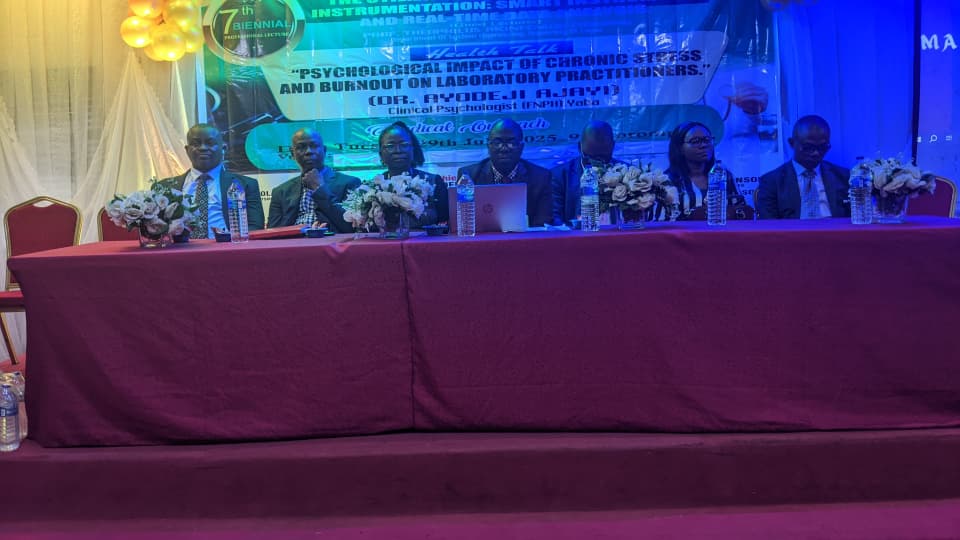
Dr Ayodeji Ajayi, Guest speaker, Prof Theophilus Fashanu, Guest speaker Mrs Afolabi Tosin Folashade, Branch Chairperson ASLTON, Dr Oluwafisoye Adefisoye, Acting DG NISLT, Mr Adeshina Samuel, NISLT Council Elect South West, Prof B.A. Tella, Dean, Faculty of Health Sciences, Mr Dike Simon, ASLTON Lagos State Chairman, Mr Ayotunde Omorilewa, National President, ASLTON at the seminar.
By Miracle Chisom
At a time when power cuts still plague laboratories and aging equipment slows diagnoses, a bold conversation is gaining ground in Nigeria’s medical corridors: Can artificial intelligence rescue our labs?
That question took center stage at the University of Lagos’ Idi-Araba campus , where laboratory technologists, engineers, and healthcare leaders gathered for the 7th Biennial Professional Lecture of the Association of Science Laboratory Technologists of Nigeria (ASLTON). Themed “The Utilization of AI in Laboratory Instrumentation: Smart Instruments and Real-Time Data Analysis,” the event wasn’t just another academic talk — it was a wake-up call.
Professor Theophilus Akinfenwa Fashanu, a systems engineer from UNILAG, didn’t mince words: “AI is not coming. It’s already inside your machines.”
He walked the audience through a new reality — one where AI-powered instruments detect cancer markers in blood samples within seconds, predict equipment failure before it happens, and flag contaminated drug batches in real time.
“In Nigeria, we’re still arguing about stable electricity,” he said, “while labs in other countries are using AI to diagnose tuberculosis from a single drop of blood, with 95% accuracy. The gap is real. And it’s widening.”
His message? Artificial Intelligence is no longer a luxury for rich nations. It’s fast becoming a necessity — especially for a country like Nigeria, where understaffed labs, delayed results, and outdated tools continue to cost lives.
Dr. Peter Adefisoye Oluwafisoye, Acting Registrar/Director-General of the Nigerian Institute of Science Laboratory Technology (NISLT), echoed the urgency.
“From spectroscopy to molecular diagnostics, AI is redefining the operational architecture of the modern laboratory,” he declared, citing cases where AI systems in pharmaceutical labs abroad detect inconsistencies faster than human eyes ever could.”
He also used the platform to unveil key highlights of the NISLT 2025–2030 Strategic Plan — a roadmap aimed at digitizing certification, integrating AI into training curricula, and establishing a network of smart, connected laboratories across Nigeria’s teaching hospitals.
“This isn’t about replacing people,” Dr. Oluwafisoye stressed. “It’s about empowering our technologists with tools that make their work faster, safer, and more accurate.”
The ASLTON Idi-Araba Branch, though just one campus chapter, has become a national model for innovation and advocacy. Over seven biennial lectures, it has hosted top minds — from Vice Chancellors to leading consultants at Lagos University Teaching Hospital (LUTH).
This year’s event drew scientists, lab techs, and administrators from across Lagos, Ogun, and even as far as Benin and Port Harcourt.
Mrs. Afolabi Tosin Folashade, Host Chairperson and a senior technologist, reminded the audience that excellence isn’t just about knowledge — it’s about service.
“We’ve organized free medical screenings, eye tests, and distributed reading glasses to hundreds in the Idi-Araba community,” she said. “Our welfare doesn’t stop at our members. We are part of this community.”
But behind the pride was a plea: support.
“Our trainings are sponsored — but minimally,” she admitted. “We appreciate every kobo from the university and TETFUND. But we need more. We need consistent funding, modern equipment, and inclusion in decision-making committees. We are not just support staff — we are essential.”
Mr. Ayotunde Omorilewa, National President of ASLTON and a member of the Idi-Araba branch, added a national appeal: sponsorship for members to attend the 2025 ASLTON/NISLT Joint Conference in Port Harcourt this November.
“Our people are skilled, committed, and ready,” he said. “But they can’t grow if they’re stuck in outdated labs with no access to training.”
He also called for the employment of more qualified technologists, proper placement in relevant units, and representation on institutional boards. “If we’re trusted to analyze your blood,” he asked, “why aren’t we trusted to sit in on meetings that shape healthcare policy?”
The road to AI integration in Nigerian labs is steep. Many facilities still rely on manual processes, lack uninterrupted power, and struggle to procure basic reagents. Training in digital tools remains limited.
Yet, the momentum is building. With NISLT’s new strategic plan, growing interest from academic institutions, and grassroots advocacy from branches like Idi-Araba, there’s a sense that change is possible.
As Dr. Adesina, representing the Provost of the College of Medicine, assured attendees: “Every concern raised here will be taken seriously. The Provost will be briefed — especially on the call for increased sponsorship.”
AI may be the buzzword, but the real story isn’t about machines. It’s about the thousands of laboratory technologists working in the shadows — calibrating instruments, validating results, and ensuring Nigerians get accurate diagnoses.
They are ready to embrace the future. But they can’t do it alone.
As the lecture ended and the crowd dispersed, one message lingered in the air: Nigeria’s healthcare revolution won’t start in the operating theatre. It will start in the laboratory — quiet, precise, and powered by data.
The tools are evolving. The question is: is Nigeria?
Disclaimer
Comments expressed here do not reflect the opinions of Vanguard newspapers or any employee thereof.