By Esther Onyegbula
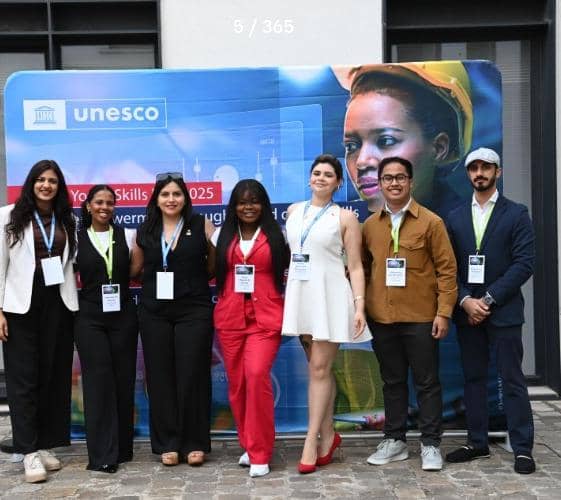
At UNESCO-UNEVOC’s global forum marking the 10th anniversary of World Youth Skills Day, Ayeni Oluwatobi Dorcas, better known as Misstechy, stood out as a refreshing and unapologetic voice for Africa’s youth.
Themed “Youth Empowerment through AI and Digital Skills,” the event brought together education leaders, policymakers, and youth advocates from across the world. In the midst of it all, Misstechy brought the conversation home to what truly matters: real people, real challenges, and real opportunities.
Widely celebrated as Africa’s foremost youth tech storyteller and a tireless champion for digital inclusion, Misstechy shared her personal experiences on two panels.
The first, “AI in TVET, A Tool for Empowerment or a threat to human potential?” explored the unsettling rise of AI-generated content. Speaking with characteristic candour, she flagged the growing struggle to distinguish real images from fake ones online, even as social media platforms rush to introduce AI labels. Her advice was clear and practical: critical thinking and rigorous fact-checking must become second nature in this era of blurred realities.
Yet, even with all of AI’s impressive capabilities, Misstechy reminded the audience of a simple truth:
“AI might help bring ideas to life, but it can never replace the human soul behind true creativity. It’s here to support us, not to take our place. The vision and spark will always come from us,” she said.
Her second session, “Policy and Practice – Skills Demand, Trends, and Institutional Readiness,” featured a powerhouse lineup including UNESCO’s Borhene Chakroun, Germany’s Heike Kuhn, WorldSkills International’s Ray English, Céreq France’s Matteo Sgarzi, and Back Market’s Amandine Durr.
Amid these global heavyweights, Misstechy’s grounded insights stood out. She spoke not just as an observer, but as someone who lives at the heart of Africa’s digital awakening, sharing stories of young Nigerians navigating, learning, and creating against all odds.
Reflecting on her own journey with AI and digital skills, Misstechy recalled how she once struggled to create her first AI-generated video.
“It was frustrating at first. But learning by doing changed everything,” she said.
Her growth, she shared, wasn’t achieved in isolation. Joining online communities kept her motivated through the messy middle, proving once again that collaboration fuels progress.
She also spoke about Gen Z’s approach to learning. Gone are the days of long, jargon-heavy lectures, she noted. Today’s young people thrive on bite-sized, focused content they can apply immediately. For her, platforms like TikTok aren’t mere entertainment, they’re classrooms without walls.
“When you break down complex topics into small, relatable pieces, learning becomes something young people look forward to rather than avoid,” she said.
Statistics presented at the forum underscored the urgency of her advocacy: only 34 percent of TVET institutions worldwide have the bandwidth to deploy advanced AI tools, and 78 percent of educators still feel unprepared to integrate them into teaching. Yet a youth-led survey found that over 4,000 young people across 128 countries are already experimenting with AI in practical ways. The gap isn’t in curiosity, it’s in structured, accessible training.
As the world marked a decade of World Youth Skills Day, Misstechy’s message rang loud and clear: for Africa, and the world, to harness AI’s promise, young people must be empowered not just as consumers, but as creators and innovators.
Her story is proof that with resilience, community, and an insatiable hunger to learn, no challenge is insurmountable.
Disclaimer
Comments expressed here do not reflect the opinions of Vanguard newspapers or any employee thereof.