By Ebunoluwa Sessou
The Nigeria Association of Patent and Proprietary Medicine Dealers, NAPPMED, has urged the Federal, Lagos State Governments and the Pharmaceutical Council of Nigeria, PCN, approve a second Coordinated Wholesale Centre, CWC, in Lagos State to avert looming threat of distribution of drugs in the state.
The Chairman of NAPPMED, Liberation Zone Idumota Lagos, Osita Nwajide gave the call while addressing journalists during a rally organised by the Association in Lagos.
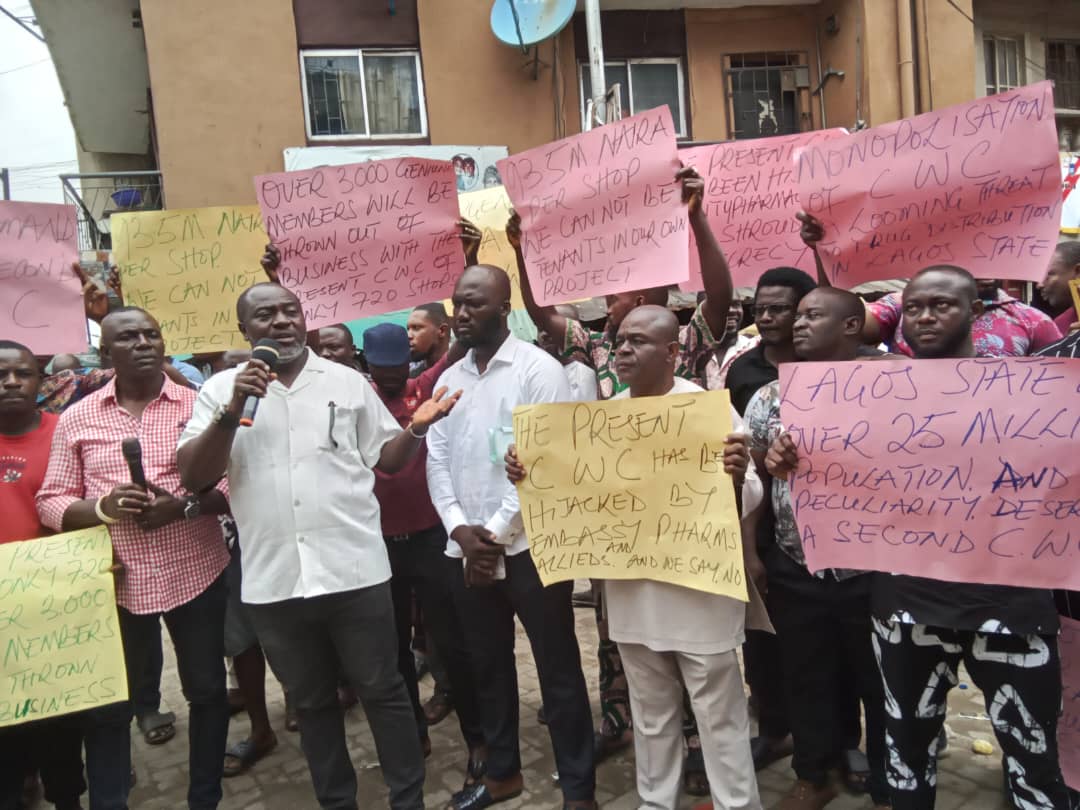
The rally which had some of the inscriptions including, “Monopolisation of CWC, a looming threat to drug distribution in Lagos State, “Over 3000 genuine members will be thrown out of business with the present CWC of only 720 shops, “The present CWC has been hijacked by embassy pharms and allied and we say no, “Lagos State with over 25million population and its peculiarity deserve a second CWC, “Between June and December, the medicine sellers are expected to pay N93.5million”, it reads.
Nwajide said that the CWC has become necessary to save lives of the Lagosians as well as avoid patronizing fake drug sellers through black market.
Speaking with journalists, Nwajide lamented that the present CWC project has been ejected adding, all subscribers of the first CWC project paid for that land as medicine dealers under Lagos State Medicine Dealers Association, LSMDA, and now it has been ejected by some few.”
Nwajide further said, the land owners’ demand is to get back their land adding that the Association on different occasions has called for account and proper explanation of what happened on the CWC project but efforts to get information has been fruitless.
“We are demanding for a second CWC and it is very simple. Lagos State with over 25 million populace demands and needs a bigger CWC because the one they are building presently is only 720 shops and we have over 3,000 medicine marketers in Lagos Island’’.
While emphasising that the land on which the Lagos CWC is being constructed was originally acquired through the contributions of genuine pharmaceutical stakeholders in Lagos Island, he said, “These marketers, over 3,000 invested in the hope that the CWC would offer fair, regulated, and accessible wholesale operations, the current reality reveals a different and disturbing picture.
“The project has been monopolised by a handful of actors, notably non-pharmaceutical businessmen and a few politically connected players. ”They have sidelined the very individuals who initiated and funded the project.
“With prices soaring as high as ₦93.5 million per unit, the vast majority of genuine pharmaceutical marketers many of whom are small and medium-scale operators have been priced out of the very market they helped create’’.
He further explained that the high price would create a lopsided business environment and also weakens drug supply security in Nigeria’s most populous state.
“This financial barrier is not only unethical but cripples the core purpose of the CWC: to provide a regulated, inclusive marketplace for safe pharmaceutical distribution.
”This development has already left over 3,000 legitimate, pharmaceutical marketers jobless or pushed to the margins.
“Many of them, who had run compliant businesses for years in open drug markets, are now excluded from formal operations in the ongoing CWC, leaving them with no viable alternative in the near future’’, he added.
On his part, a founding member of Medicine Dealers Association and one of the original planners of the CWC, Gabriel Onyejamwa revealed that the land title, initially held in trust for the dealers, was later transferred to City Pharmaceuticals under questionable circumstances.
He also noted that attempts to engage the current management structure have been futile, and many longtime members are now completely cut out of decision-making processes.
He however appealed to Federal and state Government as well as the Pharmaceutical Council of Nigeria, PCN, and the National Agency for Food and Drug Administration and Control, NAFDAC, to take urgent steps to approve a second CWC in the state and correct the imbalance.
The proposed centre, they argue, must be inclusive, affordable, and strategically located with capacity for over 3,000 traders.
They also recommend that shop rental costs be capped at affordable monthly rates to allow for broader participation among low – and mid-income operators.
In addition, they are calling for transparent regulatory oversight of any future projects to prevent similar abuses. NAPPMED members insist that the current system is not sustainable.
With Lagos serving as a critical node in Nigeria’s pharmaceutical supply chain, they warn that excluding legitimate traders from the formal distribution network could lead to dire consequences, including the proliferation of counterfeit drugs, widening health inequities, and the re-emergence of informal and unregulated drug markets.
According to him, if left unchecked, the exclusion of medicine dealers from CWC operations could destabilise the very objective the reform was meant to achieve.
He emphasised that equitable drug distribution is a matter of public health and national security, not a commodity to be auctioned to the highest bidder.
Disclaimer
Comments expressed here do not reflect the opinions of Vanguard newspapers or any employee thereof.