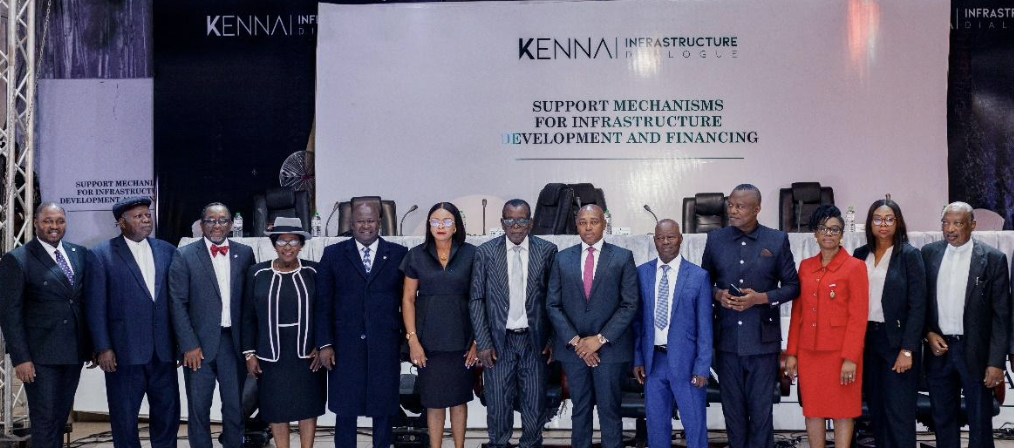
Stakeholders unanimously agreed on the criticality of infrastructure development as a fundamental element for socio-economic prosperity. This summation was made at a KENNA Colloquium on infrastructure development held in Enugu State on Thursday, June 5, 2025, with the theme: “Support Mechanisms for Infrastructure Development and Financing.”
The discourse highlighted the need for innovative financial models and collaborative frameworks to address the infrastructure deficits in the region in particular and the nation as a whole. The colloquium focused on how infrastructure initiatives can act as catalysts for broader societal advancement, identifying specific areas requiring substantial infrastructure development while offering unique solutions to the challenges.
The Deputy Governor of Enugu State, Ifeanyi Ossai, representing the Governor as Special Guest of Honour, emphasised the government’s commitment to creating an enabling environment for infrastructure investment and economic prosperity by focusing on the fundamentals of socio-economic growth.
According to Ossai, “While taxation is a source of raising funds for infrastructural projects, there is a limit to how much we can tax. Therefore, we are creating an enabling environment to encourage businesses to invest —not just in infrastructure development, but in different sectors—to create wealth for the entire state. It is for this reason that this administration is investing heavily in education and healthcare to reduce the exposure of families to fundamentals that drain their pockets, thereby leading to the growth of businesses and MSMEs.”
Senior Partner at KENNA, Professor Fabian Ajogwu, SAN, gave astute recommendations for supporting infrastructure development and financing. He touched on the strengthening and expansion of the legal and regulatory framework for infrastructure development in the State, stating that a robust framework will provide stability, transparency, and security for investors, boosting their confidence to invest in the State as a corollary.
The Learned Professor further commented, “Enugu State should consider establishing a state-level infrastructure fund; a pooled, ring-fenced, and independently managed fund with clear governance structures. The Fund, which could be named the Enugu State Infrastructure Fund, offers a more predictable financing mechanism than traditional borrowing and federal allocations, while also granting the state more autonomy over how it utilises its funds. The State is also encouraged to expand financing to include Public-Private Partnerships (PPPs), state-issued infrastructure bonds, blended finance structures, and leverage green finance for sustainable projects.”
Professor Ajogwu cited instances of states that have leveraged PPPs to great effect, including the Azura-Edo Independent Power Project, and on the digital infrastructure side, the partnership between MTN Nigeria and the Lagos State Government on the MyLagosApp, as well as the incipient partnership between the telecommunications giant and Abia State. He also commended the strides made by the Enugu State Government on the gas and power generation fronts since the passage of the Nigerian Electricity Act 2023.
In 2024, the Enugu State Government announced plans to allocate 20 billion Nigerian Naira to security and infrastructure development. However, with the Nigerian Institution of Highway and Transportation Engineers recently stating that the country requires an estimated 3 trillion USD to bridge the national infrastructure deficit, the allocation by the State will likely fall short of the demand. It was against this backdrop that a panel discussion at the colloquium was convened to discuss and identify some of the issues that have led to thecurrent infrastructure gap and to propose pragmatic solutions.
The Regional Manager of one of Nigeria’s top banks, Chiaka Mbagwu, highlighted some of the limitations faced by financial institutions in bankrolling large infrastructure projects. According to Mbagwu, “Financial institutions can only fund projects sustainably if they are sufficiently capitalised, particularly in light of the long-term nature of infrastructural projects. There is also the need for effective regulations and for professional bodies to conduct feasibility studies on projects while considering the risks associated with them.”
One of the major issues that tend to prolong infrastructure projects is conflict among parties, and Partner at KENNA and Head of the firm’s Infrastructure and Development Practice, Okechukwu Ekweanya, offered practical advice to stakeholders in the sector.
According to Ekweanya, “In the contractual stage of projects, it is vital to incorporate clauses that seek to limit the risk of litigation by incorporating a multi-tiered dispute resolution mechanism that is layered in an escalating manner. The first stage will typically be negotiation between the parties; where that fails, the second will be expert resolution, followed ultimately by arbitration.”
Commenting on the efforts made by the Enugu State Government to promote infrastructural development in the State, the Director at the Office of the Attorney General (AG), and representative of the Honourable AG, Uzoamaka Okeji, stated, “The State has carried out several reforms aimed at protecting both private investors and the government. One such reform is the Enugu State Property Protection Law that protects all parties, as well as the Enugu State Electricity Bill which opens the electricity market to the private sector. We have also established the Enugu State Geographic Information Service that enables seamless checking of title documents, acquisitions, as well as applications and registration of lands.”
Local governments (LGs) are the closest tier of government to the people, and any meaningful change to the status quo requires their buy-in. On his part, the Chairman of Enugu North Local Government, Dr. Ibenaku Onoh, opined that the lack of an effective maintenance culture often derails the gains from projects. His proffered solution to combat this menace is to “incorporate a ‘build, maintain and transfer’ mechanism into contracts. The developers of projects should be mandated to maintain the projects for a period while transferring knowledge to the locals before the projects are fully handed over. It is equally important that there is legislation that allocates certain amounts to LGs for the maintenance of projects to preclude swift erosion of gains.”
The colloquium was moderated by Partner at KENNA, Nimma Jo-Madugu, and had in attendance a plethora of dignitaries including the Chief Judge of Enugu State, Justice Raymond Afojulu Ozoemena; former Deputy Governor of Enugu State, Mrs. Cecilia Ezeilo;Commissioner for Finance and Economic Development, Honourable Dr. Nathaniel Urama; President of the Enugu State Customary Court of Appeal, Justice Chibueze Nnamani; Attorney General of Ebonyi State, Dr Ben Uruchi Odoh, and former Attorney General of Enugu State, Dr. Michael Ajogwu, among other honourable members of the justice system, members of the academia, and business leaders.
Disclaimer
Comments expressed here do not reflect the opinions of Vanguard newspapers or any employee thereof.