…Says unfolding political situation is “military-style suppression of democracy”
…Condemns President’s silence on constitutional crisis in Rivers State
By Henry Umoru
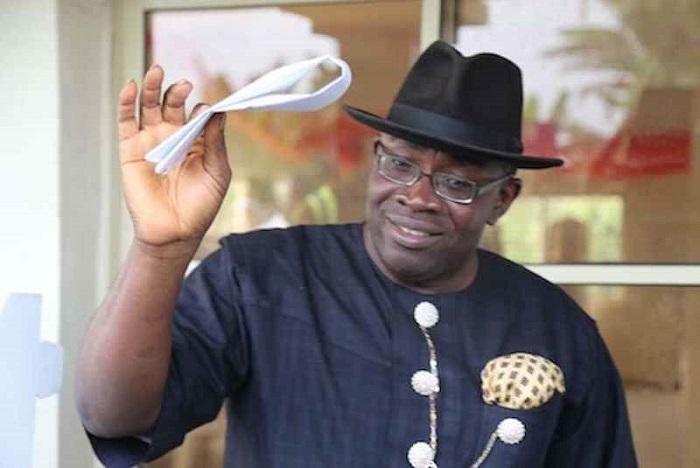
ABUJA — Senator Seriake Dickson (PDP, Bayelsa West) has strongly criticized President Bola Tinubu’s handling of the political crisis in Rivers State, accusing him of aiding the erosion of democratic values while simultaneously celebrating Democracy Day.
Addressing journalists in Abuja shortly after President Tinubu’s Democracy Day speech at a joint session of the National Assembly, the former Bayelsa State Governor condemned what he described as the federal government’s tacit support for an unconstitutional power structure in Rivers State.
“You cannot flaunt yourself as a democrat on one hand and trample democracy under your big presidential foot on the other,” Dickson said. “We are celebrating democracy today, yet Rivers State is effectively under military rule.”
Dickson likened the situation in Rivers to a “military-style suppression of democracy” and denounced the President’s silence on what he called a constitutional crisis in the state.
“The unfolding situation in Rivers State since March is nothing short of a State of Emergency. Federal power is being used to override civil authority and subvert the rule of law,” he stated.
The senator criticized President Tinubu’s Democracy Day speech, arguing that while it celebrated Nigeria’s journey from military to democratic governance, it failed to reflect the troubling political realities.
“Happy Democracy Day to all Nigerians,” he said. “But one must ask: are we truly happy? Democracy should inspire hope. What we saw today in the Senate was a direct assault on that hope.”
Dickson’s remarks followed President Tinubu’s letter to the Senate earlier in the day, which was read by Senate President Godswill Akpabio during a brief session lacking a detailed Order Paper. The letter concerned appointments to key commissions in Rivers State: the State Electoral Commission, Local Government Service Commission, and the Civil Service Commission.
The senator claimed that his attempt to raise a constitutional point of order was deliberately suppressed.
“My right as a Senator to raise a constitutional issue was completely disregarded,” Dickson said. “The Senate President rushed through the President’s message and ignored my intervention. That’s not how democracy works — that’s how military regimes operate.”
He said the timing of the communication, read on Democracy Day, was especially ironic.
“On a day meant to celebrate civil authority, the Senate is endorsing actions that undermine the Constitution. Why read this message today, if not to send a chilling signal that constitutionalism can be suspended for convenience?”
Dickson criticized the government for preaching democracy while practicing autocracy.
“The President’s speech was eloquent, beautifully written — but deeply disconnected from Nigeria’s political reality. You cannot preach democracy and then remain silent when democracy is being trampled in Rivers State.”
He emphasized that his criticism was not partisan but a principled defense of democratic rights.
“This is not about Fubara. This is not about party. It is about the democratic rights of the people of Rivers State. Today, it is Rivers. Tomorrow, it could be Lagos or Kano. If we normalize this, we endanger democracy across Nigeria.”
Dickson also condemned the Senate’s decision to accept the President’s communication without scrutiny or debate, particularly on such a symbolic day.
“I have a right as a senator to raise a point of order and be heard. This is not about numbers. This is about principle. Majorities cannot trample minority rights. That is not democracy.”
Referencing his maternal roots in Ijebu, Dickson warned that the continued centralization of power and disregard for constitutional governance would not go unchallenged.
“Words don’t show democratic commitment. Actions do. No one can monopolize power forever.”
He urged Nigerians across party lines, ethnic backgrounds, and regions to stand in defense of democracy.
“This isn’t just about one state or one governor. It’s about our collective future. The struggle of June 12 wasn’t just about voting — it was about dignity, justice, and the voice of the people. We must not betray that legacy.”
Disclaimer
Comments expressed here do not reflect the opinions of Vanguard newspapers or any employee thereof.