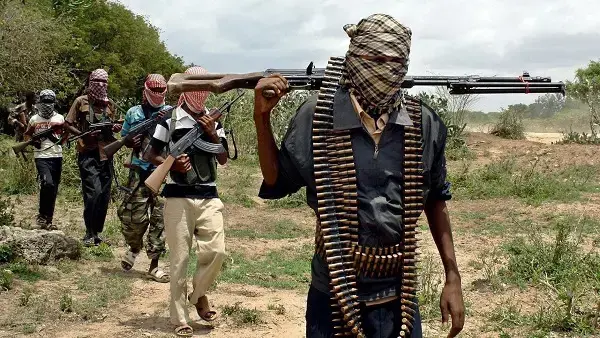
File image of bandits
By Esther Onyegbula
A coalition of civil society organizations from Nigeria’s Southeast has raised alarm over what they describe as a surge in violent attacks by armed bandit herdsmen across the region, accusing federal and state authorities of selective justice and systemic neglect.
In a joint press statement issued on Saturday, May 10, the coalition, comprising at least eight groups, including Nchekwa Ndi Ogbenye Foundation, RULAAC, and Vision Spring Initiatives, condemned what they called “incessant and unchecked” assaults on communities in Abia, Anambra, Ebonyi, Enugu, and Imo states.
According to the groups, recent attacks have led to killings, kidnappings, destruction of farmlands, and mass displacement of residents. They allege that while federal security agencies routinely conduct heavily armed operations against groups like the Indigenous People of Biafra (IPOB) and its security wing, the Eastern Security Network (ESN), similar urgency is absent when it comes to protecting rural communities from suspected Fulani herders.
“These attacks are not isolated incidents but part of a broader pattern of violence and impunity that has gone largely unaddressed by the Nigerian state,” the coalition stated.
The statement cited several recent incidents:
In Abia State, communities in Isuikwuato, Umunneochi, and Obingwa LGAs have reported persistent kidnappings and farmland destruction.
In Anambra, residents of Ayamelum and Orumba North are said to be abandoning their farms due to escalating herder violence.
In Ebonyi, suspected Fulani herders reportedly killed residents in Amegu village, Nkalaha community of Ishielu LGA
In Enugu, invasions in Eha-Amufu and Uzo-Uwani have led to multiple deaths and mass displacement.
In Imo, repeated attacks in the Okigwe zone and along the Owerri–Ngor Okpala–Aba road, including the kidnapping of passengers in commercial vehicles, have sparked widespread fear.
The coalition also accused state authorities of penalizing local communities that attempt to defend themselves. Citing a 2020 incident in Ezinihitte Mbaise, Imo State, they claimed residents were forced to pay compensation to herders whose cattle were injured after invading farmlands, despite no restitution for the affected farmers.
Quoting Section 14(2)(b) of the Nigerian Constitution, the groups emphasized that “the security and welfare of the people shall be the primary purpose of government.” They accused law enforcement agencies of failing in this duty and highlighted what they consider a discriminatory pattern of enforcement.
They also criticized the continued militarization of civilian spaces in the Southeast, saying the proliferation of security checkpoints has led to widespread extortion and harassment of locals, which remains uninvestigated.
Furthermore, the statement decried the federal government’s failure to designate violent herdsmen as terrorists under the Terrorism (Prevention and Prohibition) Act, 2022, despite “widely documented acts of terror.”
The civil society groups presented a five-point demand to government authorities:
Equitable enforcement of criminal laws without ethnic or political bias.
Immediate investigations and prosecutions of perpetrators of herdsmen violence.
Demilitarization of civilian areas in the Southeast and accountability for security misconduct.
Immediate convening of regional security summits involving communities, traditional rulers, and stakeholders.
Strengthened legal aid and support for victims through collaboration with the National Human Rights Commission, Legal Aid Council, and Nigerian Bar Association.
The statement concludes with a stern warning: “Our people deserve the protection of the law and the fairness of its application. The continued failure of state and federal institutions to confront this threat undermines the integrity of our democracy and the rule of law.”
As tensions rise across the Southeast over security concerns and perceived federal neglect, the call by these civil society groups adds to growing pressure on Nigerian authorities to act decisively in protecting vulnerable communities from escalating violence.
Disclaimer
Comments expressed here do not reflect the opinions of Vanguard newspapers or any employee thereof.