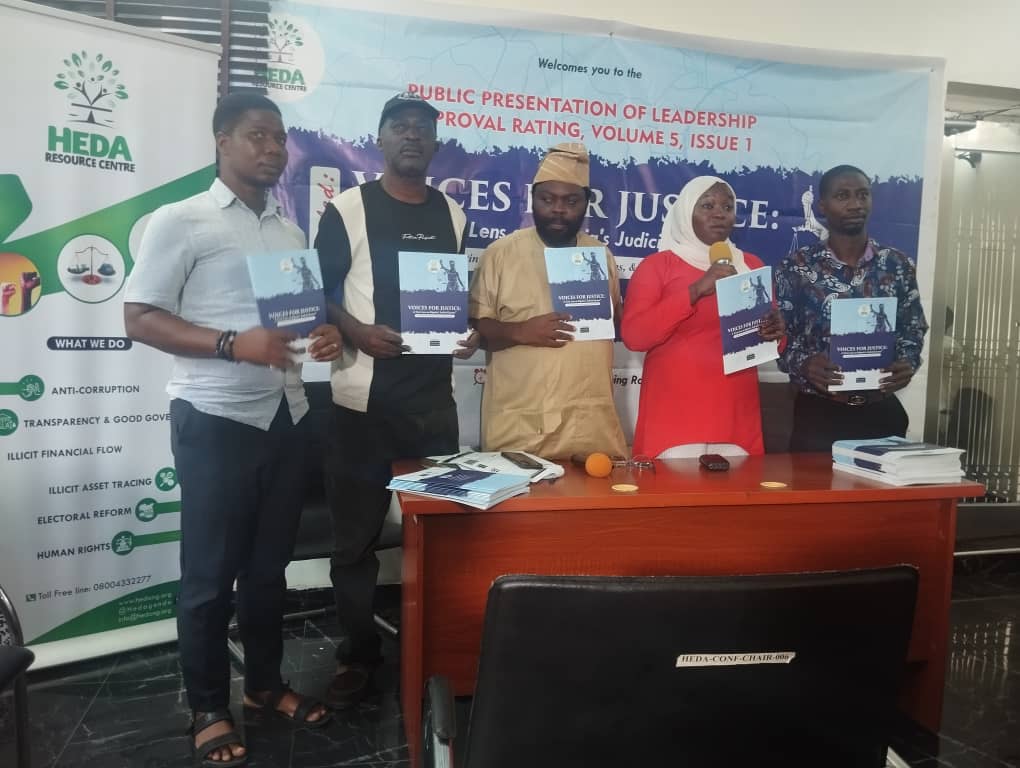
A non-governmental organisation, Human and Environmental Development Agenda, HEDA Resources Centre, has made a case for judicial independence, saying financial dependence is a threat to the fairness and impartiality of Nigerian judiciary.
HEDA Resources Centre said this in Lagos at the presentation of Volume Five of its Leadership Approval Rating, LAR, report, which showed that corruption and bribery, delays and bureaucracy as well as mixed customs had been normalised in the justice system.
The report titled: ‘Voices for Justice: a Civic Lens on Nigeria’s Judicial System – Documenting Public Experiences, Opinions & Reform Demands,’ showed that among 266 respondents who had direct encounters with court officials on various issues, 130 persons admitted to sorting officials to expedite services.
Besides, the report said: “When asked (1,357 participants across all 36 states and the Federal Capital Territory, FCT) to rate court accessibility on a scale of one to five, most respondents leaned towards the lower end, with 18.7 per cent it 2 and 17.8 per cent gave it the lowest score of one. Only 11.8 per cent found the courts highly accessible, highlighting concerns and barriers to justice.
“Respondents were askeid to narrate in short open-ended paragraphs, their experiences with the judicial workers Respondents detailed various experiences, including bribery, procedural delays, and unfair rulings. Many felt that justice favours those who can afford to pay, while others lamented bureaucratic inefficiencies and unprofessional conduct by judicial staff.”
Meanwhile, the Executive Secretary of HEDA Resource Centre, Mr Sulaimon Arigbabu, who presented the report alongside another titled: ‘A Compendium of 100 High Profile Corruption Cases in Nigeria (as at November 22, 2024), also said given the organisations findings, the Nigerian judiciary faced a serious credibility crisis.
Arigbabu said: “Allegations of corruption, inefficiency, and political interference have significantly eroded public confidence in this institution. This is not a theoretical or abstract concern; it is a daily reality for millions of Nigerians who turn to the courts to defend their rights, seek redress, resolve conflicts, arbitrate in corporate disagreements, and pursue justice. When public trust in the judiciary is compromised, the very legitimacy of our democratic framework is at stake.”
He, however, recommended that there be full judicial autonomy, reforming the National Judicial Council to enhance its effectiveness, leveraging technology to increase transparency.
According to him, “and fostering ethical professionalism within the judiciary and legal practices. These are not mere suggestions; they are imperatives for restoring public trust and safeguarding the integrity of our administration of justice.”
Disclaimer
Comments expressed here do not reflect the opinions of Vanguard newspapers or any employee thereof.