By Rita Okoye
Distinguished historian and scholar Professor Toyin Falola has called for greater recognition of African women’s roles in shaping political and social justice movements.
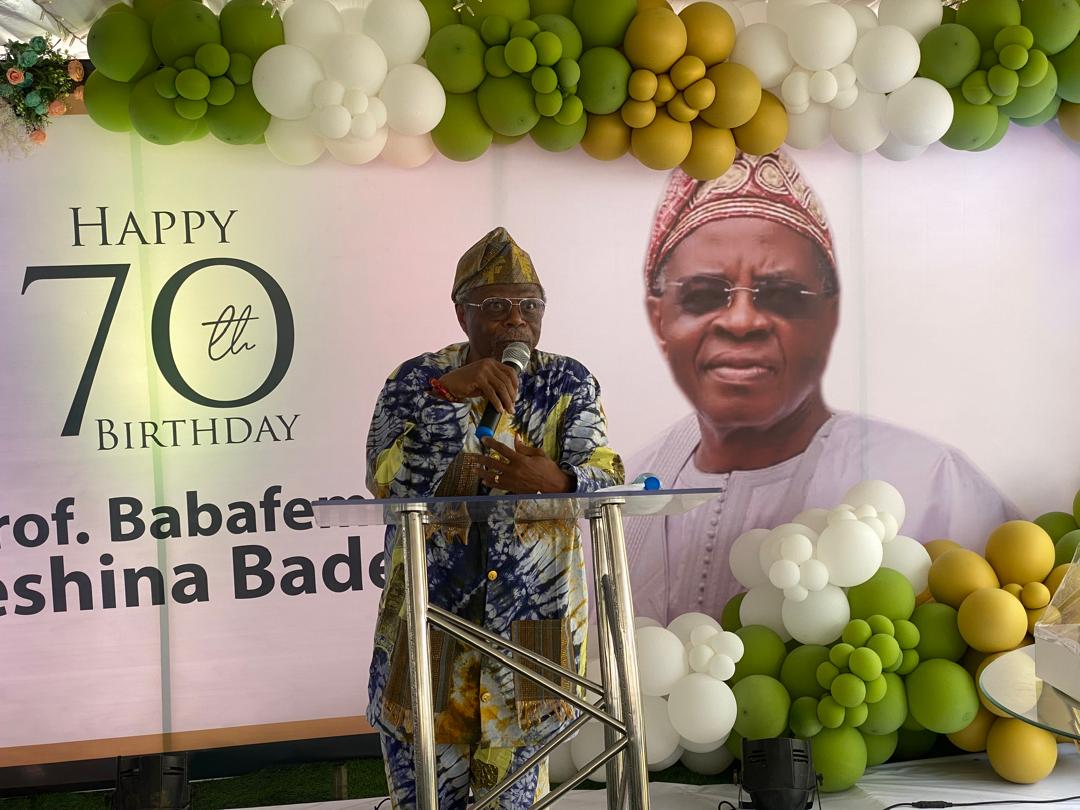
Delivering a compelling lecture titled “Power, Privilege, and Philosophy” in honor of diplomat Femi Badejo’s 70th birthday at UNILAG Estate on Saturday in Lagos, Falola highlighted the historical and contemporary contributions of African women to the fight for justice, equality, and liberation.
A globally respected historian and Jacob and Frances Sanger Mossiker Chair in the Humanities at the University of Texas at Austin, Falola has spent decades researching and documenting African history, politics, and culture.
In his lecture, Falola emphasized that African women have been central to struggles for social justice, environmental sustainability, and economic equity.
“African women have been significant political players in promoting justice and equality, from the anti-colonial struggles of the mid-20th century to ongoing efforts against gender-based violence and economic inequality,” he stated.
He cited the indelible contributions of Funmilayo Ransome-Kuti, who championed women’s rights and independence in Nigeria, and Wangari Maathai of Kenya, whose environmental activism was deeply tied to women’s empowerment. Despite their influence, Falola noted that their contributions are often overlooked in dominant historical narratives.
Falola critiqued Eurocentric feminist paradigms, arguing that African feminism must be understood on its own terms rather than through Western frameworks. He referenced scholars such as Olajumoke Yaqob-Haliso, Oyeronke Oyewumi, and Nkiru Nzegwu, whose work has shed light on the unique gender dynamics of African societies.
Drawing on Oyewumi’s seminal book, The Invention of Women, Falola noted that many African societies, including the Yoruba, originally did not organize power strictly along gender lines. Instead, factors like age and seniority determined social roles. However, colonial rule imposed Western gender norms, creating new inequalities that politically and economically marginalized African women.
“African feminism is not simply about gender—it is about dismantling a complex system of power shaped by race, class, and colonialism,” he remarked.
Falola criticized the top-down approaches of Western NGOs, which often impose foreign solutions without considering the lived realities of African women.
“The struggle for gender equality in Africa must be rooted in local traditions and historical realities rather than imported ideologies that overlook African perspectives,” he stated.
Falola also explored the concept of womanism, a framework introduced by African American writer Alice Walker, which emphasizes the intersectionality of race, gender, and class while recognizing the strength and agency of African women. He explained that womanism aligns closely with African feminist thought, as it acknowledges not just gender struggles but also broader systemic inequalities.
“African feminism has never been about gender alone; it has always been about survival, justice, and collective liberation,” Falola explained.
He urged contemporary feminist movements in Africa to honor the resilience of African women by centering their voices and developing solutions rooted in their realities.
Falola called on scholars, policymakers, and activists to engage deeply with African feminist philosophies and recognize the historical and ongoing leadership of African women in social justice movements.
“These are not just theoretical debates—they are about shaping real policies and actions that reflect African realities,” he emphasized.
His lecture reinforced the urgent need to amplify African women’s voices in shaping political, social, and economic transformations across the continent.
Disclaimer
Comments expressed here do not reflect the opinions of Vanguard newspapers or any employee thereof.