By Rita Okoye
Foremost public intellectual and eminent historian, Professor Toyin Falola has described Nigeria’s healthcare system as a national tragedy, failing millions of citizens due to chronic underfunding, mismanagement, and government neglect.
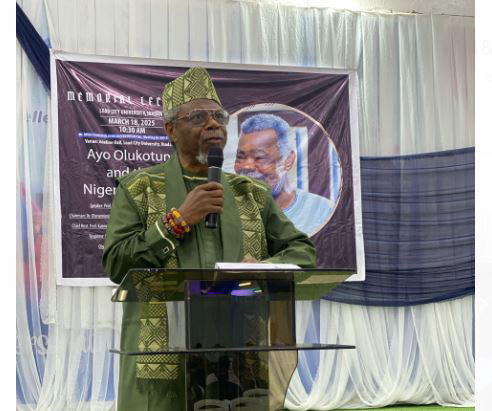
The renowned scholar stated this while speaking at the Prof. Ayo Olukotun Memorial Lecture, held on Tuesday, March 18, 2025, at Adeline Hall, Lead City University, Ibadan. With a lecture titled ‘Ayo Olukotun and the Nigerian Nation’, Falola condemned the deplorable state of the country’s hospitals, describing them as “undertakers, where unlucky patients are sent to their graves.” He warned that the nation’s healthcare crisis is deepening, exacerbated by a mass exodus of medical professionals seeking better opportunities abroad, leaving citizens at the mercy of a failing system.
Falola painted a grim picture of Nigeria’s hospitals, describing them as death traps where patients face untold suffering due to inadequate medical care, lack of essential drugs, and chronic underfunding. He decried the inexcusable decay of health infrastructure, mismanagement of resources, and absence of political will to enact real reforms.
In his characteristic bluntness, he likened Nigerian hospitals to “undertakers, where unlucky patients are sent to their graves.” His statement underscored the dire consequences of a system that has failed its citizens, leaving millions at the mercy of an underfunded, inefficient, and poorly equipped healthcare sector.
The crisis, he noted, is not just about failing hospitals but extends across virtually every department of social and economic service delivery. According to him, the country’s dysfunctional healthcare system reflects a broader pattern of governance failure, where policies are implemented without strategic vision, and institutions crumble under the weight of corruption and neglect.
Falola further lamented the alarming brain drain that has worsened the healthcare crisis, with highly skilled Nigerian doctors and nurses leaving en masse to seek better opportunities abroad. He warned that if this trend continues unchecked, Nigeria risks becoming a country unable to provide even the most basic medical services for its people.
According to him, the best-trained Nigerian medical professionals now work in hospitals across the United States, the United Kingdom, and Canada, while their home country remains in a perpetual state of health crisis. This mass exodus, he noted, is driven by low wages, lack of professional development opportunities, poor working conditions, and government indifference to the plight of healthcare workers.
Beyond the decay of public hospitals, Falola took direct aim at Nigeria’s political class, condemning their habit of seeking medical treatment abroad rather than addressing the health crisis at home. He pointed out that while millions of Nigerians die due to preventable and treatable diseases, political leaders spend billions of naira on medical tourism.
“Our politicians have enough resources to escape the medical bedlam at home by jetting abroad now and then for treatment,” he stated. His words carried a heavy weight of frustration and anger at the hypocrisy of Nigeria’s ruling elite, who fail to invest in the country’s health system yet comfortably receive world-class care overseas.
Falola called for urgent and radical healthcare reforms, insisting that Nigeria can no longer afford to treat healthcare as an afterthought. He emphasized the need for increased budgetary allocation to health, massive investment in modern medical infrastructure, and a drastic improvement in the training and remuneration of healthcare workers.
Without these critical interventions, he warned, the nation’s health sector will continue to deteriorate, leaving even more Nigerians to suffer and die from preventable causes. He criticized government officials for their lack of commitment to reform, stating that their continued reliance on foreign healthcare exposes their disinterest in fixing the broken system at home.
“It is crying shame that leaders who should be driving these changes would rather seek treatment abroad,” he concluded, leaving no doubt about the urgent need for accountability and reform in Nigeria’s healthcare sector.
His remarks resonated deeply with the audience, many of whom acknowledged the dire need for systemic change. The Prof. Ayo Olukotun Memorial Lecture, attended by scholars, policymakers, and members of the Nigerian intelligentsia, became a powerful forum for reflecting on the devastating failures of Nigeria’s healthcare system and the need for immediate corrective action.
Disclaimer
Comments expressed here do not reflect the opinions of Vanguard newspapers or any employee thereof.