By Kunle Awosanya
A student at Michigan State University (MSU) in the United States, Sunday Imosemi, has made a significant contribution to the field of transportation safety with his groundbreaking research that has advanced our understanding of the effectiveness of various speed management strategies.
Imosemi, under the supervision of MSU Foundation Professor Dr. Peter Savolainen, has developed a new approach that goes beyond the traditional use of the 85th percentile speed method in establishing speed limits.
Instead, this approach focuses on designing for “target speeds”, which are achieved by designing roadway features with an explicit consideration of those features’ impacts on speeds.
This research reflects a shift toward creating safer road environments through strategic roadway design, appropriate speed limits, educational initiatives, and enforcement measures to benefit all road users, including pedestrians, cyclists, and motorists.
Funded by the Minnesota Department of Transportation, the research investigates how drivers adjust their speeds when transitioning from high-speed highways to lower-speed rural and suburban roadways.
Using handheld lidar guns to measure speed transitions across different roadway types, Imosemi’s study focused on understanding how various roadway characteristics impact driver behavior and contribute to speed reduction.
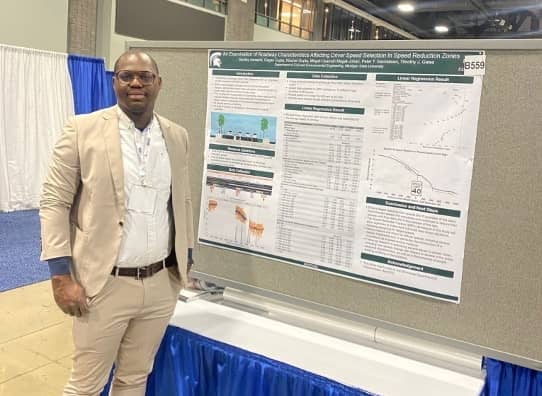
Imosemi recently presented his findings at the prestigious Transportation Research Board (TRB) Annual Meeting in Washington D.C., a global gathering of transportation research leaders, where he showcased a study offering valuable insights into how roadway design can naturally influence driver behavior, leading to reduced speeds and enhanced safety.
This latest study has introduced a new concept, Speed Reduction Factors (SRF), which quantifies the impact of specific site characteristics on vehicle speeds, providing transportation agencies with a more refined tool for predicting and managing speed reductions across various contexts.
The study’s findings also identified several key roadway features that effectively reduce speeds and promote safer driving conditions. Notably, the introduction of single-lane roundabouts was found to reduce speeds by an average of 7 mph.
Other features contributing to speed reduction included two-way left-turn lanes, which lowered speeds by 0.7 mph, depressed medians with a 1.2 mph reduction, and raised medians, which resulted in a 3.1 mph decrease in vehicle speeds.
Further analysis in the study revealed important patterns in how drivers adjust their speeds when approaching lower-speed areas, with drivers typically beginning to reduce their speed approximately 800 feet before reaching posted speed limit signs and continuing to decelerate for about 400 feet beyond the sign.
This suggests that a combination of road design features and driver anticipation of speed changes can play a crucial role in improving safety and ensuring smoother transitions from higher to lower-speed zones, with the study also finding that the presence of speed-reducing features, such as medians and roundabouts, was associated with lower speed variability, directly contributing to greater traffic stability and overall safety.
The research further emphasized the importance of incorporating these findings into broader speed management policies, suggesting that by considering how roadway features can naturally influence driver behavior, transportation agencies can design and implement roads that are not only safer and more efficient but also more accommodating for a diverse range of users.
Additionally, the development of SRFs offers a more detailed understanding of the factors influencing speed management, which can be applied across various road types, from urban streets to rural highways.
Imosemi’s work represents a shift towards a more proactive, data-driven approach to speed management, aligning with a broader movement in transportation safety that prioritizes the integration of design, technology, and education to reduce accidents and save lives.
As transportation agencies and city planners continue to adopt these insights, the vision of safer, more stable, and more accessible roadways for all users is becoming increasingly achievable.
In conclusion, this study not only emphasizes the vital role of innovation in road safety but also underscores the invaluable contributions of academic research in shaping the future of transportation.
It highlights that by recognising the dynamic relationship between roadway characteristics, driver behaviour, and safety outcomes, this work represents a crucial step towards creating a more sustainable and safer transportation system.
As speed management strategies continue to evolve, it is anticipated that Imosemi’s research will play a pivotal role in transforming our approach to roadway design and traffic management in the years ahead, marking a defining moment in the field.
Disclaimer
Comments expressed here do not reflect the opinions of Vanguard newspapers or any employee thereof.