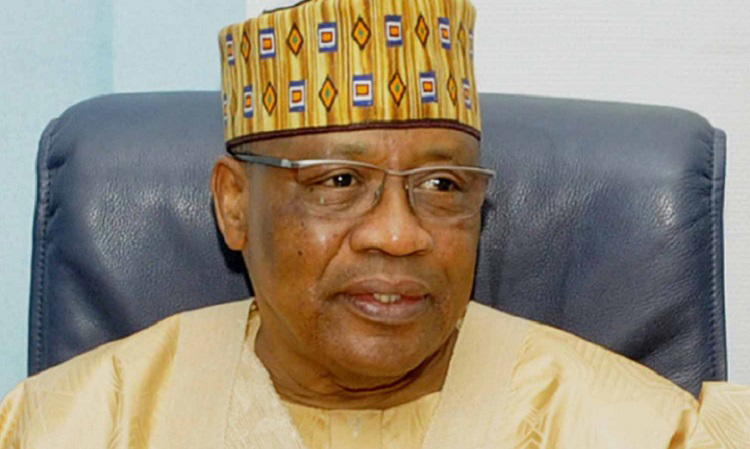
IBB
By SUNNY IKHIOYA
At long last, the much-awaited book by former President Ibrahim Babangida titled, A journey in Service, was launched last week and the man did not disappoint with the quality and quantity of people who graced the occasion. It confirms what we all know of IBB as a man of charisma, a strong man in this country, even out of government. His tentacles extended everywhere, and both ruling and opposition parties were in competition to be present. Past and current rulers were not left out. It was a crowning moment for IBB; but did he deliver?
Babangida waited this long to tell his story because he knew nothing had changed. With his disclosure, the nation has come full circle to square one. He stated in his book: “I have allowed time to pass. Three decades is a generous allowance. It was necessary to allow a cooling-off period so that the generation that witnessed our days in office would have had time to reflect, to experience other administrations, and be in a position to situate our contributions correctly. It has also been time enough to allow a new generation, those now in their twenties and early thirties, to relate to our tenure as part of national history. I believe our youth should be allowed to make their own judgments about the various stages of our national history.”
The man is right. People are beginning to make their own judgements. A friend in a group WhatsApp page wrote: “When IBB was in office, Nigeria was a fun to behold. That was when I acquired a tear-rubber, a brand new Volkswagen Santana car, in 1985 to celebrate my qualification as a Chartered Accountant.” Would you blame him? Going through the book and analysing measures taken towards solving the nation’s challenges, you will find out that nothing is new. What this government is giving today to us as solutions are total rehash of what IBB did over 32 years ago. I give you some instances: “We knew, for instance, that family incomes had taken a hit. We knew that the cost of transportation was escalating and putting pressure on the cost of living and doing business, even at the most elementary levels. We knew the general price levels had risen in response to the deregulated foreign exchange regime. We also realised that many small to medium enterprises were being strangled by the general atmosphere of stiff economic competition. But we were in no
mood to abandon course and revert to old, easier ways” (page 172). Does this sound familiar? Now take another one: “We needed to accept the implications of a fundamental change in our economic system. It was evident that when you suddenly migrate from a subsidised mixed-economy model to a free-market one, the forces of economic competition are bound to force some of the populace to the fringes. The rich would get richer, and the poor even poorer. The poor would feel crushed and suffocated” (P 173). And yet another one: “We were aware of the pressures from real hardship and political quarters. Therefore, even ahead of the SAP riots and protests, the administration had begun to consider specific palliative measures and a bouquet of ameliorative mechanisms and institutions to cushion the effects of the more severe impacts of SAP on the populace.”
Babangida’s book touched on the issue of sectionalism in the January 1966 coup. But some people have taken his statement to the market that it was not an Igbo coup. That is where our perception and reality are in conflict in this book. In reality, the coup was not initiated as an Igbo group, but its execution presented another story, which different interests groups have been debating on till this day. Babangida, in his usual manner, tried not to offend any group, but he ended up pacifying no one. He wrote: “As a young officer who saw all of this from a distance, probably, ethnic sentiments did not drive the original objective of the coup plotters. For instance, the head of the plotters, Major Kaduna Nzeogwu, was only Igbo in name. Born and raised in Kaduna, his immigrant parents were from Okpanam in today’s Delta State, which in 1966, was in the old Mid-Western Region. Nzeogwu spoke fluent Hausa and was as ‘Hausa’` as any! He and his original team probably thought, even if naively, that they could turn things around for the better in the country.” This is correct, but if you add the follow-up pages, you will understand that some people really screwed up the whole process with their own interests.
“Unfortunately, some of the decisions of the Central Command in Lagos fed into into fears of those who suspected imminent domination. For instance, in late May of that year, General Aguiyi Ironsi-led Federal Government was convinced that the best way to unify the country was to issue the Unification Decree No. 34 of 1966, abolishing and replacing the regions with a group of 35 provinces. That decree also unified the Civil Services. Decree 34 was a significant disadvantage to the North, considering its inadequacy in human resources. This further fuelled the fears of a Southern domination of Northern Nigeria and, subsequently, the entire country. Whether these fears of power domination were unfounded or not, it was clear that something was about to give from the sequence of cascading events”.
Put in perspective, the mistake of the counter- coup would have been averted if the then leadership had done the right thing. Quoting Babangida again: “The first coup attempt, which led to the counter-coup, should never have occurred. The young, idealistic officers bit off more than they could chew. Without question, both events, the first coup and the counter-coup, deepened the distrust among ethnic groups in the country, distrust that continues to plague us to this day. But, even more fundamentally, those coups led to one of the bloodiest fratricidal conflicts in modern Africa, the 30-month Nigerian civil war, with devastating consequences that we have never fully recovered from as a country.”
I believe we should concentrate on rebuilding, reintegrating all interest groups in the country instead of opening old wounds and engaging in unnecessary debates. Going through the book, one can only reach one conclusion: Nigeria has come full circle, nothing has changed. That is the reason why the man can confidently tell us stories that we already know. He did it the Maradona way, neither here nor there, and in the end leaving the questions hanging in the air. What did I see? A man who was supposed to be in seclusion, having been forced out of office in a very unpopular manner and causing severe disruption to our political progress, came out shining as a rose. Everyone who is relevant in the system was there to honour him. Past tormentors and victims were all seated in one place, backslapping – in warm embrace. What did it tell us? The hoi-polloi will continue to wallow in their own world fighting against each other, while the leaders and elites are united in their own world.
Professor Yemi Osinbajo couldn’t have put it better in his book review.
Let me close with Babangida again: “Most times, human beings don’t handle power well, and the only guarantee against power abuse, in the absence of a vibrant civilian and civil society leadership are effective and responsive institutions that can promote sustainable socio-economic development. Institutions matter even if building them in developing societies like ours takes time. But institutions matter because they endure; they
will outlive us. Again, we should strive to build enduring institutions. ”
This is true, and is the lesson the present leadership should imbibe.
*Ikhioya wrote via: www.southsouthecho.com
Disclaimer
Comments expressed here do not reflect the opinions of Vanguard newspapers or any employee thereof.