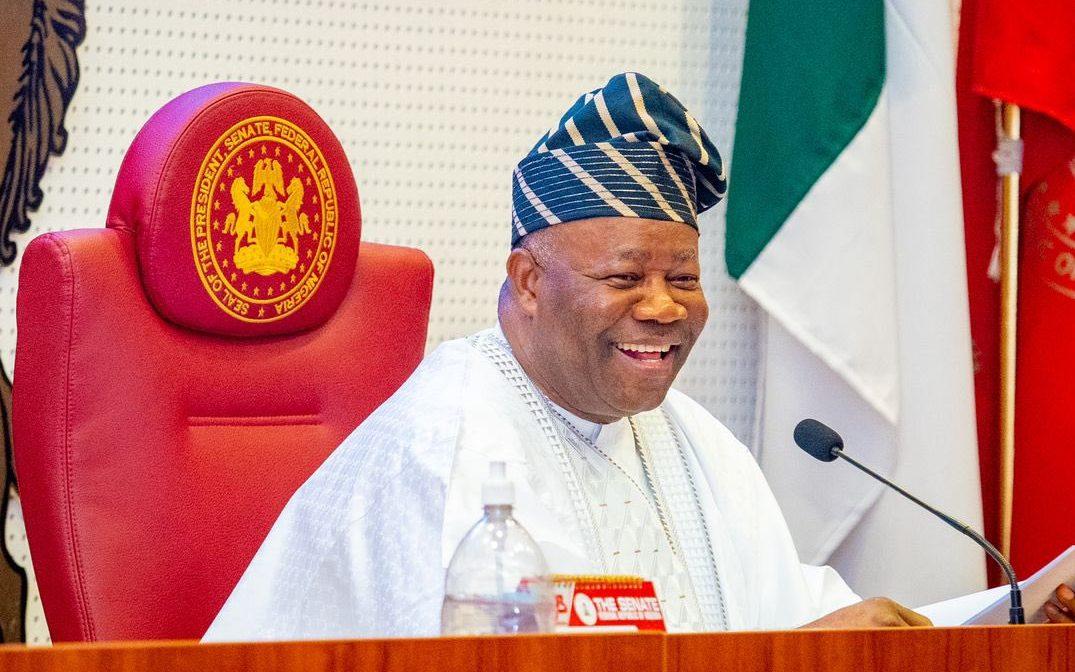
Senate President, Akpabio
By ADAMU RABIU
The contemptuous manner the leadership of the 10th Nigerian Senate under its President, Senator Godswill Akpabio, handles female senators, is a cause for concern. Frankly, we should be ashamed that in a country where men and women are almost of equal number, out of 108 elected senators (excluding the late Senator Ifeanyi Uba), only four are women. The remaining 104 senators in Nigeria are men.
Looking at the gender configuration of the Senate statistically, female senators constitute approximately four percent of the entire 10th Senate. In terms of ratio, it is one female senator to 27 male senators or 0.037, showing that the number of women in the Nigerian Senate is very insignificant.
On top of this consequential numerical disadvantage, I have never seen any other parliament in the whole world where women parliamentarians are treated the way they are being treated in the current Nigerian Senate led by Senator Akpabio. Recently, the Senate, which is gradually becoming “a theatre of the absurd,” witnessed yet another uproar over the attempt to relocate the seat of Senator Natasha Akpoti Uduaghan in the Senate Chamber without her knowledge. The fearless Senator representing Kogi Central vehemently protested against the relocation of her seat, but the Senate President ignored her. She rejected the change in the sitting arrangement and refused to relocate to another seat.
The Chief Whip of the Senate, Senator Mohammed Monguno through a point of order cited sections of the Senate Standing Rules, to justify the relocation of Senator Natasha to another seat. Monguno explained that the adjustments made in the sitting arrangement were necessary to accommodate the changes caused by the defection of some opposition members to the majority party, the All Progressive Congress, APC. According to the Chief Whip, the changes fell within the constitutional prerogative of the Senate President. He warned that Senator Natasha could be penalised and even prevented from participating in the Senate proceedings, if she refused to relocate to her new seat.
When it was obvious that no threat could sway the fuming Senator Natasha, Akpabio ordered security operatives to remove her from the Senate Chambers so that they could continue with the day’s proceedings. The order was not carried out. Regardless, Akabio begged the senators not to take offence and proceeded with the proceedings of the day, assuring that her issue would be addressed at the appropriate time. Since then, the media have been agog with accusations and counter- accusations by both the Senate and Senator Natasha. Their supporters have also been hurling brickbats at each other.
This is not the first or second clash between the President of the Senate and a female Senator in less than two years of the 10th Senate. About two months ago, Senator Ireti Kingibe walked out of the Chambers after Akpabio prevented her from raising a motion regarding the demolition of properties in the Federal Capital Territory, FCT, Abuja by the Minister, Nyesom Wike. The video of the incident sparked outrage among young Nigerians on the internet, who accused Akpabio of high-handedness and disrespect for female lawmakers.
Prior to Ireti’s walkout, Akpabio berated Senator Natasha for attempting to speak during plenary without his permission, reminding her that “the Senate is not a night club.” He later apologised, saying his wife, who he respects so much, brought the matter to his attention. But, if Akpabio respects his wife, who is a housewife so much, what stops him from respecting a fellow Senator of the Federal Republic of Nigeria of the same gender with his wife? I leave this question for my readers to answer.
Similarly, I would not want to support or condemn anybody for the needless recent seat relocation brouhaha in the Senate. However, I think time is ripe to let Akpabio know that he is presiding over the Nigerian Senate and not the Akwa Ibom State House of Assembly. Anybody ridiculing the Senate for whatever reason is ridiculing the National Assembly and by extension, the Nigerian nation.
There are more important things to discuss in the Senate at this critical time of our national life than an issue as inconsequential as sitting arrangement, no matter what precipitated it. Whatever the reason might be, a Senator of the Federal Republic of Nigeria deserves to know beforehand an impending change in the sitting arrangement in the Chambers, more so, a female Senator, knowing the torture that they endured to get to the National Assembly. I will reserve my comments on constitutionality or otherwise of the embarrassing defections in both Houses of the National Assembly for another day.
The Senate President should please be careful about the way he treats the women in the Senate, particularly the ones who are not from his party. No party is bigger than the people who they represent. Even if all the 109 senators are of APC, the National Chairman, Abdulahi Ganduje cannot preside over the Senate, even for ceremonial purposes, unless all the Senators pass a resolution, permitting him to do so. One must be elected by the people to participate in the proceedings of the Senate or the House.
The National Assembly, consisting of the Senate and the House of Representatives is a product of Section 47 of the 1999 Constitution of Nigeria (as amended). This section is seen under Chapter V(five) of the Constitution. Section 48 says that: “The Senate shall consist of three Senators from each State and one from the Federal Capital Territory.” Section 49 says that “Subject to the provisions of this Constitution, the House of Representatives shall consist of three hundred and sixty members representing constituencies of nearly equal population as far as possible, provided that no constituency shall fall within more than one State”.
Section 50-(1) (a) creates the offices of the Senate President and Deputy Senate President, who are to be elected by the Senators from among themselves, while (b) creates the offices of the Speaker and Deputy Speaker of the House of Representatives, who are to be elected by members of the House, also from among themselves. Section 5-(2) lists the conditions under which the aforementioned principal officers should vacate their office.
The Constitution is the grund norm. I have not seen anywhere the Constitution says that the principal officers of the Senate and House of Representatives are superior to other lawmakers in their respective Chambers. Under normal circumstances, presiding officers are seen as “primus inter pares” (first among equals). They occupy a position of influence, not power. While influence and power can change things, they differ significantly, for those who understand.
In the legislative process, a presiding officer can only vote when there is a tie among the ayes and the nays. If a presiding officer feels very strongly about an issue and wants to vote at the first instance, he steps aside for somebody else to preside. This is the practice in the advanced democracies.
That the presiding officer sits on the “elevated dais” wielding the gavel, should not be misconstrued as an evidence of his or her superiority over colleagues. Sitting in an elevated position gives the presiding officer the vantage position to observe clearly what happens inside the hallowed Chambers during proceedings. The power lies with the entire House.
There are no special privileges granted to the principal officers in the National Assembly by the Constitution. Like other lawmakers, they are expected to declare their assets and liabilities before taking “Oath of Allegiance” and “Oath the membership” as prescribed by the Seventh Schedule of the Constitution. That the principal officers administer oath on other lawmakers does not make them superior to their colleagues. Don’t forget that the other lawmakers, prior to being sworn in, participated in the election of the principal officers who took their oaths before the Clerk of the National Assembly.
Section 53-(1) and (2) of the Constitution deal with the issue of presiding at the sittings of the National Assembly and joint sittings. In the case of the Senate, the President of the Senate presides and in his absence, the Deputy Senate President presides. In the case of the House of Representatives, the Speaker presides and in his absence, the Deputy Speaker presides. In the case of joint sittings, the President of the Senate presides and in his absence, the Speaker presides. In the absence of the Senate President and the Speaker, the Deputy Senate President presides. In the absence of the Deputy Senate President, the Deputy Speaker presides. Sincerely, I believe that Senator Akpabio knows all these things as a ranking Senator and a lawyer.
In conclusion, I urge Akpabio to understand that he is no longer the Governor of Akwa Ibom State or the Minister of Niger Delta. The Senate is also not an assembly of school boys and girls. A Senator should not be denied entitlements and privileges because the leadership does not like the person’s face. Finally, senators should resist any form of pressure to suspend Senator Natasha from the Senate. It is shameful that when the world is talking about gender balance in governance, the few women that managed to get to top leadership positions in Nigeria are treated as people wearing their clothes backwards by accident. This should stop.
*Dr. Nzomiwu, the Director of Media and Publicity, Development Communication Research Association of Nigeria, DECRAN, wrote via: [email protected]
Disclaimer
Comments expressed here do not reflect the opinions of Vanguard newspapers or any employee thereof.