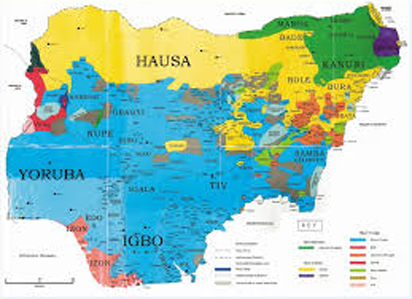
Map-of-Nigeria
By Kalu Ogbuagu
Despite fast progress in most aspects of life and development, the Nigerian society and government have resisted every trend in response to the rights and freedoms of people of unusual sexual orientation. There appears to be no future for this minority group in the country because the odds are comprehensively stacked against them traditionally, culturally, religiously and legally. Leaving them no elbow room to survive in this totally biased environment.
Each election cycle has thrown up even more belligerent leaders who rather than advocate for the rights of these minorities have gone ahead to criminalize them further in a way that has left Nigeria far behind the rest of the world. Sometimes it appears that the legitimacy and acceptability of the administration lies heavily on how tough the government grandstands against the LGBTQ community, making declarations that reduce people of irregular sexual orientation as human beings and legitimate members of the society.
The few who have braved it publicly, like the cross dresser, transgender and social media personality, Okuneye Idris Olarenwaju, popularly known as Bobrisky have faced
condemnation and shaming by the general public. In 2024 he/she was arrested and jailed in a male prison ostensibly for abusing the nation’s currency, the Naira, when he/she threw some notes around at a social event. He/she spent six months in prison for doing what most Nigerians do at celebrations and parties. The culture of spraying money on people who are celebrating is a well-known cultural trait of the Yorubas, Ibos and people in the southern parts of Nigeria. Although the federal government has been condemning it in recent years as a crime against the country’s currency, the first person that has been taken to court and sentenced to jail, curiously was Bobrisky. Was it because he/she is different?
There are thousands of others like Bobrisky, hiding in the shadows of Nigeria’s cultural intolerance, too afraid to own up to who they really are and thereafter live a ‘normal’ life. What is profound is that Nigeria is a country of religious extremity and hypocrisy. The North of the country is mostly populated by loud intolerant Muslims while the South is home to millions of Christian fanatics and hypocrites. Although adherents of the two major religions hardly agree on issues, they are surprisingly agreed on the point about eternal damnation for people of alternative sexual orientation and the fact that the Almighty has quietly appointed them to execute His disdain for these people here on earth.
Consequent to lesbianism, gay, bisexual, transgender and queer people in Nigeria, severe threats and challenges has always awaited the LGBTQ group in Nigeria and some African countries. Both male and female homosexuals are liable to jail terms of up to 14 years. There are no legal protections for LGBTQ people, who can be molested, violently attacked or even lynched by mobs if found to be engaging in the practices. Like many others, two known cases are told in utter shock the killing and dismembered body of the Abuja Area mama, who was a transgender and Tiktoker. He/she has cried out about the many threats to his/her life due to his/her LGBTQ activities, but murdered days after his/her cry for help.
Ms Roseline Ikhile is no less a familiar and industry’s personality whose identity and behaviour exposed the knowledge deficit of the layman about the activity of the LGBTQ. While many Nigerians have held the understanding that the activities of the LGBTQ is for survival and a way to satisfy the sex industry in multiple ways, Ms. Ikhile was a banker of repute and living a comfortable life.
Roseline discovered that she was a lesbian while in secondary school but of course could not find the courage to tell her parents or anyone outside her engaging same sex partners and orientation. Throughout her education and banking career, she kept her secret passion from the outside world until she ran out of luck one fateful day at her work place when she was caught making out with another woman in her office restroom. Unimaginably, all hell broke loose following public gossip! Fact-finding panels were set up to investigate her “strange” behaviour. She was to suffer grave personal threats of public shaming before she was finally eased out of her job, leaving her in shame and a-talk-about “Ikhile”
Typically, her social circle will diminish as even close friends and associates begin to distance themselves from her.
One bold gay activist, Davis Mac-Iyalla told the BBC how he was forced to flee Nigeria in 2008 because of death threats when he publicly declared his sexual orientation and has since taken residence in Europe.
Cultural impediments to LGBTQ rights cuts across most of Africa with Ugandan president Museveni signing the most draconian and discriminatory anti LGBTQ law that imposes the death penalty for certain categories of homosexuality in May, 2023. Despite international uproar and stiff condemnation from Western leaders, Museveni pushed back at the US and UK governments saying that “the Western countries should stop wasting the time of humanity by trying to impose their practices on other people.” He accused the West of “trying to normalize deviations.”
The recent executive order of the Donald J. Trump administration and policy change, that the United States of America will recognise only the male and female sex, is impacting on many countries and government to revisit the gender policy.
Nigeria with over 200 million people that accounts for her population, certainty has its fair share of these minorities, how it creates inclusive legislation that provides for their interest, will signify where we have moved up to in the total human development index. For now, though, while the church bell tolls for the Christian faithful and the Muezin calls his Muslim Ummah to prayer at dawn and dusk, the homosexuals in Nigeria must either continue to live in the shadows, disdained by all who know, what their make are, sadly find their way outside the country to now live with regrets in countries with only male and female policy or to a more inclusive environments where they can still live meaningful lives.
Kalu Ogbuagu writes from Enugu.
Disclaimer
Comments expressed here do not reflect the opinions of Vanguard newspapers or any employee thereof.