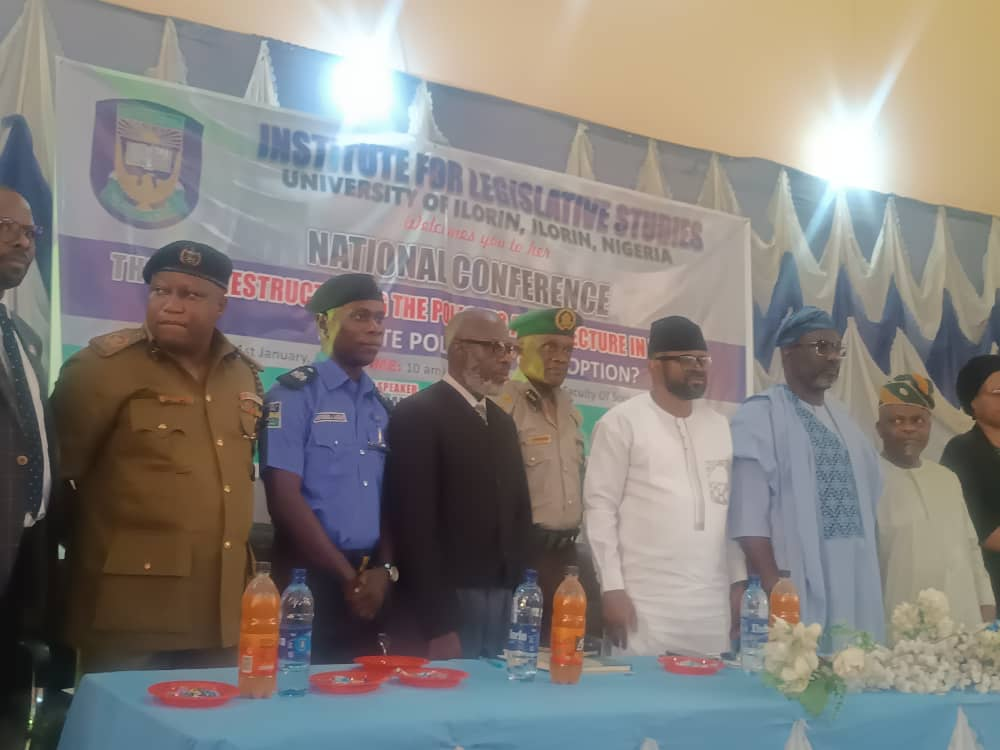
Professor Mojeed Alabi on the extreme right,and other distinguished personalities on the high table at a National Conference on “Restructuring the political architecture in Nigeria:Is state police the only option? organised by Institute of Legislative Studies of University of Ilorin on Thursday.Prof Alabi was the lead paper presenter.
By Demola Akinyemi, Ilorin
A Constitutional lawyer and Provost College of Law Osun State University, Professor Mojeed Alabi has said that one major critical factor that should be considered at the negotiation table during final decisions on the creation of state police is the assurance that the security challenges facing Nigeria are effectively tackled by the option.
Prof Alabi, also a political scientist said this in Ilorin, Kwara state capital on Thursday at the national conference on “Restructuring the political architecture in Nigeria: Is state police the only option?
The conference was organised by Institute of Legislative Studies of the University of Ilorin (UNILORIN).
According to him,”as of now, what is important is to ensure that whatever steps are taken or arrived at the negotiating table can resolve the main issue of tackling the security challenges that is tasking the capacity of the government to address other critical issues of national development.”
He noted that,” while no one can contend the fact that the security challenges facing the country require some measure of local or community involvement, which the idea of state police represents, there’s nothing to suggest that the adoption of state police simpliciter will solve the problem, or that the security challenges cannot be effectively tackled by other means.”
Former Speaker of Osun state House of Assembly,also cautioned that,” in other words, the road to full adoption of state police is fraught with landmines that need to be successfully scaled before we can arrive at the promised land.
“Apart from the much-anticipated amendment of the Constitution, there is need for robust legal frameworks to guide the ensuing regime.
” The National Assembly must be able to put in place an Act that will properly delineate the scope of the respective jurisdictions of the federal and the state polices in order to avoid conflict of interests in the use and deployment of police forces.”he said.
Prof Alabi,also a former member of Federal house of Representatives said further that,” the issue of training, discipline and control of policemen must be taken seriously.”
“In this sense, I suggest a Police Commission at the level of the Federation that will be responsible for training and certification of policemen and creation of a pool from which any units of government can recruit men and officer as may be needed.
“Such a Commission should also be able to discipline and discharge any erring police officers. Such a body will function like the National Judicial Council (NJC) mutatis mutandis with additional jurisdiction of providing professional training and certification that will ensure that anyone recruited into the police forces at any level has sufficient understanding, backed by codes of conduct, of the nature of responsibility to be discharged. “he stressed.
He however said that,”unless such a system is built, policemen operating under different control may be nothing more than armed groups for contestations arising from political, religious, ethnic or other differences.”
” The legal frameworks should state clearly the scope of the respective powers of the national and the state assemblies in making laws on policing as well as the funding sources for maintaining the polices as part of the critical structures for governance.
“The legal framework will need to harmonise the policing infrastructure in a manner that promotes collaboration at all levels rather than mutual acrimony and antagonism as has become commonplace in inter-agency rivalry among the security forces even under the centralised policing arrangements currently in existence.”
He added that,” more importantly, the envisaged regime of policing in Nigeria must consider the human dimension of the implementation.”, stressing however that,” We cannot doubt the fact that the palpable fears about state controlled policing relate to inherent abuses that may attendant to its practical implementation.”
Prof Alabi also charged that mechanisms must be put in place to ensure that the state governors do no use the state police to score political agenda against rivals and achieve other selfish interests .
His words,” concerns have been raised about the tendency for use of the police forces as tools for partisan considerations, which may do more harm than good to public safety.
” In this regard appropriate mechanisms and guidelines must be put in place to prevent abuse of power, including but not limited to creation of special administrative panels to monitor the conduct of police officers.”
“Also, the jurisdiction of the Public Complaints Commission could be expanded to accommodate such issues while the PCC itself is adequately funded to discharge this and other constitutional responsibilities.”
He said further to that,”the issue of state police in Nigeria is an idea which time has come, judging by the popular acclamation that attends the current initiatives of the President with the support of the Nigeria Governor’s Forum and the National Assembly.
“But the challenges attendant to its implementation have to be weighed against maintaining the centralised policing system currently in use with the attendant implication for public order, national security and survival of Nigeria as a federation.”
He noted that,” the experiment must be back by law and by additional reform measures to rid the police, at whatever level, of the many ills of the Nigeria Police Force. While the adoption of state police may not be an Eldorado and is bound to bring about new challenges that must be confronted squarely, maintain the status quo ante may not be a reasonable policy choice given the current multiple security challenges and the fragility of the Nigeria state.”
Disclaimer
Comments expressed here do not reflect the opinions of Vanguard newspapers or any employee thereof.