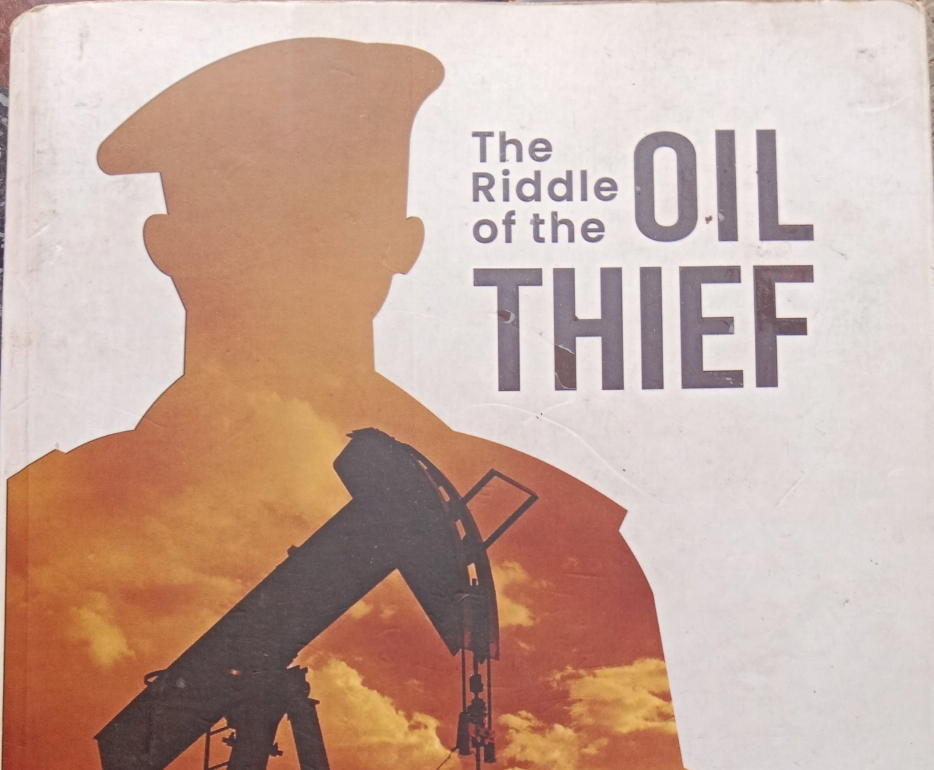
Title: The Riddle of the Oil Thief
Author: HRM. King Bubaraye Dakolo
Publisher: Masobe Books and Logistics Ltd
Pagination: 325
Reviewer: Udo Ibuot
SINCE the discovery of crude oil by Shell D’Arcy in Otuabagi oil well near Oloibiri in Bayelsa State on Sunday, January 15, 1956, and its exploitation thereafter, more than 56 billion barrels have been produced in more than 1481 oil wells from 159 oil fields in the Niger Delta region. So far, more than 60 per cent of the country’s oil deposits have been depleted, with the reserves currently estimated at 37 billion barrels. Working on the assumption that 55,713.19 billion barrels of Nigeria’s oil were sold through the Organisation of Petroleum Exporting Countries, OPEC, between 1958 and 2020 at the average price of US$40 per barrel, the country might have realised about US$2.228 trillion from this revenue source alone.
This is exclusive of the estimated US$32 billion from the 800 million barrels allegedly stolen annually in the last few years. Apart from this extremely conservative figure, more than US$400 billion was allegedly stolen between 1990 and 1999, with these monies never forming part of the country’s budget or being ploughed back to mitigate the effects of environmental pollution in the host communities of the Niger Delta. Rather, the oil thieves stashed them away in foreign banks for their personal aggrandisement, and to boost the economies of Europe and America. This discovery led His Royal Majesty, King Bubaraye Dakolo, the Ibenanaowei of Ekpetiama Kingdom in Bayelsa State, and former military officer (member of the 38th RC of the Nigerian Military Academy, Kaduna, having enlisted in 1986), to undertake to write the unusual mixture of fiction and non-fiction.
With a foreword by Dr. Sam Amadi, a lecturer, philosopher, scholar and development strategist, the book is organised into 41 chapters, where the author weaves history, military intelligence and science together to tell the story of crime and subterfuge in the Niger Delta. This book gives graphic insight into how the people of the Niger Delta and their environment have been abused, and raped all these years. It details the story of the exploitation of oil, gas and even the people of the region, the unprecedented pollution; and the insecurity in the region that has now spread to other parts of the country. With the oil and gas exploitation, the host communities that were once able to cultivate their farms for staple foods and other agricultural products are now import dependent because the viscous liquid has not only polluted but also impoverished the ecosystem. The author creates ‘Wokolo’ as a voice of the people, who presents the salient topics for his discussion.
The Riddle of the Oil Thief begins with the author’s appointment with the president in Abuja to discuss the issue of oil theft in the Niger Delta. In the story, he briefs the president about the military’s connivance with civil defence force pipeline surveillance command that has turned into bunkering criminal gangs in the region. He reveals that this gang steals about one million barrels of crude oil monthly which amounts to about US$ 30 million, or about N15 billion. This interaction apparently opened the president’s eyes to the massive ongoing corruption in the oil and gas sector, and is followed by the order to the president’s men to “ensure he is very comfortable and protected” in House 14, Aso Rock Villa. Chapters three to eight of the book focus on the author’s royal visit to Ekpetiama kingdom, his private session with the king, discussions in the king’s upper chamber, and entry into the Niger Delta hall of fame, where Wokolo the guide is assigned to explain the issues to hm. Wokolo now takes over by explaining the topics which are captured in the various chapters.
In the sub-topic entitled The Riddle of the Oil Thief, Wokolo explains how the country’s oil revenue is lost to thieves who act as individuals or corporations. Some 1001 names are listed on the hall of fame, and they include merchants, soldiers of fortune, security agents, politicians, oil subsidy billionaires, top petroleum sector players and military officers who served in the Niger Delta region in one capacity or another, or who never served in the region but corruptly enrich themselves from petrodollars. Chapter 29 of the book is entitled ‘the Bonny Saga’, and focuses on the “famous bribery scandal” which featured the names of 89 Nigerians implicated in the US$2 billion contract for expansion of construction work for one more train of the oil and natural gas plant. The Foreign Corrupt Practices Act is reported to have found that US$182 million was involved in the Halliburton/KBR bribery scandal. Not a single Niger Delta citizen was implicated in this scandal because the oil and gas host communities stakeholders are excluded from decision making processes in the oil and gas business.
While the foreign collaborators implicated in the bribery scandal were tried and jailed abroad, not a single Nigerian oil thief was jailed for this heinous economic and financial crime. Also noteworthy is the humiliation of the females in the oil and gas host communities by the international oil corporations’ employees. Oil and gas workers usually set up brothels to dehumanise the vulnerable, often under-aged girls, whom they devour as ‘bush-meat’ in such oil bearing and facilities hosting communities. Destinies of these girls are thus destroyed by these oil workers. The book ends with a question: “who is the oil thief?” One expected that the author will identify these oil thieves, but it is ironical that he returns to the beginning, and recounts the story of his new appointment by the president as the commander of the Brigade of Guards. This denouement is a surprise because with the author’s loss of the strategic position as commander of the Multi-National Military Conjoined Task Force, MNMCT, it will now be difficult for him to monitor and stop the operations of the corrupt oil thieves in the Niger Delta.
The book is an eye opener on the ongoing stealing of crude oil in the Niger Delta. It also reveals the poor condition that host communities of the oil and gas bearing facilities are exposed to. Citizens of the oil and gas bearing facilities have no schools, no access to potable water or hospitals, whereas the oil and gas workers of the international oil corporations, IOCs, are often well catered for. With the pollution of their land, sea and air in these communities, residents of the oil and gas host communities are uncommonly exposed to diseases, poor and unhygienic housing and water supply situations, and starvation. It is indeed time for the authorities to curtail the corruption that is prevalent in the industry, rein in the oil thieves, and plough back these recovered resources to the development of the oil and gas bearing communities.
Disclaimer
Comments expressed here do not reflect the opinions of Vanguard newspapers or any employee thereof.