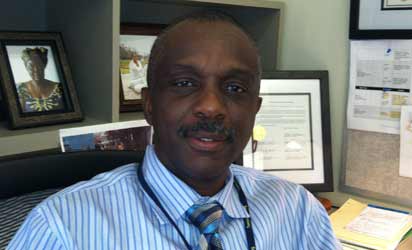
Nathaniel Ogedegbe
US-based former youth international Nathaniel Ogedegbe is in Nigeria on vacation. While in the country, he has organised a football tournament for U10/12 age categories. “I want to give back to society,” he said in a chat with Jacob Ajom. He also spoke on the national team and what the NFF must look out for when engaging a new coach
Could you recall a few things in your young era?
I grew up in Ebute Metta area of Lagos. We moved to Yaba when I was about ten. We used to play at the popular Evans Square. I loved playing pick-up games, sets. From there I was selected to go to St Finbar’s College, where I eventually played for the school team. My teammates at that time were Stephen Keshi, former Nigeria coach, Henry Nwosu, Franklin Howard, among many others. We also started Greater Tomorrow at the practice pitch of the National Stadium Lagos, where we all met for the first time. While at College, we won the Principals Cup, I was the captain of the team. During that time we were selected to play for the Flying Eagles. About six players from my team were part of the initial Flying Eagles.
I also played for National Bank Football Club against teams like Stationery Stores in the LADFA League. I must have been 16-17 years old. I was at St Finbar’s and still playing for National Bank.
From that point to the Flying Eagles. We were invited for a Nations Cup qualifier, but I never played, they said I was too small and skinny.
I noticed that after training, Adokiye Amiesimaka was going to school. I wondered how he was combining going to school and playing football at the same time? Then it reigned in my head that I had to start thinking about my future. Fortunately, I passed my WAEC and I had a four-year scholarship to play soccer in the USA. Luckily, during this time, I did very well and was eventually inducted to the Hall of Fame, got so many other awards, including being chosen among the best ten players during my years at Alabama University.
I was almost going to play in Europe. I had a coach, who was one of the coaches in MLS. He took me from Nigeria to the USA. He had a clinic which I attended in the summer, a scout came, saw me playing and he proposed I moved to Europe but I said no. Keshi at that time was in Belgium and this coach was asking Keshi about me. Keshi told him, ‘ah, that one is Maradona’. I couldn’t move at that time because I was focused on my engineering work. I asked myself whether to go to Europe or remain in America. For some reason, I could not go. I was already an Engineer but was still playing as a semi-professional at the time in the US. As a semi-professional, we were paid weekly wages.
My football salary was lower than what I got doing my engineering and, like I said earlier, I was making more money from engineering than from football. Also in football there was no job guarantee. You could start but when a better player came you could be asked to go. No job security. I decided to do my academy. I had what I call Flawless Soccer in 1993. I went for a coaching course and got a B License. I started to develop players on scholarships for colleges. I also decided to look at how I could also help by giving back to the society that made me what I am today. For the past 20 years I have been trying to do this; but planning, timing and situations had not permitted. But the feeling, the urge kept coming. I tried to forget about it but it kept coming back, hence what you are seeing today as the Nathaniel Ogedegbe U10/12 football tournament.
After successfully bringing these kids together, what next for them?
My programme is under the aegis of the Nathaniel Ogedegbe Foundation. My focus is not only for football. However, football remains the vehicle which carries all other aspects of the larger picture. If you remember, it is the same vehicle – football – which I used to be what I am today. Football took me to become an Engineer, it took me to the United States, it also took me to what I am doing today. I am trying to replicate what I am for these kids. Not every kid here may play professionally. You look at Osimhen, for instance and all other top players, how they started from primary school and check the number of kids that have played alongside him, how many of them are in his bracket? Now what do we have for those others? Without skill, no education, they are bound to waste away. If you look at my counterparts, what are they doing now? How are they sustaining themselves without football?
So, I am trying to replicate myself in the kids and show them that they can still play professionally and still learn. I played, I went to school. What I am doing is what Father Slattery did at St Finbar’s College, Bariga. Under Fr Slattery, if you were not up and doing academically, you would not be selected. These are the things I am trying to bring back; to show these children that through football you can still be successful in other fields. I want to change the paradigm
We want to keep track of their education; not just come for practice and go away at the end of the day. We want to also monitor their academics. We hope to achieve that through their coaches. Hopefully, we can collaborate and ensure they are placed in schools. I see myself in these kids because when I see them, it gives me joy. It brings back fun memories.
The first edition was held last year in Ajegunle.
What is your assessment of the tournament?
My expectation was blown away because the kids played a very good game and they have shown a lot of improvement. I am happy with the competition , the drama and intensity. Above all, I am happy with the maturity in the way they play. Hopefully, in the future, we will be able to put together a coaching clinic in a train the trainers programme.That will help in giving the kids better training so that when they travel and go outside they can beat anybody.
Is it an annual programme?
It doesn’t have to be an annual thing because if we leave for too long, we might lose track and the purpose would be defeated. When I get back to the US and review what we have been able to achieve in this edition, maybe six months from now we may do another one.
How was it like playing for Nigeria at that time?
Well, I was very brief. I had a very short period with the Flying Eagles and in the national team. I was invited to come and play but ended up not playing. But to play for Nigeria that time called for passion. There was less pressure then, we played for shirt; not the money. Look at the likes of Haruna Ilerika, Thompson Usiyen, Amiesimaka, Odegbami. They were in high school or the university when they were invited to come play for the nation. The level of skill was so high and they just enjoyed playing.
Today, the national team is 100 per cent foreign based. Why was there so much quality among the local players in your time?
Back then, we had raw talents and very good coaches. In Europe, they wanted to recreate the way we play, our style. When you looked around then, very few European players could dribble or do well in one-on-one situations, our fitness and skill level were high. How we harnessed that is because we play sets. They came to learn from us. When they came, they saw that we played sets – four players against two and so on. They used that and in their academies they set out a philosophy, and that was followed to the letter. Every coach that trained their kids in the country had a particular way to follow.. I don’t see that here, I don’t know if the NFF has such a philosophy with the coaches that work here. The question is, what is our philosophy? The country needs to know what to expect. Every country in Europe knows what to expect from their national team and it will filter down to the local coaches. If we adopt a national philosophy or playing style and you go to Enugu, for instance and pick a player to any team in the west, he can fit in because he already knows what is expected of him.
Why do we fire coaches because they failed to win one match or even two matches? Secondly we need to have a consistent philosophy and policy in appointing coaches. If we have a consistent policy or formula that we adhere to in selecting these players, before their selection, they already know what our philosophy is at the NFF. You do not wait one week or a few days before you call them to camp and when they lose you turn round to blame them. The spectators should be kind to these players and the coaches. They should not expect them to do magic.
The World Cup qualifiers are coming, the players should know who their coach is, their invitations should be formalised and rationalised. The players should know what plans are there and what is expected of them.
Disclaimer
Comments expressed here do not reflect the opinions of Vanguard newspapers or any employee thereof.