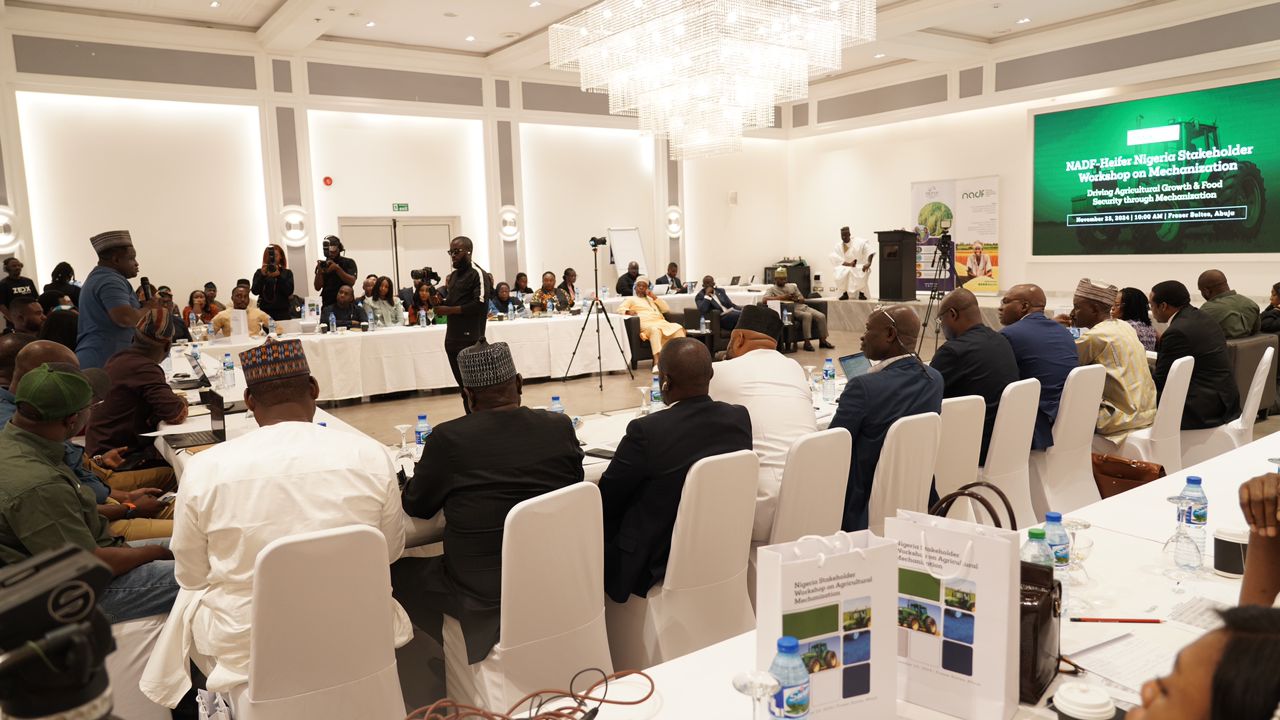
In a groundbreaking move to transform Nigeria’s agricultural sector, the National Agricultural Development Fund (NADF), Heifer International Nigeria, among other stakeholders have drummed support for data-driven, de-risked mechanization model to drive Nigeria’s agricultural sector.
The stakeholders made the advocacy during pivotal stakeholder workshop, held on Monday in Abuja, aimed at advancing the implementation of the 10,000 Tractors Initiative.
The workshop, titled “Implementation of the 10,000 Tractors Initiative with a Focus on the 2,000 Tractor Pilot Phase,” brought together key public and private sector players to discuss innovative strategies for enhancing agricultural mechanization in the country.
Speaking, Dr. Lekan Tobe, Country Director of Heifer International, underscored the importance of mechanization in achieving agricultural transformation.
“Looking at the growing investment by both federal and state governments in agriculture, particularly in tractor procurement, we see this as a key part of the transformation we seek.
“Technology is fundamental to agricultural transformation, and tractor access is central to that. We are partnering with the Nigeria Agricultural Development Fund (NADF) to bring stakeholders together, focusing on ownership, deployment, and sustainability of these tractors,” Dr. Tobe said.
He also highlighted the need to address the historical challenges faced in mechanization efforts.
“It’s not that Nigeria has not invested in mechanization before, but in the past, too much emphasis has been placed on acquisition without proper management. This time, we aim to ensure that those lessons are not repeated,” he added.
With mechanization being critical for Nigeria’s agricultural future, Dr. Tobe stressed the importance of collaboration, saying:
“As the Federal and State Governments continue to increase their investment in tractors, it’s crucial that all stakeholders work together to achieve our shared goals of mechanization and food security. This event exemplifies the spirit of partnership and collaboration that will drive transformative change in our agricultural sector.”
Dr. Nneka Enwonwu, Country Director of Hello Tractor, also spoke on the necessity of mechanizing Nigeria’s smallholder farmers.
“We have over 200 million people to feed, and most smallholder farmers are still using rudimentary tools. Only about 10% of farmers are mechanized. If we want to achieve food security and feed our population, we need to mechanize smallholder farmers,” she said.
Dr. Enwonwu further emphasized the need for access to mechanized services, such as tractors, implements, and harvesters, which will significantly increase productivity and yields.
It should be noted that discussions at the workshop revolved around various challenges and solutions for enhancing the tractorization ecosystem, with a strong focus on financing, access to spare parts, youth involvement, and data-driven models for the efficient deployment of tractors in Nigeria.
Stakeholders engaged in robust discussions on best practices, including land cluster farming to improve efficiency, training programs for tractor operators and technicians, empowering youth and women in agriculture, and ensuring sustainability through IoT-enabled tracking and maintenance systems.
The workshop underscored the need for a data-driven, de-risked mechanization model to ensure that tractors are not only accessible but also sustainably maintained, ultimately leading to a more productive and food-secure Nigeria.
Disclaimer
Comments expressed here do not reflect the opinions of Vanguard newspapers or any employee thereof.