By Ayo Onikoyi
The mounting problem of chemical warfare agent exposure and its devastating impact on the eyes has led to groundbreaking research at Michigan State University (MSU).
With no existing FDA-approved treatments for the eye injuries these agents cause, this work offers a vital step forward in addressing the urgent needs of military personnel and veterans.
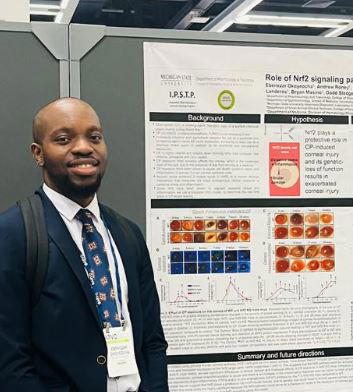
At the forefront of this initiative is Ebenezar Okoyeocha, a dedicated scientist working under the guidance of Dr. Tewari-Singh. Together, they have developed innovative ocular models to better understand the mechanisms of injury caused by chemical agents, particularly chloropicrin and mustard vesicants. These agents, notorious for their use in warfare, remain poorly understood despite their profound and lasting effects.
Based on extensive studies conducted in Tewari-Singh’s lab, Okoyeocha’s findings reveal critical insights into how these chemical agents damage the eye. The models also demonstrate the potential for repurposing FDA-approved drugs to treat such injuries, opening the door to life-saving therapies.
“This research is transformative for the field of ocular toxicology,” said Dr. Tewari-Singh.
“Without reliable models to study the mechanisms of injury and test potential treatments, it’s impossible to develop effective ocular countermeasures. This work fills that gap.”
The team’s research has already been published in top-tier ocular journals, garnering recognition for its innovative approach and relevance.
Their models are a critical step in understanding the distribution and toxicity of mustard vesicants in the eye, enabling scientists to evaluate treatment efficacy more effectively.
In recognition of this work, the Tewari-Singh lab recently received a $1,380,587 R01 grant from the National Eye Institute to further their research.
The grant, titled “Understanding Mustard Vesicants Distribution and Toxicity in the Eye Using In Vivo and In Silico Models,” will support ongoing efforts to refine these models and explore potential therapeutic solutions.
It was further gathered that the lab secured a supplementary grant to expand its focus on ocular studies, underscoring the importance of their work in addressing an often-overlooked area of chemical injury research.
“These models are not only advancing our scientific understanding but also giving us hope for practical solutions to an otherwise overwhelming challenge,” said Okoyeocha.
“Our goal is to ensure that military personnel and veterans affected by these agents have access to effective treatments in the future.”
This latest work, according to findings positioned MSU as a leader in the field of ocular countermeasures, offering hope to those impacted by chemical warfare and setting the stage for future breakthroughs in ocular pharmacology and toxicology.
Disclaimer
Comments expressed here do not reflect the opinions of Vanguard newspapers or any employee thereof.