By Onyeka Ezike
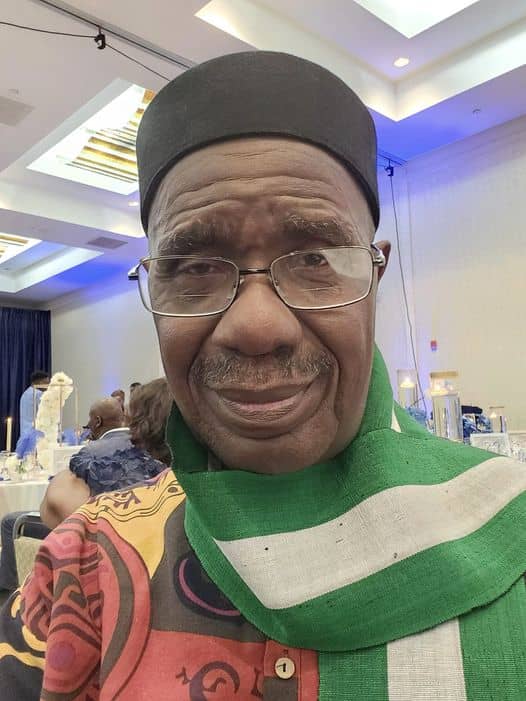
US-based Nigerian language evolutionist and creator, Prof. Alex Igbineweka, has called on Nigeria and the Economic Community of West African States (ECOWAS) member nations to adopt Guosa Language as a common central language among the various countries of West Africa as Swahili does for East and South Africa.
Igbineweka, an inspired linguistic scholar and creator of the language said that the language was developed for Nigeria and ECOWAS lingua franca for the promotion of peace, unity, identity, political stability, Arts, culture and
science.
A member of World Language Creation Society (LCS) Igbineweka disclosed that he has written more than eight books on Guosa language in addition to endless Wikipedias written by Europeans and Americans Linguists, adding that he has made several efforts to get the language – which has been accredited alongside Edo as an African language in America – approved by the federal government of Nigeria, but to no avail.
He explained that “Guosa is an evolved or created indigenous zonal lingua-franca also known as auxiliary language, born in the poly lingual milieu of Nigeria and the surrounding regions of West Africa in the mid-19th century,” recalling that “West Africa is home to three language families, the Niger-Congo, Afro-Asiatic and Nilo-Saharan, which represents over 500 recognized languages—not including commonly-spoken colonial languages like English, French, Spanish, and Portuguese.
“Some decades ago, 1975 to be precise, nations in West Africa – Benin, Burkina Faso, Côte d’Ivoire, the Gambia, Ghana, Guinea, Guinea Bissau, Liberia, Mali, Mauritania, Niger, Nigeria, Sierra Leone, Senegal, and Togo signed a treaty thus creating the Economic Community of West African States (ECOWAS), which is the area that the Guosa language aims to serve. Within those regions, some of the major native languages are Hausa, Yoruba, and Igbo, Ga,Twi, Wolof, Bassa and about 490 other indigenous languages and dialects according to the world ethno-linguistics research.
“So growing up in Nigeria in the 1950s and 60s, I was repeatedly exposed to not only colonial English, the Nigerian Pidgin English and my mother tongue Edo, but also Igbo, Yoruba, Hausa, Afik, Urhobo, Izon, Kalabari, and Fulfulde; thanks to the Nigerian Broadcasting Corporation (NBC) scheme whose aim was to educate and sustain Nigerian Indigenous languages beginning from 1958. The scheme saw the Rediffusion radio channel sequentially broadcast their program in the nine Nigerian local languages, which I enthusiastically consumed.
“The 1958-1960 nine-language broadcast scheme was really a relief to me. I remember painfully how my father was forced to pay a one-penny fine to St. Stephen’s Primary School management on 1st East Circular Road Benin City for speaking Edo language, my mother tongue to a classmate at school during the British colonial law that forbade local Indigenous languages or dialects from being spoken in academic environment. The question is: has there been any meaningful change in our government linguistic structures between the 1958 era of the British rule to date and now that we are independent nations? Yet we introduced foreign languages into our academic syllabuses in preference to our mother tongues and, the unified Guosa language. Why do we hate our nation’s dialects and cultures so badly? Who did this to us?
“Listening to the nine Nigerian language broadcasts on daily basis then enabled me to learn and write additional local languages—or at least corresponding lexical items if not diverse grammatical features like; morphology, syntax—and using these cognates in everyday speech when I was alone. In our daily speech in Nigeria, it is common to code-switch between the English language with interlaced words from our various mother tongues. For me, it was not just code switching between English and my mother’s native Edo language but also all the nine language broadcasts from NBC.
“I synced volumes of different Nigerian Indigenous words and meanings in my brain as a young boy, and I was able to pronounce and recite those words with ease. Having acquired lots of different Nigerian traditional language words, I found myself interlacing Edo language words with Igbo words, some other Nigerian languages and dialectal words. For example, “biko, fun mi ruwa” meaning “please, give me water” became a common phrase on my lips, and that is a blended linguistic element from Yoruba, Igbo, Hausa, Itsekiri, etc. Thus, at age 13, living in my family home at 19, Abakiliki Road, Enugu Nigeria, the Guosa language was born.”
On how this indigenous zonal lingua franca can serve as the panacea for unity in our culturally and ethnically diverse nation, Igbineweka who has won awards for his contribution to world culture said: “For me, Guosa represents a natural lifetime of work. From my early youth when I created the language from my dreams, a divine message like the Ignota created by Hildegard von Bingen in the 12th century, and the Interslavic language of the European Slavic nations created by two brothers: St. Cyril and St. Methodeus in the 11th century popped up. Others are the combinative teams of Presidents Julius Nyerere of Tanzania 1962–1985 and President Jomo Kenyatta of Kenya 1964–1978 who promoted Swahili language as integral to the East African region’s political and economic interests, security and liberation. As an inspired code-switching teenager growing up in a multicultural and multilingual Nigeria, it was a call of nature to create an indigenous national language for my motherland Nigeria and then expand it to the neighboring ECOWAS region of West Africa. I am happy to share this inborn linguistic knowledge and experience, and allow linguistic interpretation, research, documentation and spread of the Guosa language for the unity of humanity at home and abroad. However, I cannot do it alone because, all over the world, a tree has never made any forest.”
Prof Igbineweka also spoke on several efforts to get Nigeria’s government to accredit the language as a lingua franca before America seized the opportunity: “I wrote to late ex-president Shehu Shagari and Dr. Chuba Okadigbo who was the former political adviser to the President. They were very pleased about the Guosa language evolution and sent my request to the Ministry of Education to work with me, and develop the language. The ministry of Education directed me to contact the Nigerian universities to help me out. The Linguistic Association of Nigeria tossed me around and declined to be of help, claiming that they did not see any success in the Guosa language because the Esperanto, to them, was a failure.
“I also went to the University of Ibadan so many times. All my invitations and discussions ended up fruitlessly negative and in frustration. The dons told me that Guosa language is good, but that it lacked grammatical parts of speech and rules. What an ignorant attack! So, after about 15 years of struggles with the Nigerian universities’ employees without any form of help in sight, I had no choice but to accept the invitations from the International language professionals for help. If one was in my shoes I am sure the person won’t decline such golden opportunities.
“I am happy and thankful to God that I chose the right decision. Otherwise, Guosa language could have been forgotten long before now. Worst still is the fact that in 1993, the Nigerian Educational Research and Development Council, Jibowu, Yaba Lagos, offered to assist me to print the first Guosa language dictionary. They required me to pay some portion of the dictionary funding as part of my commitment to the project. I paid the required amount and guess what, 1993 to date the Guosa dictionary was not published, and my money wasn’t refunded either.”
One of the students he taught at the West Contra Costa Unified School District Richmond, California Kenneth Benson has this to say about the study of Guosa and Edo as African language in the United States of America: “The course appeals to me as a connection to my African root,” he said, adding that he traveled to South Africa and Egypt about six years ago as part of a study-abroad Programme.”
Disclaimer
Comments expressed here do not reflect the opinions of Vanguard newspapers or any employee thereof.