By Prisca Sam-Duru
This may perhaps, pass as one of, if not Nigeria’s best outings in the history of the International Venice Biennale.
Since the opening of the Nigeria Pavilion at the 60th edition of the prestigious International Venice Biennale, over 50,000 visitors have walked through its doors, as favourable reviews in most international press and media result in an upsurge of interest.
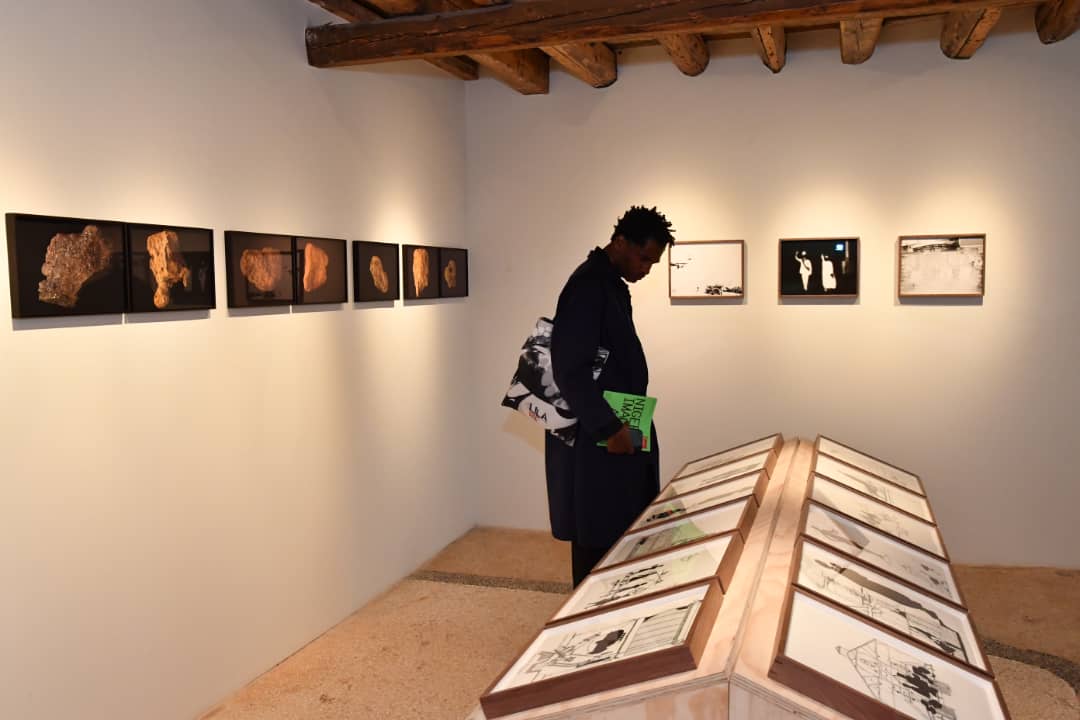
Titled ‘Nigeria Imaginary’, the Nigeria Pavilion has attracted immense attention from art enthusiasts, curators, and critics alike, cementing Nigeria’s position as a burgeoning creative powerhouse.
Venice Biennale is an international cultural exhibition hosted annually in Venice, Italy by the Beinnale Foundation.
The Nigeria Pavilion was commissioned by His Excellency Governor Godwin Obaseki, in collaboration with the Federal Ministry of Arts and Culture, represented by the esteemed Honourable Minister for Arts, Culture, and the Creative Economy, Barr. Hannatu Musa Musawa.
Organised by the Museum of West African Art (MOWAA), an independent, non-profit organization formed in 2020 for the preservation of heritage, the expansion of knowledge, and the celebration of West African arts and culture, the pavilion was not only an exhibition of remarkable contemporary art but also, a showcase of MOWAA’s vision and curatorial expertise. The success of the exhibition highlights the growing international interest in Nigerian creativity and West African modern art.
The exhibition was described by Siddhartha Mitter, New York Times, as “One of the most ambitious African presentations ever at the Venice Biennale.”
Over the course of the past six months, notable Nigerians stopped by to visit the Pavilion and shared their experience.
One of such eminent Nigerians is Professor Wole Soyinka who said, “What I’ve seen today, for me, has been most fulfilling. It’s replete on its own. It’s both artistic, historic, and evocative. It goes from lyrical, the lyrical, to the, how do you say, the contrasting, kind of statuesque aspect of our society.”
Also, impressed by Nigeria’s participation, the Honourable Minister Musa Musawa stated, “We are committed to working with private sector institutions and foundations such as MOWAA and we see the Nigeria Imaginary as a shining example of what can be achieved with partnerships. We see this as the beginning of a long-term collaboration with MOWAA and look forward to more successes.”
The pavilion, curated by MOWAA’s Aindrea Emelife, featured works by an intergenerational group of eight Nigerian and Nigerian diasporic artists, including Tunji Adeniyi-Jones, Ndidi Dike, Onyeka Igwe, Toyin Ojih Odutola, Abraham Oghobase, Yinka Shonibare CBE RA, Fatimah Tuggar, and Precious Okoyomon, whose works explore complex narratives of history, identity, and the future.
The success of the pavilion is evident in the breadth and depth of positive international media coverage from the opening. The Pavilion has been featured extensively in print and online media, including prominent articles in major daily newspapers: The Financial Times, The Guardian, The Washington Post via The Associated Press, Le Monde, The Evening Standard, and The Times UK, among others; leading art and architecture trades, including: Artforum, The Art Newspaper, ARTnews, ArtReview, and Frieze; high-impact lifestyle outlets: Hemispheres and Vogue; and major wires and broadcast outlets, such as: The BBC and The Associated Press, including pick-up on NBC News.
The exhibition’s excellence secured it coveted inclusion in roundups of the best Pavilions at the Biennale, including in: Art in America, ARTnews, The Evening Standard, Forbes, Harper’s Bazaar, The New York Times, The New York Times: T Magazine, and W Magazine, among others.
Following the Biennale, MOWAA is preparing to bring the Nigeria Imaginary home to show at the MOWAA campus in Edo State, Nigeria.
The goal, according to Aindrea Emelife, “Is to ensure that the exhibition not only continues to shine at the Biennale but thrives when it returns to Nigeria.”
Through ongoing partnerships, MOWAA offers programmes and resources that foster deeper connections between contemporary art and culture and the rich heritage of West Africa while creating a center of excellence for African and diaspora artists and scholars.
MOWAA’s Creative Campus in Benin City, Edo State, spans 15 acres and includes multiple buildings and public spaces for art display, performances, and commerce.
It features the Rainforest Gallery, an exhibition building within a replanted rainforest, the Art Guesthouse for visiting artists and researchers, and the Artisans Hall, which reimagines traditional Benin architecture as a space for contemporary artisans to showcase their work. Through partnerships, MOWAA connects contemporary art with West Africa’s rich heritage, creating opportunities for artists and scholars from Africa and its diaspora.
Disclaimer
Comments expressed here do not reflect the opinions of Vanguard newspapers or any employee thereof.