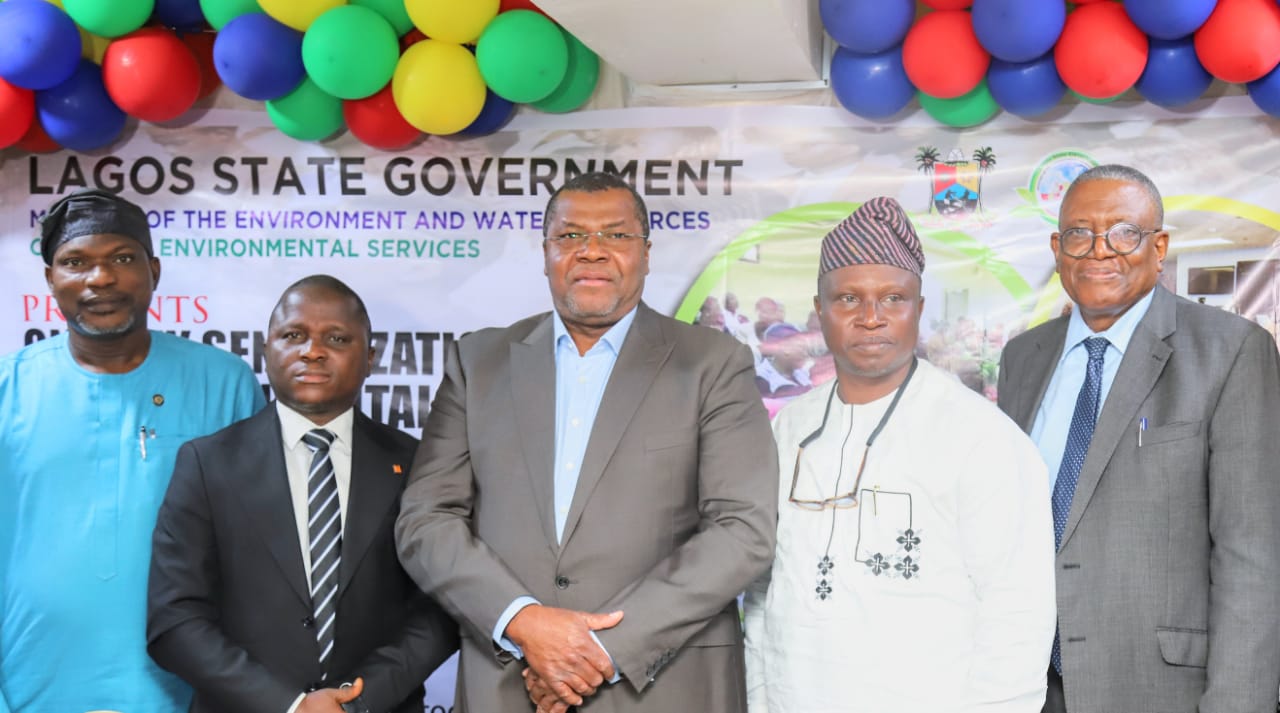
L-R; Director Sanitation Services, Office of Enviromental Services, Dr. Hassan Sanuth; Representative of Access Bank Plc, Mr Gbenga Adeleke; Representative of the Commissioner for The Environment and Water Resources and Permanent Secretary, Office of Enviromental Services, Gaji Omobolaji; Director Environmental Impact Assessment (EIA), Dr. Olasunkanmi Sojinu and Guest Lecturer, former Deputy Vice Chancellor Academics, University of Lagos, Prof. Babajide Alo, during a one day Sensitization on Environmental Impact Assessment (EIA) for Financial Institutions and Professional bodies in Lagos State, held on the 12th of September, 2024, at the Lagos Chamber of Commerce and Industry (LCCI), Dr. Nurudeen Olowopopo drive, IKeja, Lagos State.
By Olasunkanmi Akoni
The Lagos State Goverment has expressed determination to enforce procurement and compliance with the Environmental Impact Assessment, EIA, reports for project development executions toward ensuring safety and sustainable development in the State.
Government said the measure has become necessary as some private sector players have continued to execute development projects in the State without EIA.
This is coming as the state government unveiled the “Citizens’ Guide on EIA, aimed to educate members of the public with required information on the process in the State.
The State Commissioner for The Environment and Water Resources, Tokunbo Wahab, made the remarks at a stakeholders’ workshop, on Thursday, held in Ikeja.
The one day workshop, themed: “Embracing Environmental and Social Impact Assessment, ESIA, as a critical management and sustainability tool in Lagos State,” brought together representatives of financial institution and professional bodies in the built environment to discuss the critical role of EIA as collective strides towards sustainable development in the State.
EIA is a formal process for identifying the likely impacts that may arise from a proposed activity or project on the environment, human health and social economic activities.
Specifically, EIA helps in identifying the likely adverse and beneficial impacts of a project with the aim of putting in place measures to reduce or mitigate the adverse ones.
Wahab, who was represented by Permanent Secretary, Office of Environmental Services in the Ministry, Omobolaji Gaji, noted that, “Lagos State remains the preferred destination for many businesses operating within the various sectors of Nigeria’s economy.
“This preference can be likened to a two sided coin. While on one hand, it is a cheering news as it opens the State to economic prosperity and growth, on the other hand, it comes with various types of environmental and social challenges.
“The establishment of industrial facilities, creation of new settlements, and construction of infrastructure, all come with huge adverse environmental impacts ranging from pollution of various environmental media (Air, Land and Water) to sometimes irreversible environmental degradation if not properly managed.
“It is for these obvious reasons that the State Government through the Ministry of the Environment & Water Resources has adopted the application of EIA process in ensuring sustainable implementation of developmental projects in the State in line with global best practices.
“Thus, EIA is a critical environmental management tool that must be embraced by both private and public sector if we are to achieve sustainable development.”
Wahab reiterated that the State government cannot afford the huge cost of addressing environmental degradation and ecological challenges resulting from unwholesome project development activities.
“The cost of doing the right things is cheaper than the cost of remediating or correcting the consequences of refusal to do them.
“This is why as a Ministry, we have committed ourselves to creating awareness on the need for participation and compliance with the EIA process in the State.
“To this end, we have developed the Citizens Guide on EIA to educate members of the public and provide them with required information on EIA process in the State.
“It is, however, worrisome that while we continue to see improvements in the level of compliance of the Private Sector players to the process, the same cannot be said about some professional bodies especially in the built environment.
“Some private sector players have continued to execute development projects in the State without EIA. Protecting our environment is our collective responsibility.
“As we strive to improve the welfare of Lagosians through implementation of the various laudable projects of this administration, we must do so in a sustainable manner ensuring that more problems are not created as we try to solve existing ones,” Wahab stated.
Earlier, Gaji, whose address was read by Director, Sanitation Services Department of the Ministry, Dr. Hassan Sanuth, also stressed that EIA is a critical safeguard instrument that has been adopted across the globe as a tool for protecting the environment, public health and safety.
“The objective of EIA among others is to identify at an early stage of project development both adverse and beneficial impacts that could result from an activity or a project and proffer measures to either eliminate, reduce or mitigate the adverse impacts.
“Therefore, EIA has become a major management tool that any nation that is determined to achieve sustainable development cannot afford jettisoned in project consideration and design.
“It is a necessity for us to keep the environment safe, not just for us but for the future generation.
“Our development drive must pay critical attention to the sensitivity of our environment and the implications for our collective well -being.”
Disclaimer
Comments expressed here do not reflect the opinions of Vanguard newspapers or any employee thereof.