By Adeola Badru
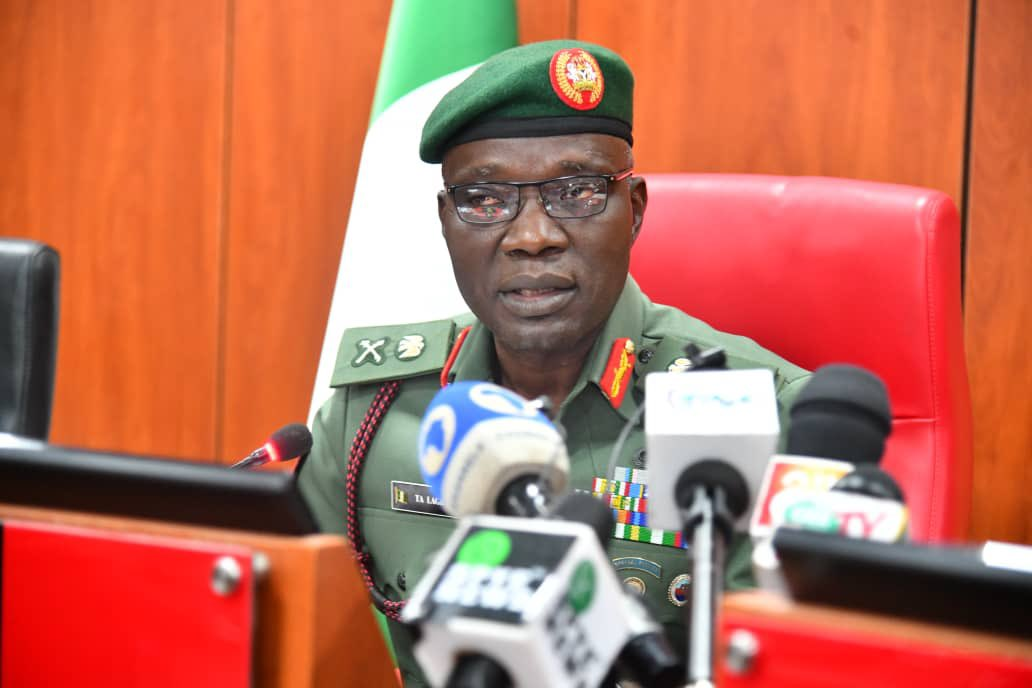
The Chief of Army Staff, Lieutenant-General Taoreed Lagbaja has emphasised the critical need for Nigeria to address poverty and unemployment to combat long-term insecurity and instability.
Speaking at the University of Ibadan on Friday, he noted that over 54% of the population is under the age of 35, with less than 20% gainfully employed, making youth vulnerabilities a key factor in security challenges.
Delivering the first strategic lecture at the Institute of Peace and Strategic Studies, titled, “Combating an Adversary Without Boundaries,” Lagbaja highlighted the importance of a whole-of-society approach in national security.
He stated that enhancing communication and cooperation among various sectors is vital to align efforts with national interests and address the root causes of insecurity.
Lagbaja pointed out that Nigeria’s porous borders facilitate the infiltration of adversaries from West Africa, noting that four countries in the region rank among the ten most terrorized globally.
He stressed that no single agency can effectively tackle the complex security issues facing the nation, advocating for deeper collaboration among security agencies.
The Army Chief also addressed human rights concerns, stating that the Nigerian Army supports over 60 humanitarian organizations operating in the Northeast by providing escorts and fostering cooperation to reduce allegations of human rights violations.
Lagbaja warned that modern security threats, influenced by technology and non-state actors, require a coordinated response to ensure national security.
“The operating environment has evolved to a point where no single service or agency can effectively and independently tackle the threats to national security.”
“It is therefore crucial that synergy is developed with other security agencies in the implementation of the whole of society approach to the threats. Communication, cooperation, and collaboration amongst MDAs have been major topics of discussion. Although there has been some improvement, much more still needs to be done.”
“Counter-insurgency operations require synergy amongst agencies, who need to collaborate with each other towards achieving a common goal. Collaboration, communication, and cooperation are required for planning, sharing of intelligence, and the practical execution of all operations.’
“Where synergy is lacking among security agencies, there can never be a coordinated approach to the prevailing security challenge. In the North East for example, the Nigerian Air Force provides air support, aerial surveillance, casualty evacuation and logistics airlift for troops while the Nigerian Navy has deployed its Special Boat Services and operationalized its Forward Operation Base in Baga as part of the overall operations on the Lake Chad waters.”
“Furthermore, personnel of the Nigeria Police, Department of State Services, Nigeria Security and Civil Defence Corps, Immigration and Customs are deployed in liberated towns and villages in Bornu and Yobe states to ensure their security and relieve Nigerian Army personnel of policing tasks in such areas, resulting in better synergy and collaboration,” Lagbaja stated.
In his address of welcome, the Vice-Chancellor, University of Ibadan, Professor Kayode Adebowale, acknowledged the IPSS’s role in training security personnel and expressed confidence in the Nigerian Army’s ability to devise effective strategies against adversaries.
Disclaimer
Comments expressed here do not reflect the opinions of Vanguard newspapers or any employee thereof.