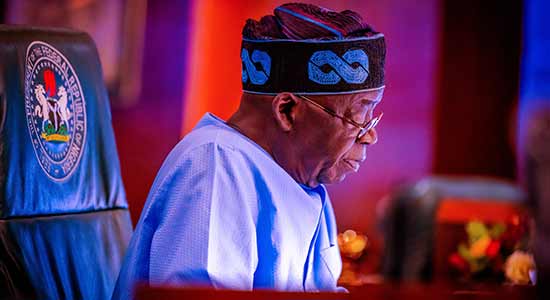
President Tinubu
By Chris Onyeka
With the passage of the new national minimum wage into an Act and the subsequent assent by the President last week, many would think that the storm over the minimum wage debacle has been settled. However, for a lot of us, we know that the real battle has just begun. Its implementation not just at the federal level, but tougher at the state level where it has historically met its greatest test up till now.
In recent years, negotiating the consequential adjustments of the national minimum wage has always met with serious challenges in the hands of many state governments who deploy all manners of gimmicks to keep from meeting the dictates of the Minimum Wage Act. This has left most of the stakeholders always wary of the brutal battles ahead and thus compelled them to make preparations to ensure that they are not outwitted by the other parties in the ensuing negotiations.
The signs are in the air with some state governments already pointing to the difficulties that full compliance poses for their fiscal positions. Gombe State governor was quoted as saying last week that the state would be unable to pay or comply with the new National Minimum Wage Act given its financial capacity. However, this is an excuse that is well-known as it has been shown continuously that it is not the claims of lack of resources that makes states unable to pay but on the willingness of the states to prioritise the salaries and welfare of workers in their respective states. Many states have, however, shown willingness to pay even before the passage of the new wage bill into law. Edo State for example, has already started paying even before the new wage Act came into existence while some few other states have indicated willingness to comply with the law whenever it is passed.
Welfare of workers
The Labour Centres especially the Nigeria Labour Congress, NLC has continued to point out that until the states begin to place premium on the welfare of its workers, they will continue to complain of their ability to pay which is generally not true. They insist that it is evident that when most of the state governors received funds from the Buhari administration to pay arrears of salaries to their workers, they refused to pay and diverted the funds to either unexplainable projects or entirely misappropriated them. This, to Labour, remains a constant proof of the habitual disposition of state governors to the welfare of workers in the states despite being the goose that lays the golden egg.
After the passage of the new act which is supposed to take effect retroactively from the 19th day of April, 2024 according to the stipulation of the 2019 Act which expired on the 18th day of April, 2024, the gladiators are already mapping out strategies to ensure proper implementation of the Act. It promises to be an epic battle beginning from the national then to the states where the battle will be fiercest. It is not, however, supposed to be problematic but for the level of impunity and lawlessness pervading governance in our nation. If laws are obeyed to the hilt and if the welfare of the downtrodden is prioritised, the implementation of the new wage law will not be a major problem. In this case unfortunately, the contrary will be the case.
We say this because, negotiating the implementation of the new minimum wage will not be a simple matter. You have to win the best increase for your members and you have to avoid this process taking years as the last one. Negotiating the consequential adjustment is fraught with rigours and attempts to either bribe or intimidate state representatives of the Labour centres who would normally come together between the NLC, TUC and the Joint Negotiating Councils. This means that the battle will be fought by the state councils and the outcomes will therefore depend largely on the capacities of the state representatives to deliver on their mandates to the workers.
State negotiations
The NLC Secretariat in each state needs to ensure, through vigorous negotiations, that the new wage is implemented in all public and private sector organisations in each state. In the public sector, this includes state, local government and state-owned enterprises. Care should also be taken to ensure thatpensioners are provided with the proper consequential adjustment. It should be possible for the minimum wage to be implemented within two months of the Act having been assented to by the President on 29th of July, 2024.
Our findings shows that the NLC, in recognition of the need to build the capacities of its representatives to ensure that they have clear understanding of what is to be done and to be able to deploy such knowledge in negotiating better wages for its members in the states, has set machinery in motion to train its state officers in all the 36 states of the federation including Abuja through a workshop. It is hoped that it will help the centre deal with the shortcomings of the previous National Minimum Wage implementation exercises.
These shortcomings led to the undue delays and outright refusal of some state governments to pay. It also led to the representatives agreeing to less than acceptable outcomes for its members which often led to dissatisfaction amongst the workers eventually leading to strike actions around the country. The preparation as we were informed, is therefore envisaged to avoid these negative outcomes and build greater understanding amongst the stakeholders in order to quickly deliver the benefits of the new wage Act to all benefitting workers across the nation.
It has to be understood that in negotiating the consequential adjustment, it is not simply the issue of no-one being paid less than N70, 000 which is for workers on grade level one, step one. Fortunately, no worker should be on this grade level. Most of the time, the minimum grade level for workers in the states is GL 4, step 2 and for federal workers, it is GL3, step 4.
The implication of this is that no public sector worker should be paid less than around N100, 000 and in some states, this will be N115, 000 to N120, 000. It does require that the negotiating teams representing the centres will have to ensure that the details are negotiated carefully to ensure that workers do not lose out during the negotiation exercise. It therefore requires patience, knowledge and tact on the part of the unions while the government and private organisations require understanding and altruism for smooth and successful implementation that would guarantee industrial harmony.
What normally should happen is that the Salaries and Wages Commission or the Revenue and Fiscal Mobilisation will sit down at the National Joint Public Sector Negotiation Council at the national level for the Public sector and agree on a table which serves as a framework for its implementation. This Council is made up of representatives of workers in the Public sector and the Government. The federally agreed salary table would then be used as a guide by each state to ensure proper consequential adjustments. It is therefore the duty of Union leaders at the states in their Joint Councils to ensure proper application of this in their respective states.
Private sector/Pension
In the Private sector, however, a more robust mechanism has evolved over the years which ensures that in most of the organised private sector, salaries and wages are renegotiated every two years which is what the new National Minimum Wage Act is trying to bring closer for public sector workers to keep pace with inflation. Nonetheless, the challenge in the sector is that with the new Wage Act, employers must then sit with the various unions in their respective sectors to negotiate adjustments upwards based on the size of the increment in the new Act.
In addition, Pensions are negotiated upwards in line with the New Minimum Wage Act. This ensures that adequate and proper remunerations are availed to workers who are no longer in active service. This explains why the Union of Pensioners are often part of the negotiating team but as observers.
A cursory look at what this exercise holds shows that the days of long knives are here again as it promises to be explosive and turbulent if not well managed especially by belligerent and obdurate governors. We may not expect much resistance from the employers as what is required most of the times are far less adjustments given that they are far ahead in Wage scale than in the public sector.
It is important therefore that the parties must seek to apply necessary caution as the process of implementation begins in a few weeks’ time. The Umpire, which is the Federal Ministry of Labour must deploy all weapons in its arsenal to ensure that it monitors this process to douse tensions and avert industrial crisis in the nation. We believe that if all hands are genuinely on deck, the 2024 National Minimum Wage implementation exercise will be the smoothest and most rancour-free thus far. However, this depends largely on the attitude and disposition of all the parties during the process. It is therefore important that all parties should bear in mind that workers need to quickly begin to earn the new wage to help assuage the massive hardship in the country which has created a deep crisis of survival in Nigeria. A quick resolution will help end hunger and douse the escalating social tension in our country including the ongoing #EndBadGovernance protests.
Chris Onyeka is Assistant General Secretary, NLC.
Disclaimer
Comments expressed here do not reflect the opinions of Vanguard newspapers or any employee thereof.