By Prisca Sam-Duru
Contemporary African stone carving is very rare but remains a flourishing art form which employs a unique fusion of traditional and modern techniques appreciated across the continent. Unlike other genres of visual art, stone carving is practiced by very few artists in Nigeria.
Notable among them is Emmannuel Afolayan who has transformed over the years as a global phenomenon. Afolayan who prides in the interaction he enjoys with the stones, has carved a unique path in the world of visual arts particularly, stone carving
It’s also rare to hear artists introduce themselves with the appellation of their major or discipline. It’s usually generally as a visual or fine artist or better still, as a multidisciplinary artist before they begin to explain which art genre they majored in.
This artist is different. He introduces himself as Sculptor Emmanuel Sunday Oladapo Afolayan. When asked why he introduces himself that way, he simply said that’s how he wants to be known. That’s interesting! Sculptor Afolayan is proud of who he is and the kind of art he does. And to say he is good at it will be an understatement.
Nigeria’s foremost collector, and the collector of Afolayan’s best stone sculptures, Omooba Yemisi Shyllon, thinks highly of him. The founder, Yemisi Shyllon Museum of Art, Pan African University, Lagos, described the sculptor as one of the best artists Nigeria has produced adding that he has excelled greatly in a rare art discipline. “Stone carving is more difficult than wood or other mediums but Afolayan is doing wonders with stones.”
Yemisi Shyllon further said, “I started buying his works as far back as the 90s. And I sponsored his trip to Italy at that time where he acquired additional skills. Before he left, he was using Nigerian equipment but he came back more informed and equipped. He is now carving wonders and you can see the difference in the works showing in this exhibition.
Shyllon spoke at the National museum Onikan, Lagos on Saturday August 17, a few minutes before declaring Sculptor Afolayan’s solo exhibition open. It is tagged, ‘The Stone Speaks: A Retrospective Solo Exhibition of Stone Sculptures’.
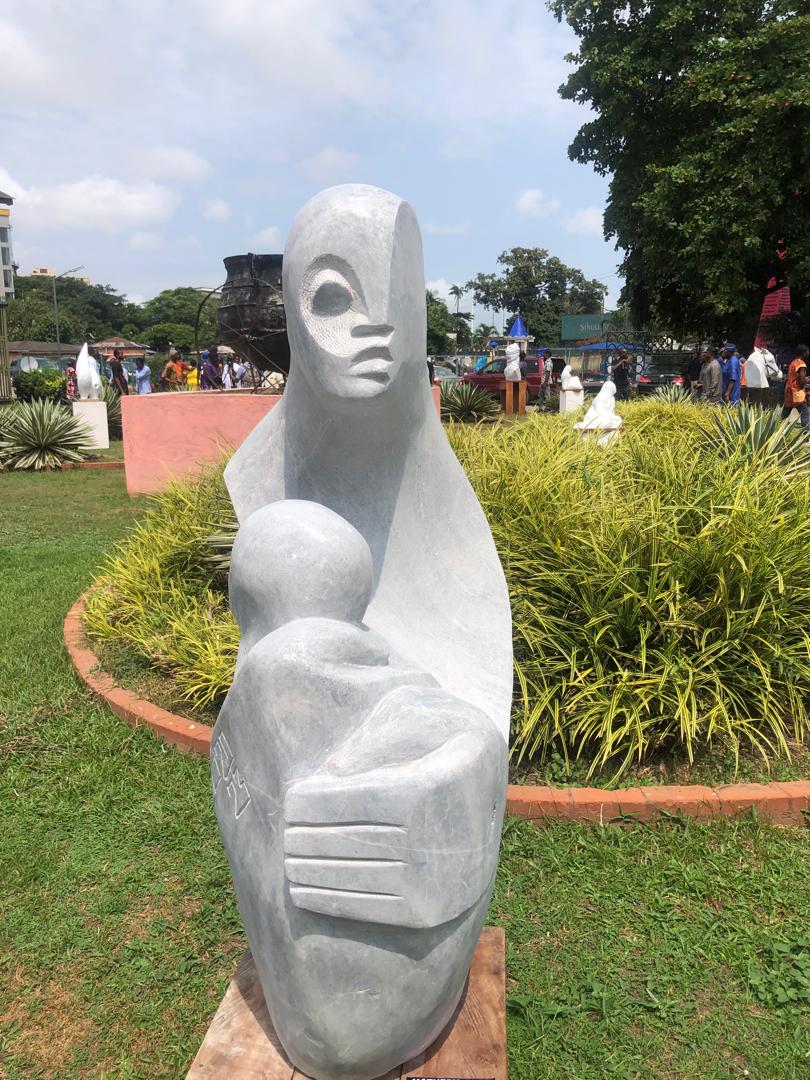
Observing the amazing work of creativity even from a distance, one will agree that the aesthetically carved stones have so much to say. The works encourage viewers to appreciate the beauty in the material as well as the process of bringing them to life such that they speak.
The exhibition curated by Dr Otonge Bille Ayodele runs till August 30, 2024.
According to Dr Bille, “Stone-carving is not for the faint-hearted and soft-bodied. Stone is the king-medium of sculpture practice. The depth, width and length of Afolayan’s stone-sculpting career is as legendary as the most ancient stone art cultures that the world still gaze and gape at in awe. I believe the future world will continue to be awed by Afolayan’s magnificent contributions to human existence, through his extricated forms hidden in stones.”
On display are about 20 must-see masterpieces all in white, with each telling a different story. ‘Where Comes Our Help’, ‘Royalty’, ‘Agbajo-owo Lafi Nsoya (Ikpeshi marble)’, ‘Despudent (Marble cast)’, ‘Vailed Damsel’, Despodent (Marble Cast), ‘Tributes to Chibok Girls’, ‘Brotherhood flame (Simulated marble Cast), ‘Oju Osupa (Portrait of the Moon), ‘Dialogue’, ‘Aiyelujara II’, ‘Tribute to Leah Sharibu (marble cast), ‘Vessel’, and many others.
The Sculptor who has participated in over 40 group exhibitions with some solos to boast of, described the ongoing exhibition at the National Museum as ‘the main, the main solo exhibition’ because it is a retrospective solo show.
As already noted, each sculpture speaks to a different issue. While some celebrate eminence, there are sculptures offering viewers a peep into the level of spirituality of the artist. ‘Where Comes Our Help’ for instance, is a sculpture of a man’s head looking up in prayer. This is taken from Psalm 121 of the Holy Bible. And the answer to that surely is that ‘Our help comes from the Lord who made heaven and earth’. One cannot but trust that this piece has the capability to direct observers’ attention to keep trusting in God at this critical time of our lives as Nigerians.
Also, striking works such as ‘Tributes to Chibok Girls’ and ‘Tribute to Leah Sharibu (marble cast), are outstanding. They once again remind us that while we enjoy freedom, the remaining Chibok Girls still in Boko Haram captivity and the little Leah Sharibu who was abducted for refusing to renounce her faith in the Lord Jesus, must not be forgotten. It’s a call to the government to ensure these children regain their freedom.
Afolayan, whose experience spans three decades, explained that his journey of stone exploration dates back to 1986. At the time according to him, “Varieties of stones were collected across the country for carving. The studies ascertained abundant availability in Nigeria. In my early days and for quite some time, I explored the softer varieties and small sizes. However, in this exhibition, featuring 12 garden stone sculptural pieces, they are mostly in Calcite Marble. The concepts went through a wide range of time and years of contemplation. Some took months for the concepts to emerge, while others resulted from spontaneous exploration of forms.
Attempt was also made to explore the challenge of weights in the natural stone through what Sculptor Suleiman called ‘Simulacre’ that is a simulated Stonecast as in ‘No More Two’, ‘Tribute to Leah Sharibu’, ‘Despodent’, and ‘Brotherhood Flames’.
Aside from the permanent display of stone carvings at Esie and Ikom Museums, this exhibition is an addition to the display of garden stone sculptures in the museum.”
Referencing the Holy Bible in Luke 19:40 – “I tell you that, if these should hold their peace, the stones would immediately cry out”, the artist said, it takes a man who understands the language of Stone to be able to unravel intrinsic virtues that are hidden in each stone boulder. He added that the works in this exhibition are a result obtained through tripartite dialogues with the ‘Man Within’, the ‘Hands’ and the ‘Stone Boulder’ to arrive at these stone sculptures.”
Disclaimer
Comments expressed here do not reflect the opinions of Vanguard newspapers or any employee thereof.