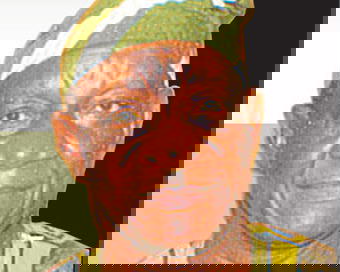
“There are times when a leader must move ahead of the flock, go off in a new direction, confident he is leading his people the right way” – Nelson M“ andela, 1918-2013, VANGUARD BOOK OF QUOTATIONS, p 124.
Irrespective of any other mistakes his government hasmadeinitsthirteenmonths
in office, the decision to remove tariffs on food imports – particularly wheat, rice and beans – was one of the most courageous and timely. Every global organisation with research units focusing on food supply has declared that acute food scarcity is underway or inevitable in Nigeria this year. Approximately 31 million Nigerians are now estimated to be living with famine – the highest of any country in the world. The situation threatens to get worse on account of several factors – insecurity, millions of farmers driven off the land, millions of hectares of farmland lying fallow, high and unaffordable costs of inputs, and export of food to neighbouring countries – among others. Right now, the best possible outcome for aggregate food production this year is fairly well known. What is in doubt is the quantity which might be lost to floods, pests, drought and destruction by herdsmen. The best projections indicate far less food production this year than the nation will need if tragedy is to be averted.
Two weeks ago, in an article published on this page, the inevitability of food importation was predicted in these words: “It is almost impossible to avoid massive food importation this year.” That was in response to Tinubu’s declaration that “there is nothing we are doing that is more important than producing high quality food for our people to consume.” But, the President had followed that statement with revelations of the plan to supply fertilisers at affordable prices to farmers this year. I was alarmed because only the minority of farmers engaging in dry season farming can use fertilisers provided now.
For the vast majority, any fertiliser supplied now will amount to total waste of resources. We have missed the boat on that. Furthermore, with my contacts with farmers in various parts of the North, it has been possible to establish beyond reasonable doubt that the harvest this year will be the poorest in a few years. Bandits, Boko Haram and other causes have rendered farming a risky business for millions of farmers. I have never prayed so hard for any decision to be made by government as this one. Even with expected increase in imported food, Nigeria would still not escape widespread hunger this year. This new policy will merely reduce the tension a bit. Ultimate food security lies in our ability to feed ourselves instead of out-sourcing that duty to other nations and creating jobs abroad for others.
WHY THE CONTROVERSY?
“To ameliorate food inflation in the country caused by affordability and exacerbated by availability, the government has taken a raft of measures to be implemented over the next 180 days. A 150-day duty-free import window for food commodities, suspension of duties, tariffs and taxes for the importation of certain food commodities through land and sea borders. These commodities include maize, husked brown rice, wheat and cowpeas. Under this arrangement, imported food commodities will be subjected to a Recommended Retail Price” – Abubakar Kyari, Minister of Agriculture and Food Security in Abuja, July 8. I fully expected a storm of controversy to follow this announcement; and it was not long in coming. Rice Farmers Association of Nigeria, RIFAN, led the domestic attack on the measures. Summarised, their objection came to this – imported rice will retard the progress made towards Nigeria’s sustainable self-sufficiency on rice.
They also kicked in the old story about rice unfit for human consumption being imported on account of this set of measures. Because I spent years in the rice sector, nobody needs to tell me that poor quality imported rice was a charge we have been making without substantiation. In reality, rice is imported – legally or smuggled – all the time. To the best of my knowledgetherehasneverbeen any time food poisoning was traced to imported rice. It was just a rumour we always propagate whenever there is a threat of large import of rice. At any rate, even RIFAN itself is on record as stating that there is already a severe scarcity of paddy rice for milling this year. Several rice farmers have been driven off their farms by threats too numerous to count. Acute rice scarcity has been predicted by every organisation with established food research units. The supply gap, if not reduced will result in life-threatening famine for millions of Nigerians – while rice farmers laugh all the way to the bank with windfall profits at the expense of fellow Nigerians who will literally die of hunger by the millions. The truth is: Nigeria is not experiencing just rice scarcity but scarcity of every food item. There is insufficiency on all fronts; no surplus anywhere to help cushion the impact of pervasive scarcity.
DR ADESINA’S OBJECTIONS ARE MISPLACED
“Nigeria cannot import its way out of food insecurity…Nigeria must not be turned into a food import- dependent nation….Nigeria must feed itself with pride” – Dr Akinwunmi Adesina, President, African Development Bank. Of all the critics of the Tinubu emergency food measures, the one which was incomprehensible to me was Dr Adesina’s. Speaking at a Christian Church function, he made the utterances which we summarised above. I could not help wondering if Adesina was in possession of the Minister’s full address before making what was obviously a knee-jack reaction to food importation by Nigeria. To begin with, food security and self-sufficiency does not mean growing everything we consume. Not even the largest food producers – China, India and the United States – do that.
The still relevant of the principle of Comparative Advantage precludes the idea thatanynationwouldproduce everything its people need to feed themselves. Food sufficiency means achieving a balance between food import and exports bills. Nothing more. Furthermore, Nigeria has always been a food import- dependent nation. That includes the period Adesina was Minister of Agriculture under President Jonathan. I was writing on this page and on the Monday paper when Dr Adesina was proclaiming, without proof, that Nigeria was almost self-sufficient in rice production at a time major rice smugglers were flooding Nigerian markets with imported rice. That Nigeria is still far from achieving self- sufficiency in rice production can be partly attributed to the false reports of all our former Ministers of Agriculture.
Tinubu, like the next runner in a relay race, has merely received a baton which has been dropped too often by other runners before him. To be quite candid, the entire statement credited to Adesina is so hypocritical that one would not expect it from a global expert on food. It would have been more acceptable if he had limited himself to advocating that we should strive to strike a balance between imports and exports by playing to our inherent strengths – yams, cassava, sorghum, millet etc – instead of lamenting our inability to compete in areas where we are now at a distinct disadvantage.
Nigeria is not one of the top largestproducersofrice,wheat and maize; and we are unlikely to break into the top ten for decades, because the leaders are relentless in their efforts to increase productivity and maintain their export potentials for as long as possible. Finally, the Minister made it quite clear that the stop gap measure is for 180 days only. It is designed to respond to an emergency situation, with disaster looming in the shortest possible time. The preferences of the World Bank, International Monetary Fund, IMF and the African Development Bank, with modifications to suit our own peculiar circumstances, with respect to food production are generally acceptable for the long run. But, the 32 million Nigerians already identified, as well as others hidden, as being at great risk this year cannot wait for food in the long run; perhaps, not even in the short run. They must eat today. That being the case, there is no alternative to massive import of food items. What Tinubu has approved does not amount to a change of policy; sustainable food security is still the aim of government. But, the emergency must be addressed NOW. I think Tinubu has taken the right decision; but there might be problem with implementation.
RECOMMENDEDRETAIL PRICE, RRP, TOUGH TO ENFORCE
“History does not repeat itself; man does.”
My experiences in the pharmaceutical and brewery sectorsinthe1980shaveproved beyond doubt that RRP is tough, if not impossible to enforce. Given adequate supply of any commodity, no RRP is needed. Scarcity induces higher prices asretailersseekhighermargins. Allocation at control price results in corruption as the regulators invariably engage in self-enrichment to allow disobedience. Several prices eventually emerge; not one. And, the entire purpose is defeated. The best option is to increase supply as much as possible; target institutions – schools, hospitals, armed forces, public service for supply and remove those consumers from the open market. Aggregate prices will decline gradually.
READ VANGUARD BOOK OF QUOTATIONS ONLINE
You can now read it anywhere, anytime at your convenience.
Disclaimer
Comments expressed here do not reflect the opinions of Vanguard newspapers or any employee thereof.