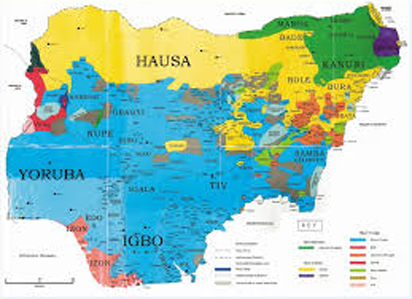
Map-of-Nigeria
A former President of the Nigerian Bar Association, NBA, and foremost rights activist, Chief Olisa Agbakoba, recently expressed his opposition to the calls for a new state to bring the South-East to six, like four other geopolitical zones of the country.
According to him, most of the already existing states are not “viable”. Adding a new state will mean increasing the number of local governments, federal constituencies and other relevant structures that will only further drain the nation’s purse. He said the better way to go is to return Nigeria to the defunct regional structure which was in place before the Nigerian Civil War.
We need to point out that right from colonial times, “viability” was never a consideration for the splitting of Nigeria into administrative or federating units. Viability means the ability of a unit to leverage its resources with little or no external (federal) help to thrive.
In colonial times, Northern Nigeria was economically unviable. The British colonialists had to tie it together with the South to enable it fund its budgets. That structure remains till date. The only state that can stand on its own is Lagos, which boasts itself as the sixth largest economy in Africa. Lagos is strong because of almost a century of continuous investment of our collective resources in it as our former Federal Capital. No state has received anything close to that quantum of favour.
The military merely followed the footsteps of the colonialists. All the states, local governments and political constituencies they created were done capriciously to feather the nests of privileged sections while relegating others.
The call for an additional state in the South-East is meant to foster a semblance of equity and justice for a section of the country pushed to the back seat after the war. It is not a mere agitation for the creation of more states. Even in the USA, some states still heavily depend more than the others on federal subventions to balance their annual budgets.
We, however, are on all fours with the Senior Advocate of Nigeria, SAN, that a return to the regional system of between four and eight will at least drastically cut the cost of governance and free up funds for investment on the people.
We are strong advocates for the regional arrangement because we recall how the four Regions in the First Republic engaged in healthy competition and produced rapid development. Regional federalism conduced fantastically for productivity and advancement, while the state-based federalism is tailor-made for consumption.
The problem is: how do we persuade Nigerians to discard this wasteful and failing state system and return to a regional arrangement that will take food from millions of politicians?
Till we solve this puzzle, justice for the South-East must be addressed.
Disclaimer
Comments expressed here do not reflect the opinions of Vanguard newspapers or any employee thereof.