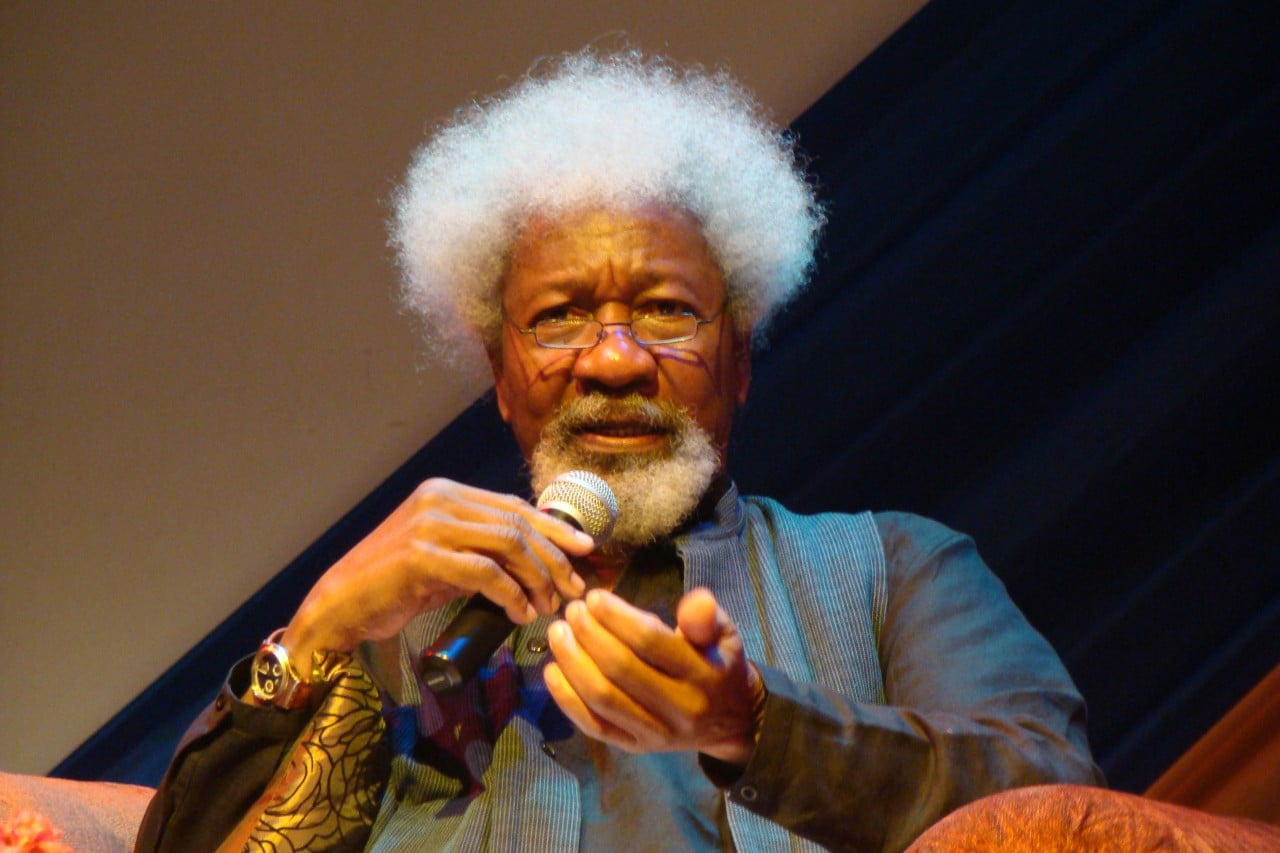
Professor Wole Soyinka
By Osa Mbonu-Amadi, Arts Editor
Yesterday, Nobel Laureate, Professor Wole Soyinka, clocked 90. Some events of his life that mostly engaged people’s interests outside his books and his 1986 Nobel Prize in Literature are (1) His founding of the Pyrates Confraternity, (2) His charge with armed robbery for breaking into the Nigerian Broadcasting Corporation studio in Ibadan in 1965 at gunpoint, asking the man in the studio to broadcast his own recording in which he asked the Premier to quit, and (3) His involvement in the Nigeria-Biafra Civil War for which he was sent to prison. This is a review of Soyinka’s responses to those events:
His founding of the Pyrates Confraternity
Soyinka was said to be a “Captain Blood in the Pyrates Confraternity” and founder of a ‘campus cult’. “The Pyrates Confraternity,” Soyinka says, “was never a cult. There is a difference between a cult and a fraternity.”
“There is absolutely no correlation between a cult – secret or not – and a college fraternity. The Pyrates Confraternity was a typical high-spirited college club with a self-deflating disposition allied to social commitment. Tafawa Balewa – if you go all the way back to pre-independence – the authorities invited the Pyrates Confraternity to help in welcoming him. With their colourful dress and theatrics, they were the main feature when the Prime Minister visited UI. That is what all university alumni of that period recall about the PC – or seadogs as they also address themselves. Fun driven, yet committed to social service, irreverent, an eccentric slice of the college creative spectrum.”
He also clarified his tag of ‘Captain Blood’ in the Pyrates Confraternity: “Now, in those early days, you might have encountered a slogan – “Blood for Blood”. What did it really mean? How did it arise? Let us delve into ancient history a little. A campaign in blood donation was introduced into this country late 1953. Blood banks were a rarity. As always, the Pyrates Confraternity undertook to be among the first donors, breaking a superstitious jinx for the uninformed. And the slogan was ‘Blood for Captain Blood … let’s go and donate blood’. The Pyrates led the way. And that sense of public service has endured till today. I shall not bother to enumerate. One of the pyratical codes is – ‘Just act. Don’t advertise’.”
Because the Pyrates Confraternity loved to hold their activities in the forests, people tended to see them as a cult group. But why should nature settings like forests be associated with evil? Soyinka says people should stop being frightened about nature environments:
“Now again, the tendency of seadogs to gather, party and ‘inter-talk’ all night long in bush clearings – many people then contort this into satanism in forest shrines. People get scared so easily of anything to do with nature. I live in the bush; my house is built inside the bush. I personally have a deep affinity to nature. When Boy Scouts march into the forest to camp as part of their personality build-up, nobody says Boy Scouting is a cult. I think we should stop being frightened about nature environments. One favorite space in the University of Ibadan – where the PC was born – was the bush across the road from the university gates. If you were walking past, you would see dancing – or ‘sallying’. There are traditionalist religionists who similarly prefer to worship right in the heart of nature, religions are not cults, but there are cults within religions. Yes, these cults are all over the place, they are there and they will claim that they derive their inspiration from the Bible or the Koran…. You can always extract what you want from religious scriptures; you manipulate, extrapolate, distort and pervert extracts, then make your reading the rigid principle of righteousness. You claim authority over the originating source. This is a problem of humanity in general, not just of Nigeria. Education is vital.”
His being charged with armed robbery for breaking into the Nigerian Broadcasting Corporation studio in Ibadan in 1965
“I thought the charge sheet was very unkind. It was no robbery.” Asked whether he removed the tape, Soyinka answered: “Look, the person you are talking about substituted his own tape. He said, ‘Take this one instead; there is also material in it, play it so there is no gap in transmission.’ Tell me, how does that amount to armed robbery? The man came, exchanged his tape, is that something for which to charge someone for armed robbery? I think that was most inconsiderate. Didn’t those prosecutors belong to this country where we say ‘exchange is no robbery?’”
Asked how he got into the studio, he replied: “Look, I was acquitted and you are talking as if I was the culprit. I was acquitted. I stood trial and I was acquitted. Why do you keep saying ‘you, you, you!’ What’s your problem?”
His involvement in the Nigeria-Biafra Civil War
Wole Soyinka’s involvement in the Nigeria-Biafra Civil War for which he was sent to prison is even a bigger event in his life without which his life history will be incomplete. His words:
“We were more or less a family of artistes at Independence. There was a creative family and that family was being scattered. I was in Stockholm in 1967 for the Scandinavian-African Writers Conference. And one of the saddest moments for me was that so many faces were missing from Nigeria – expected but not there: Christopher Okigbo, Chinua Achebe, Gabriel Okara – the Biafrans were missing even in safe Stockholm. The drums of war were no longer muted. It was the last chance for us to meet and talk about what was now inevitable but could still, just maybe, be averted at the last moment. I returned to Nigeria very sad and I was feeling as if I lost a limb – several limbs in fact. It was like – was this going to be it? We would become enemies confronting each other across the line of fire? There were people who were ready to take up arms – like Christopher Okigbo. At the time I had already run into Christopher Okigbo – it took place in Brussels – I even recall the name of the hotel – Hotel Koenisburg – purely by accident, and I knew he had come to purchase arms for Biafra. I challenged him and he admitted it. All these fortuitous encounters impressed on me a sense of urgency. Later I had a meeting in London – I mention that in my IBADAN – where we talked about the possibility of going to Biafra on a last-minute mission of intervention.
Again, as I disclosed in my memoirs, Aminu Abdullahi who is now dead, actually volunteered to go – this was at the meeting in London. We hooked up around a place called the Transcription Centre. We didn’t even know which way some of us would go. Would JP consider himself an easterner or westerner? It was the breakup of a robust circle of creativity. We decided that Aminu should not go because he looked so clearly a northerner. We said, “Look, you won’t even get past the first road block.” Because at that time, there was such bitterness, murderous paranoia, and it was understandable… on account of the pogrom which had taken place earlier…. I went to the conference, my colleagues were not present and when I returned to Nigeria, the first skirmishes had taken place – on the northern border, and I realised that soon, it would be impossible to travel to Biafra. I was restless. I knew I couldn’t function until I had crossed the lines in search of them. I said, ‘When I get there, I will find Christopher (Okigbo) somewhere’ and then get to Ojukwu. That was the reason why I went, a chance at that last moment that something could be done. Some people continue to narrate that I went across to persuade Ojukwu to renounce the secession.
No, I didn’t go to persuade Ojukwu to renounce anything – it was far more complicated. Some of us still felt that it was still possible to avoid an all-out shooting war. Let me state this clearly that I totally disagree with the philosophy of unity at any cost, a simplistic rendition of that pietistic mantra: ‘United we stand, divided we fall’. What infantile nonsense! It has no basis in logic or rationality whatever. Sometimes, not only is it that “small is beautiful” but also “small is perfectible”. People have the right anytime to say, “We want to leave this union, whatever it is”, any kind of union, politically or whatever type of union. Peoples have the right at any time to say, “Let’s have a referendum in this area.”. That is, for me, part and parcel of democracy.
Look at what’s happening in even England today – Scotland wants independence. Long, long ago, Cameroon and Nigeria, the people detached themselves from Nigeria here and went to Cameroon. Ethiopia-Eritrea remains instructive, so does the even more recent example of the Sudan. Whenever things get to a certain unmanageable stage, people look at separationist options. There is nothing – I want to stress this – absolutely nothing morally wrong or pernicious in a people saying – we want our own autonomous unit.
It’s a childish notion, something which has been implanted in our brain, to chant or be conditioned by the gospel of: ‘What white man has put together, let no black man put asunder’. What kind of nonsense is that? True, I do prefer that we stay together, if only because I don’t like to keep spending time obtaining visas when I want to go see a former next-door neighbour and collaborators. Also, I am partial to existence within a plurality of cultures. It offers a richness of resources, a dynamic of infinite sensibilities. But to say that you must go to war over ‘unity?’ No! Go the civilised way – plebiscite. Instead, we wasted an estimated two million lives through bullets, sickness and starvation – to preserve a European myth? It’s a lack of maturity”.
Disclaimer
Comments expressed here do not reflect the opinions of Vanguard newspapers or any employee thereof.