By Chukwvuma Ajakah
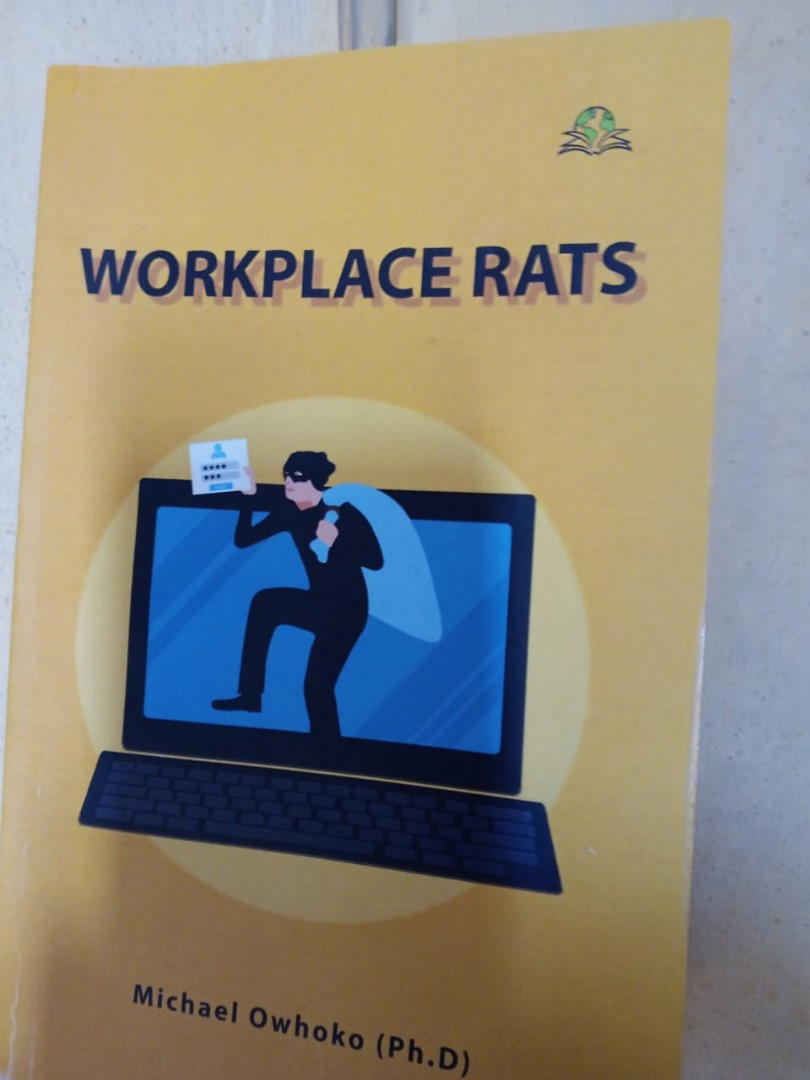
Prolific author and public relations practitioner, Dr. Michael Owhoko explores the central theme of financial corruption in this new book, “Workplace Rats”.
Published by Exceller Books, India (2022), Workplace Rats is a metaphor of fraudsters whose nefarious activities are inimical to the survival of the entities they serve in.
The author beams his searchlight on all cadres of workers, exposing their antics at the workplace. “There is hardly any company all over the world where cases of fraud have not occurred,” he writes, adding that “Man is absolutely the cause of such frauds as computers and other electronic devices, on their own, cannot swindle unless they are programmed by man to do exactly that.”
Revealing his motivation for the new work, Owhoko remarks that the book is an attempt to bring to the fore the activities of the workplace rats who have done much havoc at the workplace, leading to system collapse, bankruptcy, or insolvency.
The author exposes the devious methods of operation, strategic processes, and inherent dangers in the malpractices.
Right from the preface, the author pinpoints some atrocious character traits of potential fraudsters, linking the cause to a psychological detachment from the ownership structure of the organization. He argues that most junior staff do not see themselves as part owners of the business, but believe that they can be fired anytime at the discretion of the owner.
Ironically however, even business owners and high-profile executives engage in graft due to their insatiable appetite for wealth acquisition. The author reasons that the inexplicable lust for lmaterialism, to a large extent, accounts for the sudden collapse of healthylooking conglomerates and government parastatals.
The proclivity for fraud as revealed in the book extends to entrepreneurs who steal from their own company. “This practice is most common with companies quoted on the stock exchange,” the author observes, pointing out that “After growing businesses to a particular level, some owners get enlisted at the stock exchange and launch an initial public offer to shore up the company’s capital base.”
Having the firm listed is a clever way of fleecing it and the public as the influence of the owners on strategic management positions paves the way for unethical manipulations that might eventually ruin the organization,” he writes, decrying the unfortunate realities in the society. Noting that “Workplace rats involved in corporate irregularities, do not see anything wrong with their actions,” the author opines that their sharp practices contribute adversely to the value system of families and ethical standards at the workplace as children eventually get to know of their parents’ false lifestyles which they unwittingly emulate to the detriment of the larger society.
“The children become vulnerable to the carryover influence of corruption-induced values they have imbibed from their parents,” the author states that “Parents use their unearned income to finance the home, including payment of school fees, but most of the children grow up to know that unmerited incomes are products of graft at the workplace.”
Workplace Rats is presented in seven crisp chapters with subtitles such as: Workplace Rats-Who are They and Where are They Found? The conversation encapsulates the game plans-motives, schemes, network of conspiracies-Intrigues, payoffs and gains, cover up- and falsified audited financial reports.
Besides, the author uncovers the roles corporate organizations play in either mitigating or fueling crime under topics like Institutional Involvement-Security and Exchange Commission, No Winners, All Losers-the Burst and the Harms. He also proffers possible solution to the menace of workplace rats, in the last chapter subtitled “Solution”, which features topics such as “Moral Suasion and Fraud-Proof Mechanism.”
Justifying the choice of words for the book title, Owhoko writes: “Workplace rats as used in this book, is an allegory for people who steal and indulge in unethical practices at the workplace for selfish interest without being mindful of the consequences.”
While elaborating on the allegory of rodents, exemplifying dubious persons in homes, offices and even relationships, Owhoko avers that “Since the actions of workplace rats have the capacity to lead to loss, insolvency, bankruptcy, and eventual collapse of an organization, such persons are tantamount to rats whose actions are capable of transmitting viruses, sicknesses, and diseases that eventually lead to organizational distress.”
The second chapter, “Game Plans”, focuses on the motives and schemes that fraudulent workers deploy to realize their inordinate ambitions.
The narrative features case studies and real-life experiences, which the author employs to illustrate the negative impact of fraudulent activities on taxpayers, investors, and the society. Exposing the strategies the fraudsters apply to realize their hideous intentions, Owhoko stresses that
“Workplace rats are intelligently smart people who make planning a critical component of their game…Like a typical thief, they do not want to be caught, so they carry out proper planning before execution… Prior to the execution of plans, workplace rats deploy intelligence as part of the strategy to study the system, including the work process and key officials of the organization.”
One of the revelations the reader might find startling is embedded in the following excerpt: “During my working years in one of the local banks in Nigeria, perhaps, an insider, working in collaboration with external forces, forged a letter with the client’s letterhead, requesting for the transfer of a specific amount in US dollars from their account to a foreign account. The letter was the usual company’s standard with the same logo, font, and signature…I verified the signature against the mandated format and found it to be correct since it was a true resemblance to the one in the mandate card. I authorized the amount to be transferred. About three weeks after this transaction, the client called and confronted the bank that there was an unauthorized debit in their account, insisting that they never authorized such a transaction.”
The book reveals that frauds in banks are rampant in the area of credit loans which fraudsters, in league with their collaborators, secure with the intent of defaulting. Owhoko decries the ineptitude of professional bodies and regulatory authorities towards checkmating the criminals: “Painfully, various professional accounting bodies have not been able to put in place mechanisms that can prevent or minimize the abuse of positions by members,” he observes, noting that “Accountants and auditors are members of these accounting bodies empowered by law to regulate the conduct of members.
Accountants have also failed to ensure companies fully comply with legal and regulatory requirements, particularly firms listed on the Stock Exchange.” He points out that in attempts to cover up fraud, some companies deliberately flout the rules by failing to submit audited reports as required by law.”
Owhoko admits that “Workplace rats exist in all other professions, including medicine, engineering, law, and the military.”
Moreover, the book reveals that institutional involvement in curtailing fraudulent activities is hampered by a network of internal and external forces that frustrate regulatory authorities.
Citing instances of quoted companies that fail to submit audited annual reports or hold AGM despite the presence of the Security and Exchange Commission, he quips: “To guide against malpractices in the capital market, SEC is empowered to carry out surveillance and oversight functions over the NSE and the capital market, to protect investors’ interests and the market from unethical and dubious practices by ensuring laid-down rules and procedures are strictly followed.
“However, some companies circumvent the law by delaying or failing to hold AGM as a strategy to carry out unethical practices. Having gone to the capital market to obtain cheap funds, they ought to know that they are under obligation to make their financial statements public as required by law. But, workplace rats take advantage of the absence of good corporate governance to manipulate the system.”
Repetition is a dominant narrative device in the book as the author repetitively deploys the imagery of rats at the workplace in virtually every page. Perhaps, this is a deliberate attempt to drive the message home.
The didactic piece also encapsulates warning on the likely consequences of dubious dealings: “Once employers observe that employees have dubious character, such employees risk being sacked because of their ways of life which could push them into cutting corners for monetary gains” (p. 70).
With a long list of once notable public figures whose status diminished after they were found culpable in shady financial dealings, Owhoko reiterates that “The day anyone’s atrocities are revealed, the respect they enjoy in society wanes.”
Workplace Rats is narrated from a third person point of view as a sad commentary on the atrocious acts of diverse categories of workers, including those that occupy top-notch positions in the government.
The author boldly makes some startling revelations about the ignominious roles such prominent individuals play in destroying organizations. The author posits that the involvement of dubious workers in governance infractions is motivated by their selfish desires to sustain ostentatious lifestyle without considering the consequences on shareholders’ and other stakeholders.
Extending the metaphor to the judiciary, the author depicts unscrupulous legal practitioners as workplace rats in the system, revealing that they connive with officials of fraudulent firms to subvert justice. The book mirrors some of the corrupt tactics that thrive despite the legal system as intentional. For instance, Owhoko pinpoints in Chapter 5 that “Some of the companies listed on the stock exchange in Nigeria, subvert the regulatory process with impunity by deliberately refusing to hold AGM, while others fail to produce annual financial statements as required by law.
“In some cases, lawyers to defaulting companies approach the courts to seek adjournment under flimsy excuses. Some companies accused by SEC have escaped justice and punishment through resort to perpetual injunctions. Reliance on these obnoxious legal tactics has helped in no small measure in encouraging corruption in these public quoted companies.”
The language of the narrative is relatively simple and accessible to an average reader. For instance, the theme of financial corruption is portrayed through unambiguous declarative sentences such as:
“Due to the uncontrolled nature of corruption in Nigeria, no organization is spared of the menace of Workplace rats. There are workplace rats in all tiers of government, including the presidency, national assembly, judiciary, ministries, departments, and government agencies at federal and state levels.”
Also, Owhoko unpretentiously decries the aftermath of dubious dealings in organizations noting that “A singular action of workplace rats may not only have a devastating effect on the organizations but could endanger the future of stakeholders whose aspirations are tied to the prospects of such companies.’
In the last chapter of the book, captioned “Solution”, the author suggests ways of curbing the activities of fraudulent workers. Paramount among the tips is “Moral suasion” which underscores the deductive nature of the book. By “moral suasion”, the author implores administrators and business leaders to provide training on ethics and values that would appeal to the conscience of the workforce. He also canvassed for the establishment of independent auditing units, ideal compensation plan for honest workers, and strict adherence to accounting principles, among others as ways of reorienting workers.
In the concluding section, the author recommends that “Seasoned auditors with reportorial lines to the board of directors of the company should be employed to carry out regular audit of the company with oversight functions on the activities of both the internal auditors and employees of the accounts department.” Moreover, he submits that “Fraud and theft control measures must be put in place, otherwise, employers, shareholders’, and other investors will continue to lose their investments and suffer from the acts of a few dubious employees.”
Workplace Rats is written in a conversational language that readers will readily connect with. It is embedded with a lot of moral lessons that many will find useful in sanitizing the workplace for the good of all.
Disclaimer
Comments expressed here do not reflect the opinions of Vanguard newspapers or any employee thereof.