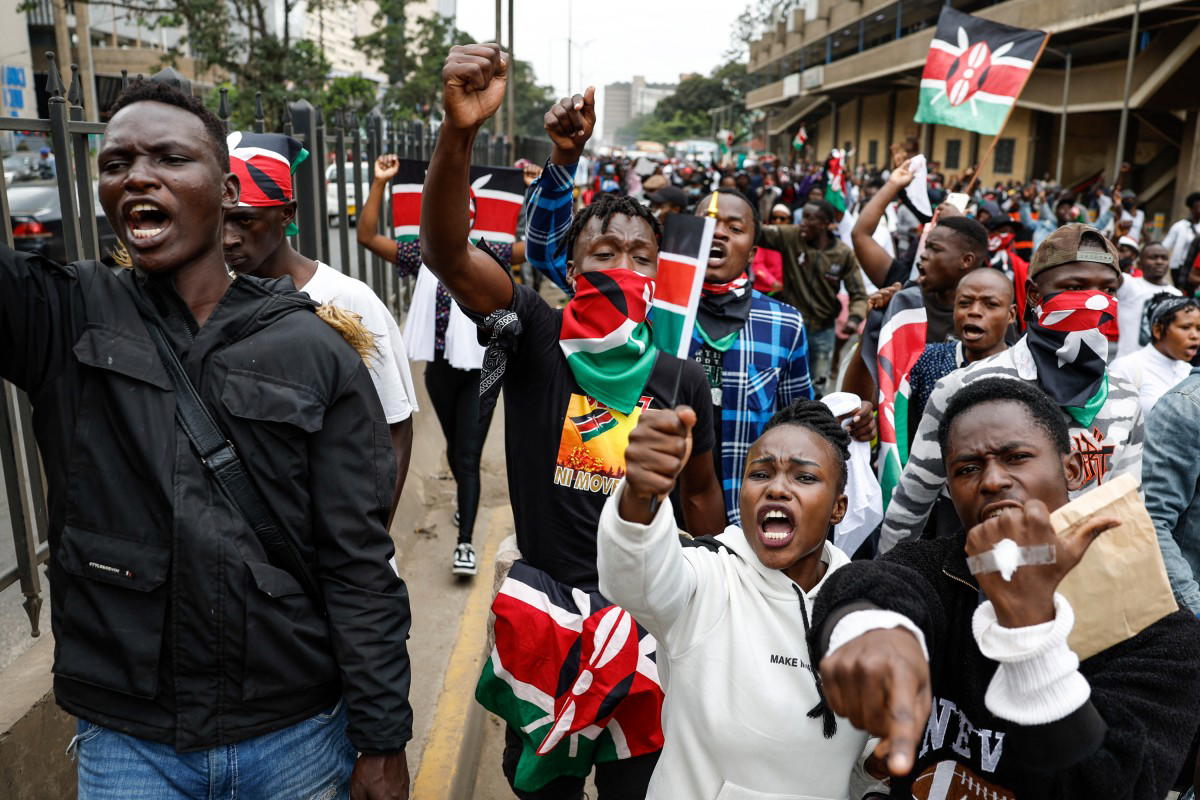
Kenyan youths chant as they carry flags during the candle light vigil in memory of protesters killed during the nationwide deadly protest against a controversial now-withdrawn tax bill that left over 20 dead and shocked the East African nation, in Nairobi on June 30, 2024. – A few hundred people marched peacefully on Sunday in the Kenyan capital Nairobi, in tribute to the victims of the deadly anti-government demonstrations of June 25, during which several dozen people were killed according to NGOs (Photo by SIMON MAINA / AFP)
Kenya is not Nigeria. This is perhaps the best way to summarise the victorious mass actions of the Kenyan people which forced the government of President William Ruto to back off from the tax-laden finance bill already passaged in the parliament.
Like Nigeria’s, the Kenyan economy is in distress. The international lending organisations, such as the International Monetary Fund, IMF, and World Bank, WB, are typically demanding sweeping tax reforms as their preconditions to lend to Kenya. The finance bill was seen as the shifting of the burden to the people instead of the government cutting down on its own governance costs and getting more creative in revenue generation.
Exactly the same scenario has been playing out in Nigeria. But the Nigerian people have been unable to demonstrate the capacity to prevent their government from overburdening them. Amidst extreme hunger, insecurity and unprecedented inflationary trends, Nigerians are crying and bearing the burden, while its ruling elite continues to live large.
Unlike the Kenyans who came out en masse, confronting the parliament amidst fierce water cannons by the police and losing 20 lives within a week of protests, Nigerians are sitting on their haunches and waiting for Organised Labour to fight for them. This same Organised Labour that is still wrestling with government over minimum wage.
Quite obviously, the Nigerian people have lost their power to bring their rulers to account. They have lost their power to choose their leaders through transparent and credible elections or obtain justice in their courts. The reasons for these are not far-fetched.
Unlike in other African countries such as Ghana, Senegal, Algeria and others, the peoples of Nigeria allowed their political elite to use their ethnic, regional, religious and cultural differences to divide and weaken them. Our differences, which should be our strength, have been weaponised against us. At every juncture, while the people are fighting one another, the elite goes behind, closes ranks and continues to gorge on our collective resources.
In 2020, the EndSARS protests presented a perfect opportunity to retire the old ruling class and change the political paradigm at all levels. Suddenly, narrative of a ploy to overthrow Muhammadu Buhari was used to dissuade Northern youths from the movement. It not only fizzled out, the ruling class also reorganised. Capitalising on ethnic profiling, they took control of state power and strengthened their grip on power.
Also, efforts to stage the “hunger protests” have failed because youths from a part of the country have vowed, based on ethnic sentiments, not to participate.
When the people forfeit their power to bring their elected governments to account, they must endure the quality of governance they get.
Disclaimer
Comments expressed here do not reflect the opinions of Vanguard newspapers or any employee thereof.