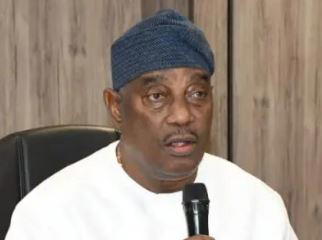
Arase
… As police officers lament loss of reforms
By Evelyn Usman
News of the removal of Dr. Solomon Arase as Chairman of the Police Service Commission (PSC) by President Bola Tinubu ,on Monday, June 10, 2024, with Deputy Inspector-General of Police Hashimu Argungu (rtd) as replacement, has begun to spark widespread speculation and concern.
The surprise element in Arase’s removal also raised questions about the circumstances surrounding his departure and the future of the PSC.
With many calling for transparency and clarity on the reasons behind this action, others are speculating about the implications for the PSC, as Arase had spent only 17 months out of the statutory five-year tenure as stipulated by the provision of the constitution that outlines the tenure and removal process for the PSC Chairman members.
Specifically, Section 157, subsection 1, of the 1999 Constitution (as amended) states that “The Chairman and members of the Police Service Commission shall hold office for a period of five years from the date of their appointment, and shall be eligible for reappointment for a further term of five years, subject to the confirmation of the Senate.” Also, subsection 2 of the same section provides that “the Chairman and members of the Police Service Commission may be removed from office by the President, acting on the recommendation of the Senate, for inability to discharge the functions of their office (whether arising from infirmity of mind or body or any other cause) or for misconduct.”
The statement issued by Special Adviser to the President on Media and Publicity, Chief Ajuri Ngelale, did not state whether due process as stated in the constitution was taken before the change of baton. It only said the change was with immediate effect and that “the President expects absolute demonstration of integrity, diligence, and patriotic zeal in the discharge of these important functions for the overall wellbeing of the Nigeria Police and the nation.”
Arase’s last assignment
The surprise element was that, at the time news of the end of Arase’s tenure as Chairman of the Police Service Commission (PSC) was announced, he was in a meeting with past Inspectors General of Police in Ibadan, Oyo State capital. This unprecedented gathering, which marked the first in the annals of the Nigeria Police Force, started last year.
It showcased Arase’s innovative approach to leadership and his commitment to harnessing the collective wisdom of the institution’s past leaders and provided a platform for the former IGPs to share their insights and perspectives on the current state of the police force and the security challenges facing the country. The meeting’s timing, just before Arase’s removal as PSC Chairman, adds to its significance, as many participants said it suggested that Arase was actively seeking guidance and support until the very end of his tenure, underscoring his dedication to the role of the PSC and the Police Force.
Reactions
Twenty-nine Civil Society Organizations in Nigeria that reacted to the removal called for transparency and clarity on the reasons behind the action, as they described it as a violation of the established legal procedure for removing the PSC chairman.
The CSOs’ statement read, “We note that the State House press release dated June 10, 2024, which announced the removal of the PSC Chairman, Dr. Solomon Arase, did not disclose any reason for the removal. We are concerned that this removal appears to have violated the established legal procedure for removing the PSC Chairman.”
It cited Section 5, Subsection 1 of the PSC Act, which states that “the Chairman and any other member may be removed from office by the President, acting on an address supported by a two-thirds majority of the Senate praying that he be removed for inability to discharge the functions of the Office.” But they expressed worry that the decision “undermines independence, effectiveness, and confidence of the Commission to discharge its mandate without undue interference,” noting that “the controversy surrounding the removal does not serve the interest of the Nigeria Police Force or the country.” They therefore called on the President to reverse the removal and fully constitute the Board of the Commission.
Mixed feelings
The announcement was also greeted with mixed feelings, as some policemen described his exit as an end to a significant reduction in extortion for promotion. Others, who said his tenure was marked by significant reforms and transformations in the Nigeria Police Force, described his removal as an end to significant reforms and improvements in the police force. This is because they said he introduced measures to improve the welfare of police officers, enhanced the promotion process, and ensured that recruitment was based on merit. His leadership was hailed by many as a breath of fresh air in the police force.
Uncompromising stance
Many policemen, especially those who benefitted from categories of promotions, having stagnated in their former ranks, hailed Arase for his uncompromising stance on promotion, described his short tenure as one devoid of discrimination in promotion.
A senior police officer who spoke on the condition of anonymity said, “Solomon Arase’s tenure as Chairman of the Police Service Commission was marked by a significant reduction in extortion for promotion. His zero-tolerance policy for corruption created a culture of meritocracy, where promotions were based on hard work, dedication, and merit, rather than bribes. He ensured that promotions were transparent, with clear guidelines and criteria, making it difficult for corrupt practices to thrive.”
In his stint as PSC Chairman, many officers who were reportedly denied promotion and left behind by their course mates benefited from the categories of promotions to the next ranks.
One of the beneficiaries, a Chief Superintendent of Police (CSP), said, “Under Arase’s leadership, the Police Service Commission implemented measures to increase transparency and accountability in the promotion process, which included the use of technology, such as digital platforms, to track and monitor promotions, making it easier to identify and prevent corrupt practices.”
Another officer, a Superintendent of Police, said, “I was among the 1,607 Deputy Superintendents of Police that were promoted to SP in March 2024. Some of my colleagues are CSPs; they were given special promotions for doing their jobs, while we in the administration units were denied “.
Recruitment Racketeering
Also, for the first time since the recruitment of policemen, there was reportedly no room for racketeering. Sources said Arase kept tabs on the recruitment process, with a resolve to avoid selection of misfits into the police. Although there were reportedly pressures on members of the Commission by some prominent Nigerians to slot in names of their relatives in the list of qualified Nigerians, Arase’s stance on merit drastically reduced such instances, according to sources.
To ensure that recruitment was based on merit, with candidates selected solely on their qualifications, performance, and physical fitness, Arase, reportedly introduced a rigorous screening process to ensure that only qualified and suitable candidates were recruited.
Some PSC members, who spoke on the condition of anonymity, said during his short stay in office, he introduced significant reforms in police by transforming the recruitment process from manual to digital, making it more efficient, transparent, and reducing the risk of fraud.
Moreover, Arase reportedly made the recruitment process more transparent, with regular updates and information provided to candidates and the public. His reforms significantly reduced corruption and extortion in the recruitment process and also ensured that more female candidates were recruited, promoting gender diversity in the police force.
Contrary view
But a statement by the Nigeria Police Force, five days after Arase’s removal, opined otherwise, stating rather, that the released list of successful candidates for the 2022/23 Police Constables recruitment under Arase’s watch was marred by irregularities and alleged corruption.
The Police High Command also alleged that there were allegations of financial dealings and corrupt practices, leading to an outcome where unqualified and untrainable individuals have been shortlisted.
But the Joint Union Congress of the Police Service Commission has described the allegations by the Nigeria Police Force as diversionary and in bad taste, accusing it of not allowing the Police Service Commission to perform its constitutional duties.
A member of staff of the Commission who spoke on the condition of anonymity, highlighted some of Arase’s transformations to include “the introduction of psychological evaluation as part of the recruitment process to ensure that candidates were mentally fit for police work. He ensured that recruits received modern and professional training to prepare them for effective policing. So, saying the recruitment was marred with irregularities is definitely not true.”
Disclaimer
Comments expressed here do not reflect the opinions of Vanguard newspapers or any employee thereof.