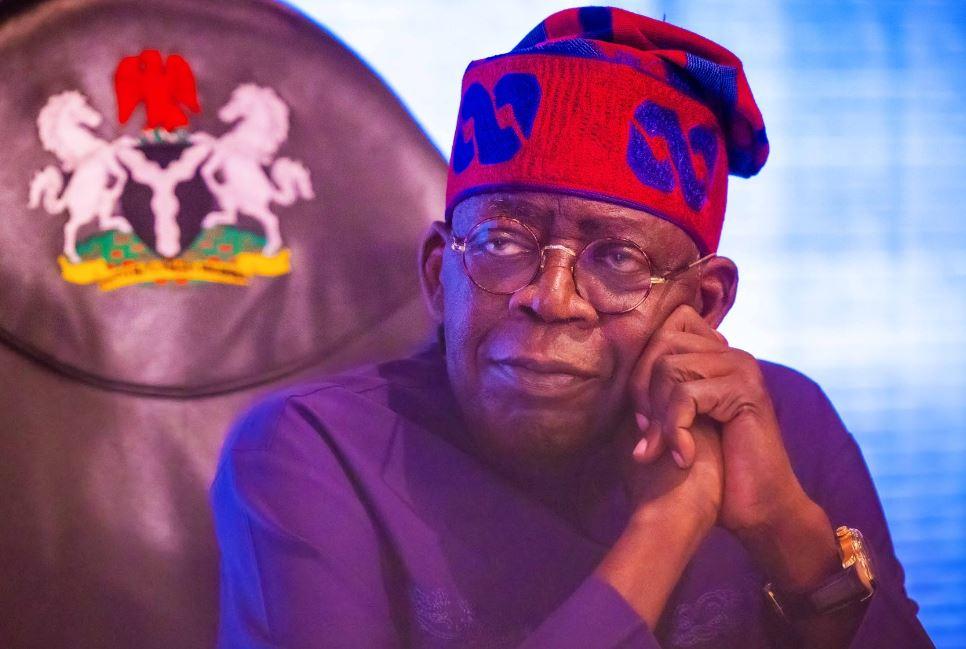
President Bola Tinubu
By Johnbosco Agbakwuru
President Bola Tinubu on May 29, 2023 took the oath of office as the sixteenth leader of Nigeria.
He took over from Muhammadu Buhari, who stayed eight years in the saddle. At his inauguration at the Eagle Square Abuja, Tinubu, was declared winner of the February 25, 2023 presidential election under the platform of the All Progressives Congress, APC. In his inaugural speech, he said: “Subsidy is gone.” He later floated naira to compete with the dollar as a means of stabilising the volatility in the forex market.
Although it was obvious that the administration removed the petrol subsidy through the Petroleum Industrial Act, it made provision for the product until the end of June 2023. It’s also an undisputable fact that Nigeria has, for a long time, depended on oil and gas to keep the government running. However, the abrupt removal of subsidy by the Tinubu administration has drastically affected the economy and standard of living. The level of hunger in the land has been unprecedented.
Few weeks after the President’s inauguration, prices of food items, transportation, and essential goods skyrocketed. Hunger, starvation and lamentation have become the order of the day. Despite the worsening state of electricity supply, tariffs have also been increased. The exchange rate has worsened, thereby making naira worthless. Getting medical attention in the hospitals or even buying medicines at patent medicine stores, has gone beyond the reach of the ordinary person as everything has become unaffordable to the poor. All these were as a result of the removal of subsidy on petrol and some other tough decisions taken by the administration.
In fact, some critics of this government have said the administration of former President Muhammadu Buhari, which some argued was a wasted eight years, started better than Tinubu’s.
Beyond the subsidy crisis, which even drew bad blood between the President and the organised labour movement, Tinubu administration, in the last one year, has been characterised by tax burden of all sorts. Only recently, the Central Bank of Nigeria, CBN, in a bid to bring deepend the country’s forex reserve introduced the Cybersecurity levy – a policy that generated outcry among the different strata of society. Meanwhile, when the wailings of citizens became unbearable for Tinubu, he had to wade in to suspend the policy.
With these teething problems, what has been the subject matter for many is whether the President has showed signs of excellent performance in line with his electoral promises or under-performed in his first 365 days.
Many pundits would argue that Tinubu is not to be blamed for all the economic and social woes being faced by the nation right now. In fact, some have said that before his emergence, the country was bleeding and was on life support, hence to get out of the woods, government has to take tough decisions, which might cause suffering.
Supporters of the Tinubu government have also contended that he inherited an already battered economy where corruption and insecurity nearly brought the country down to its kneels.
They also believe that with the policies he has put in place and the team of cabinet members he has, in no distant time, the people will begin to reap the dividends of the hard work currently being put in place.
Despite the present economic realities which has brought hardship and suffering, Tinubu, in his eight-point Renewed Hope Agenda, has assured Nigerians to be patient with him, assuring that in no distant time, things will change for better.
Like the saying that commitment is what transforms a promise into a reality… Commitment is the stuff character is made of; the power to change the face of things. It is the daily triumph of integrity over skepticism, and in the words of David McNally, commitment is the enemy of resistance, for it is the serious promise to press on, to get up, no matter how many times you are knocked down, the President has not overtly or covertly shown any sign of defeat in his efforts to salvage what appears to be a hopeless situation.
Being obvious of the daunting task before him, Tinubu acknowledged that the road in the last one year of his administration has been bumpy and rough. Speaking on Friday when he received a delegation of the Yoruba Leaders of Thought at the State House, he emphasised that governance must be transformative and must address the critical needs of citizens.
He said the past 12 months have been fulfilling for his administration despite the presence of some challenges that are being addressed frontally.
He said: “It has been challenging. It has been fulfilling as well. We took over, and we have stopped the bleeding. I can say categorically now that Nigeria is no longer bleeding. And it will not bleed to death, but rather will now move to prosperity. That is the promise that I made to you all, and it is also the charge that you gave to me.
“We are managing to swim through the pond. The current is not a good one. We will turn the tide. We are turning the bend. This I assure you. I am being very careful. The worst is over for Nigeria. We will prevail.
“I thank the team who have been working really hard. All I can promise is that we will do whatever it takes. We are determined, and we will work so that all Nigerians can feel the impact of good governance.”
The President assured Nigerians that his administration will ensure they get value for every kobo spent, and that his government will leave a lasting legacy of prosperity to future generations, while removing the yoke of poor governance and expanding access to qualitative public goods.
“We will get value for our money, and it is not for ourselves, but for our children. Our children will not inherit the burden of bad governance. Yet, they will enjoy the prosperity of Nigeria as a blessed nation from our very hands; from our sweat. We will bequeath to them a nation full of pride and prosperity,” President Tinubu said.
Tinubu also called for the deepening of governance and the reinforcement of leadership across all levels of government and institutions, adding that his administration is committed to encouraging fiscal federalism and strengthening the system to enhance inclusion and equity for all Nigerians.
“Healthcare upgradation is ongoing. Road rehabilitation and construction is ongoing. Education development is ongoing. I am charging you to look at what is going on in the states. Pay attention to your state governors. Tell them to take their responsibilities seriously and make the people the focus of their development plans. Once there is synergy, then I can assure you that Nigeria will be one of the best nations that you will see anywhere on earth.
“Local government administration is being suffocated. People are looking at the opportunity to ensure that they survive and become more purposeful through community development programmes. What I will not support is any effort to make the local government a unitary system by handing all core responsibilities to the federal government. That is criminal when there is a federal system.
“We have a federal system. There are state and federal administrations. We have two components. States must do whatever is in the best interest of their process of administration. There is no one-size-fits-all. That is what we should do by looking at the revenue formula, and we must be consistent with federalism; fiscal federalism. Those are the things you should expect from me, not the knee-jerk reactions ahead of elections.
“Our population is growing. It is getting larger. The geographical requirement is getting bigger, so we still want more space for housing. The population is growing. So that is the basis for flexibility at the local government level. We must grow and expand,” the President said.
Some experts in economy have argued that some of the President’s economic policies appear suffocating at the moment, with time, they will mature and make Nigeria the real pride of Africa and a beautiful bride for foreign investors.
Tinubu appears to be an advocate for hope for Nigerians. A term that has been reflected in most of his policy formulation, especially in his social and economic programmes as “Renewed Hope Agenda”.
For him, Nigerians must pay the supreme price of “sacrificing” for their country, even though the masses believe that the leaders have not shown enough sacrifices for them to reciprocate.
In the last one year, many would agree that one positive aspect of the Tinubu administration that portrays him as a leader is that he has the listening ears.
It’s an obvious fact that in the last one year, Nigerians hold divergent views regarding Tinubu’s performance in office. While those in government circle believe that he has surpassed his peers in performance going by decisive reforms he has initiated within a very short period, others would disagree with such propositions, especially when one considers the economic realities on ground.
However, when one looks at the pedigree and performances of some of the appointees of government in their various ministries, agencies and parastatals, it becomes an incontrovertible fact that there will be light at the end of the tunnel. Many of his appointees are round pegs in round holes and they are working round the clock to ensure that the President delivers on the campaign promises he made to Nigerians
The Minister of Information and National Orientation, Mohammed Idris for instance is a thorough professional and media guru, whose style is not to insult people of different views from the government or use propaganda to market the administration but with facts and figures.
For Idris, who has a stint in the media, Nigerians ought to come to terms with the fact that President Tinubu is focusing on attracting long-term local and foreign investments to the country, which he said should be viewed in positive light because at the long run, it will culminate in new jobs, increased productivity for local consumption and for export.
He believes that for the investments to come to fruition, the business environment must be conducive. Hence recent fiscal reforms by the Central Bank of Nigeria to clean up the system that was messed up.
He also believes that the Renewed Hope Infrastructure Development Fund (RHIDF), recently introduced by Tinubu which is mobilising billions of dollars for infrastructure projects will reshape the country’s landscape, particularly roads and highways, airports and seaports, power plants, and so on.
He said during Tinubu’s foreign engagements, particularly with local and foreign investors, the President plays the role of Chief Marketing Officer for the country with great energy and enthusiasm.
“In fact, in the last one year, we have seen investment commitments in excess of 30 billion USD, across various sectors, the chief spokesperson for the country reeled out,” he enthused.
The Information Minister also revealed that the President in the last one year has been focused on policies and programs that provide direct and targeted economic relief and benefits to the pockets and livelihoods of Nigerians, by way of grants, education loans, food and fertilizer distribution, cash transfers, health insurance, and consumer credit.
He revealed that disbursement has since commenced of the nano-grants of fifty thousand Naira each intended for one million Nigerians, which is part of a larger 200 billion Naira MSMEs credit program.
Besides, he said that the National Social Investment Programme (NSIP) is currently being repositioned to ensure that it delivers maximum value to the intended beneficiaries, without the distortion of middlemen, stressing that this vision of targeted economic relief has also led to the launch, in recent weeks, of the Nigerian Education Loan Fund (NELFUND) and the Nigerian Consumer Credit Corporation (CrediCorp), as well as the work going on to negotiate a new minimum wage that will touch the lives of millions of Nigerians.
“The Presidential Compressed Natural Gas (CNG) initiative also came to the fore as it would provide a cheaper alternative to petrol and diesel for transporters and commuters which is being finalized,” he added.
For Idris, Nigerians are largely not aware of the President’s dispositions to their genuine welfare needs and he understands that desirable developmental outcomes often require a temporary period of pain and adjustment, a situation that he seizes at every little opportunity to be seen and heard asking for the understanding of the Nigerian people.
He said Tinubu even took that a notch further while speaking recently at the World Economic Forum meeting in Riyadh, Saudi Arabia, where he said, “Concerning the question of subsidy removal, there is no doubt that it was a necessary action for my country not to go bankrupt and to reset the economy and the pathway to growth. It was going to be difficult, but the hallmark of leadership is making difficult decisions when they need to be made.
Commenting also on the foreign exchange regime reforms, he had stated, “The currency management was necessary, equally to remove the artificial element of value in our currency. Hence, our local currency finds its level and competes with the rest of the world’s currencies as we remove corrupt arbitrage and opaqueness.”
The Information Minister asserts that President Tinubu wants to build a Nigeria that is confident and competitive on the global stage. Hence the country and its contemporary leaders can no longer afford certain ways of doing things.
“We must push past the false comfort of certain ingrained habits and practices, and endure inevitable but temporary discomfort, because we are certain that ahead of us lies lasting reward,” he said.
On the human side, Idris thinks Nigerians don’t realize that they have a President who listens very actively to their opinions.
Tinubu, who he said he has worked closely with, does not allow ego to get in the way of doing what is best for the people and does not shy away from implementing adjustments in the policy-making process, where necessary.
He recounted that when the Students Loan Act required some more adjustment or review work, he wasted no time in getting it done. He sent the Act back to the National Assembly, where it was revised in record time, and returned for presidential assent.
He boasts that following that review there is a much-improved Act that will deliver even greater value to the young Nigerians for whom it is intended.
The Minister as the chief mouthpiece of the government sees his principal, the President as an adept communicator who leads by example, and wants Nigerians to always be in the know regarding the decisions being taken on their behalf.
Despite pointing out glowing features which somehow characterises the Tinubu administration, many Nigerians would agree that one year might be too short a time to really assess a government that has shown signs of birthing a new country.
Yet for others, it perhaps may not be out of place to give the new administration the benefit of doubt to double up efforts by rapping up economic policies, programmes and deliver the gains, because as it appears now, majority of Nigerians may not really be in a position to discern the positive intentions of the government when they are faced with excruciating challenges on account of their daily livelihoods.
Again, the Minister of Interior, Dr. Olubunmi Tunji-Ojo, is one of the most capable hand that is changing the image of the country and according to Femi Salako, media consultant to the Minister of Interior, Tunji-Ojo has emerged as a beacon of transformative leadership under President Tinubu’s administration.
He said, “Since assuming the role of Minister of Interior, Tunji-Ojo has orchestrated a symphony of unprecedented reforms, deftly steering various agencies under his purview towards a brighter horizon.
“An accomplished business magnate and consultant with a robust background in ICT, Tunji-Ojo’s multifaceted expertise has illuminated the corridors of the Ministry of Interior. His stewardship encapsulates a tapestry of achievements across various sectors, marked by a resolute commitment to enhancing efficiency, professionalism, and progressive change.
“One of his hallmark triumphs was the commendable feat at the Nigeria Immigration Service, where he orchestrated the clearance of an overwhelming backlog of 204,332 passports within a record-breaking three-week period, rescuing the nation from the grips of a dire national crisis.
“Beyond this, Tunji-Ojo’s visionary directives have heralded a new era of efficiency and service delivery. He pledged to revolutionise passport processing, promising a two-week timeline and the introduction of home and office delivery of passports, commencing in February 2024. His initiative to implement personal uploads of passport photographs further streamlines the application process, fostering convenience and accessibility.
“Tunji-Ojo’s proactive stance on international relations demonstrates his commitment to reciprocity in visa processes, challenging inequitable privileges granted to foreign nationals while championing the rights of Nigerian applicants. The minister’s Midas touch extends to the welfare of paramilitary officers. He advocates equitable compensation and initiated plans for a functional pension board, boosting morale and productivity within the ranks. His efforts signify a pivotal step towards aligning paramilitary salaries with those of the Nigeria Police Force, ensuring fairness and equity.
“Furthermore, Tunji-Ojo’s resolve to decongest correctional facilities through the clearance of fines and compensations worth N585m for 4,068 inmates showcases his compassionate approach to criminal justice reform. His dedication to transforming correctional homes into centres of rehabilitation signifies a paradigm shift from punitive measures to holistic rehabilitation, fostering hope and redemption. In recognition of his sterling performances, he was awarded the Public Service Person of The Year 2023 by The Leadership Newspaper.”
The Minister has been found worthy for finding his way into the hearts of millions of citizens for whom obtaining or renewing the Nigerian passport had become a nightmare; for his bold, extensive and exceptional reforms tackling the perennial passport booklet debacle at the Nigeria Immigration Service, in less than five weeks into his assumption of office, a stride which earned him the sobriquet, “Minister talk and do.
In tandem with these accomplishments, Tunji-Ojo’s engagement with agencies, stakeholders, and international partners underscores his commitment to tackling illegal migration and organised crime, ensuring a safe and secure nation. As the year draws to a close, Tunji-Ojo’s tenure as the Minister of Interior stands as a testament to his unwavering dedication and transformative leadership. His accomplishments in a relatively short span resonate as a prelude to greater strides in the coming year.
With his sterling performances thus far, Tunji-Ojo is poised to elevate the Ministry of Interior to greater heights, fortifying the nation’s security and amplifying its role in shaping a brighter future for Nigeria.
In the Federal Capital Territory, FCT, Abuja, where the former governor of Rivers State, Nyesom Wike, holds sway as the Minister, he has in less than ten months changed the landscape with quality road projects. He is one of the appointees of the Tinubu administration that have proven that his appointment is merited.
The Minister recently inspected the ongoing projects in the FEC, saying, “This is the final inspection as regards the preparedness for the inauguration of various projects.
“From what we have seen, we believe we are ready for the commissioning from 27th of May and will end June 6th. Is going to be a nine day long event.
“So, we are happy, and contractors are meeting up, and all the promises they made, they are have been fulfilled and we have also fulfilled our own part to make sure that we have cash backup. None of them is complaining in terms of cash” Wike said.
He hinted that the Abuja metro railway line will be flagged off for commercial operation on May 27.
“By the approval of Mr President, we believe that 27th of this month, we shall start the inauguration of various projects, particularly, on 27th of May, we believe the President will flag off the commercial operation of the metroline, “ he added.
Also the Minister of Works, Engr. David Umahi is another square peg in a square hole. The former governor of Ebonyi state, who transformed the state with quality road networks, bridges and other transformative projects, has started replicating the work at the federal level.
Since assumption of office, Senator Umahi has been insisting on concrete pavements and he has been visible at several road junctions across the country inspecting projects to his display of knowledge of the terrain especially his ability to persuasively quote huge figures.
In the words of a media guru, Tonnie Iredia, “Minister Umahi has been all over Nigeria inspecting road projects. The other day, he was in Ekiti State to, assess the level of work done on some ongoing road projects in the state particularly Ado, Ijan Road and Ado – Ikere – Akure road and to also assess the state of federal roads in the state.It is precisely what he is doing in virtually every other state, In Abia State, he has inspected the on-going Bende Ohafia Arochukwu road, just as he has done concerning the Lokoja–Okene road in Kogi State.As if to show that payment for the Abuja-Kaduna-Zaria-Kano Roadwas virtually guaranteed Minister Umahi went on inspection of the road with his counterpart – Olawale Edun Minister of finance and co-ordinating Minister of the Economy.
“In all of this, the innovation our new Works Minister is holding-on to is his preference for concrete pavement over asphalt because concrete according to Umahi is most suited for the terrain of Nigerian roads. He insists that”you cannot put asphalt in water but you can put concrete in water,” adding that the cost of materials for concrete pavement is significantly cheaper when compared to the cost of materials for asphalt pavement.
“Whereas his call for prudence and value for money, makes ample sense especially during this period of Nigeria’s vanishing economy, there is no proof that the money he needs to do all the works he is propagating will be available.”
Disclaimer
Comments expressed here do not reflect the opinions of Vanguard newspapers or any employee thereof.