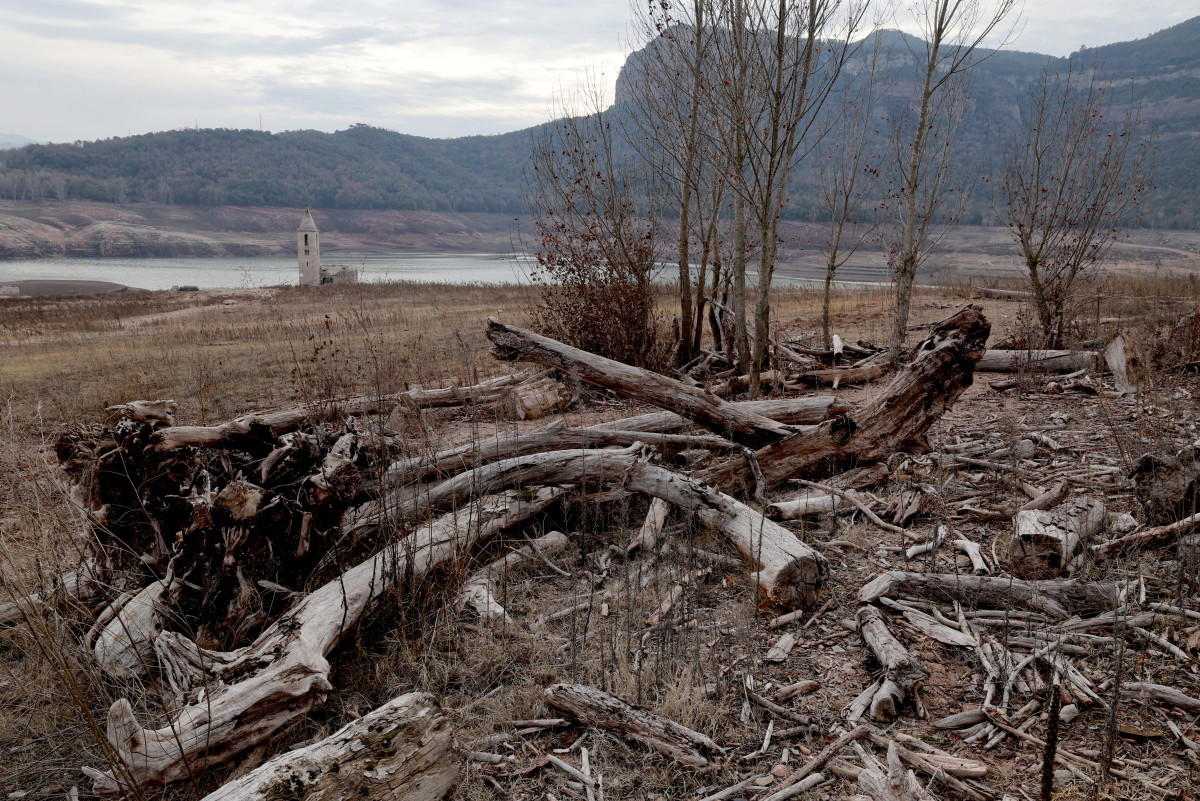
This photograph taken on January 15, 2024 shows the dry soil next to the low water-level reservoir of Sau with in background Sant Roma de Sau church, in the province of Girona in Catalonia. – Catalonia struggles with historic drought for three years, with some residents already experiencing water restrictions in their daily life. (Photo by LLUIS GENE / AFP)
Climate researchers from the University of Lagos (UNILAG,) Lead City University, Ibadan and The Nigerian Institute of Social and Economic Research (NISER) were in Ilorin, Kwara State to review climate extremes and its effects on Nigerians in rural and urban areas.
The experts who drew stakeholders to the state capital for participatory sessions with a view to co-designing and co-producing the study, engaged representatives from rural communities, Government MDAs, NGOs, Academia and the Private Sector to identify the effects of flood, droughts, and heat wave “on the marginalized rural and urban populations.”
Code named: A Pan-African and Transdisciplinary Lens on the Margins – Tackling the Risks of Extreme Events” (PALM TREES,) the researchers were facilitated by the Climate Adaptation and Resilience (CLARE) Programmer of the UK International Development and Canadian International Development Research Center (IDRC,) to find enduring solutions to the consequence effects of climate change on farmers in the grassroots and their livelihoods.
Prof. Mayowa Fasona of the University of Lagos said that the project was focused on live experiences with climate extreme events of those living on the margins, including women, people with disability, elderly and orphans among others and will help the participants to prepare, adjust, and cope. It will also sensitize the participants on impacts of climate extremes on their livelihoods and health with a view to designing and implementing transformational interventions to strengthen their resilience.
Prof. Andrew Onwuemele of NISER emphasized the strategic need for adoption and uptake of the expected research outputs by all concerned, “as it is the best channel that the research could aid sustainable development, particularly in strengthening the adaptation and resilience of the marginalized people and communities to climate change,”.
Prof Grace Oloukoi of Lead City University, Ibadan reckoned that the session was to gather inputs from relevant stakeholders with a view to identifying “how climate extremes had impacted their living and livelihoods in order to enrich the expected outputs of the research”.
The expected outputs, according to them, will among others, “reduce barriers to sustainable knowledge networks, more equitable relationships between communities, practitioners, researchers and policymakers.”
The University dons added that their study would also focus on “sustainable change and transferable methodology to understand and respond to multidimensional compound extremes”.
The team, during a focused group discussion with stakeholders, harvested the challenges confronting the stakeholders, with regards to certain extremes and how they affect their farming activities, health, lifestyles and existence
Disclaimer
Comments expressed here do not reflect the opinions of Vanguard newspapers or any employee thereof.